Languages
Sunday, November 8, 2026



News and Views from the Global South
Humanitarian Emergencies
Pakistani Deportees
In March 2016, the EU signed a far-reaching deal with Turkey to stem the flow of migrants into their union, which has spiked since September 2015. The hastily crafted deal, criticised by the UN for its disregard for human rights safeguards, requires Turkey to accept all migrants currently stranded in Greece, in return for visa-free travel for Turkish citizens to the EU, and a hefty sum of six billion euros.
Ecosystem Conservation Gives Hope to a Vulnerable Community
42 year-old Saraswati Subedi still remembers the night she almost died in a flash flood. “I heard the cries of my neighbours and ran out of the room with my two children. There was water all around and I thought we were going to die, so I started to pray,” says the mother of the three in Karki Tahara – a village by the river Harpan Khola in Nepal’s Kaski district.
Climate: Africa’s Human Existence Is at Severe Risk
“Africa’s human existence and development is under threat from the adverse impacts of climate change – its population, ecosystems and unique biodiversity will all be the major victims of global climate change.”
Climate Change and the Middle East (II)
No Water in the Kingdom of the Two Seas—Nor Elsewhere
There is an oil producing country situated in the Gulf region, made of a cluster of islands. It is small, surface and population wise. But it holds the dubious privilege of ranking top of the list out of the 33 countries most likely to be water-stressed in the year 2040.

Climate Change (I)
Will the Middle East Become ‘Uninhabitable’?
This is not about any alarming header—it is the dramatic conclusion of several scientific studies about the on-going climate change impact on the Middle East region, particularly in the Gulf area. The examples are stark.
The Unknown Fate of Thousands of Abducted Women and Girls in Nigeria
The plight of 219 Chibok schoolgirls abducted two years ago is all too common in Nigeria's conflict-affected north-eastern communities, and up to 7,000 women and girls might be living in abduction and sex slavery, senior United Nations officials on 14 April 2016 warned.
Can an Animal Heist Fable Help Solve the Middle East Crisis?
Make no mistake-the Middle East is the longest and perhaps the most complex crisis in recent History, this explaining the innumerable, successive –and frustrating- attempts to solve it.
OPINION: Wake Up! We Need Statesman and Values but We Get Selfish Politicians and Cynicism…
A total indifference has accompanied the number of refugees injured by Macedonian police in Idomeni, where more than 12 000 people, including 4 000 children have been trapped, since Austria asked Macedonia, Serbia, Croatia and Slovenia, to prevent the continuing passage of refugees. Austria has now informed the Italian government that it will send several hundred troops to its border with Italy.
Desert Locust Invading Yemen, More Arab States
Now that Yemenis begin to hope that their year-long armed conflict may come to an end as a result of the Gulf Cooperation Council and the United Nations sponsored round of talks between the parties in dispute, scheduled on 18 April in Kuwait, a new threat to their already desperate humanitarian crisis has just appeared in the form of a much feared massive desert locust invasion.Baby Steps on Long Road to Justice for Atrocities in Syria
The negotiations on April 11, 2016 in Geneva and the recent reduction of hostilities in Syria may represent important steps towards a peaceful solution to more than five years of turmoil. Few would not welcome the guns falling silent once and for all and for an end to the suffering of civilians.
Focusing on Future of Food: What’s Next for Global Agricultural Research?
Food security scientists from around the globe gathered in Johannesburg last week with one objective: to work towards the transformation of agriculture as engine for growth in developing regions of the world. The gathering was also an opportunity to examine what farmers need to prosper in the face of social and environmental challenges.
Turning to Agriculture
Facing an unprecedented economic crisis, South Sudan -- the newest nation of the world -- has urged its 12 million inhabitants to turn to agriculture instead of depending on declining oil revenues.War Zones Littered with More than Just Land Mines
Land mines are not the only type of explosive devices that families returning home after conflicts risk stumbling across, representatives from the UN’s Mine Action Service (UNMAS) told journalists here Monday.
Heavy Rains Once Again Scatter the Poor in Asunción
Néstor Colman, 69, remembers the river overflowing its banks nine times in Bañado Sur, the poor neighourhood in the Paraguayan capital where he was born and has lived all his life. “A record,” he jokes.
International Community Falls Short on Syrian Resettlement
“We cannot respond to refugee crises by closing doors and building fences,” said UN High Commissioner For Refugees (UNHCR) Filippo Grandi in his opening address to a high-level event in Geneva. By the end of the meeting, however, the international community remained reluctant to welcome refugees.HUMANISTANBUL: World Humanitarian Summit
Despite worldwide shock and indignation, it looks like little Aylan Kurdi's tragic death last summer changed little. This is a sad – but brutal – comment on our collective humanity, if such a thing still exists.
Challenges of Polio Vaccination
Pakistan and Afghanistan, the two remaining polio-endemic countries, have joined forces to eradicate poliomyelitis by vaccinating their children in synchronised campaigns.Yemen’s Health Crisis is “Critical,” Says WHO
The health situation in Yemen has severely deteriorated and is critical, the World Health Organisation (WHO) has reported.
Quake Fear Stalks Kathmandu
Early evening, there is a play of light and shadow over Kathmandu’s famous Durbar Square. The rising monuments, damaged by the April 2015 earthquake, appear as dark silhouettes while large flash lights streak through in between them.
Water Crisis in Zimbabwe
A narrow dirty trail snakes through what used to be a small dam in Mpudzi Resettlement Scheme south of the eastern border city of Mutare. And what remains of this once perennial dam is just a small puddle of mudded water; the dirty water is completely covered with thick green algae.Women`s Revolution
For as long as I can remember, people have been talking about the possibility of revolution in Pakistan. They were originally inspired, or perhaps frightened, by the Iranian Revolution in 1979, when ordinary Iranians rose up under the leadership of the clergy and overthrew Western-backed Reza Shah Pahlavi.« Previous Page — Next Page »





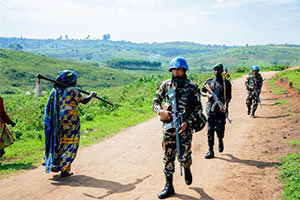 MONUSCO Peacekeepers and FARDC Soldiers Patrol Fataki Area. Credit: UN Photo/Jorkim Jotham Pituwa
Conflict, human rights violations, natural disasters, and famine have been at the forefront of concerns for humanitarian organizations. The escalation of humanitarian crises has led to over 239 million people in need of humanitarian assistance at the start of 2026, as estimated by OCHA’s Global Humanitarian Overview. The 2025 humanitarian appeal received only $12 billion, the lowest funding in over a decade, which has left 24 million fewer people reached in comparison to 2024. Conflict has remained the primary driver of crisis.
Humanitarian emergencies massively impact progress towards the Sustainable Development Goals (SDGs), adversely affecting economic development, inequality, education, planetary well-being, and poverty. Millions of people are faced with reduced access to essential services, including shelter, food, healthcare, and access to clean drinking water. UN Organizations such as UNHCR and the United Nations Children’s Fund (UNICEF) are committed to providing direct relief to affected communities when state governments cannot.
The United Nations 2024 Summit of the Future discussed measures that will be taken to reduce global inequality and promote peacekeeping efforts around the world. The recent UN Climate Change Conference (COP30) in Belém, Brazil, agreed to mobilize $1.3 trillion annually for climate action by 2035, operationalize the loss and damage fund, and triple adaptation finance. However, a fossil fuel transition commitment was not secured, despite climate change and the greenhouse effect being major contributors to humanitarian crises worldwide.
Countries across the world have also rallied to end humanitarian crises, as witnessed in conflicts such as Palestine and Ukraine. IPS is committed to providing relevant and in-depth reports of humanitarian emergencies around the world and their implications.

The Week with IPS

NEXT STOP - SDGs
Tracking global progress towards a sustainable world
Tracking global progress towards a sustainable world