Languages
Monday, November 9, 2026



News and Views from the Global South
Population
RIGHTS-EAST TIMOR: Women Learn the Political Ropes
Like many women in East Timor, 34-year-old Mariquita Soares joined the Revolutionary Front for an Independent East Timor (FRETILIN) party during the nation's 24-year resistance struggle against Indonesian occupation from 1975 to 1999.
COLOMBIA: Displaced People Evicted From Protest Camp
Thousands of displaced Colombians living in a protest camp in a park in central Bogotá are the target of an eviction plan by the local authorities, who admit they are overwhelmed by the influx of people fleeing violence in the countryside.SRI LANKA: Island Faces Key Test in Upcoming Elections
Elections in early August for local administrative bodies in Jaffna and Vavuniya, two Tamil-dominated northern towns, would be the first litmus test for the Sri Lankan government to restore normalcy in a region devastated by nearly three decades of war.MIGRATION: Tricky Gateway to a European Dream
Izmir has for years been luring migrants and refugees who dream of crossing into Europe.MIGRATION: U.S. to Admit Palestinian Refugees from Iraq
Approximately 1,350 Palestinian refugees from Iraq are being considered for resettlement in the U.S. after being referred to the U.S. Refugee Admissions Programme by the United Nations High Commissioner for Refugees (UNHCR).DEVELOPMENT: India, China Fight Poverty, Population Growth
The world's two most populous nations - India and China - are placing a high priority on reproductive health and poverty alleviation as part of their efforts to meet the U.N.'s much-touted Millennium Development Goals (MDGs) and its 2015 deadline.SAUDI ARABIA: New Bill Fails to Protect Domestic Workers, HRW Says
Despite a bill passed by Saudi Arabia's Shura Council on Wednesday, a prominent New York-based human rights group is asking for more protection for the estimated 1.5 million domestic workers in the country.
RIGHTS: No Safe Haven for Ugandan Girls
A year ago, a mother in Kashari County took the law into her own hands and castrated a man she caught raping her seven-year-old daughter.GUATEMALA: Population Growth Impacts Migration
Marco Tulio Guerra went to work as usual that morning at the meatpacking plant in Postville, Iowa. But his life was turned upside down when immigration agents swept into his workplace and arrested him along with another 388 foreign workers. Their crime: using false Social Security numbers.RIGHTS-AUSTRALIA: Uplifting Aboriginals, a Matter of “Urgent National Significance”
In this remote Aboriginal town, 420 km south-west of Darwin, Northern Territory’s capital, third world living conditions still prevail despite the Australian government’s efforts to improve life for its oldest inhabitants.
Q&A: Teens Wrongly Excluded From Family Planning
Nafissatou Diop has worked for decades on issues of reproductive health, HIV/AIDS and development in West Africa, including designing and implementing many studies and programmes.
PAKISTAN: Displacement Traumatic for Pregnant Women
Pregnant women uprooted by the violence in the Malakand region, northwest Pakistan, have suffered acutely in refugee camps for the internally displaced.
POPULATION: Poorest Countries to Bear Brunt of Growth
The world's population - already at least 6.7 billion people - will double in the next 40 years if current growth rates are left unchecked, warns the United Nations Population Fund (UNFPA).G8: Financial Crisis Or No, Rich Can Help Fight Hunger
The World Food Programme (WFP) is urging G8 leaders to turn words into action and meet urgent hunger needs in Africa and other developing nations as they gather in Italy for the 2009 G8 Summit.HEALTH: Private Sector Boosts Public Toilets in Poorer Nations
The United Nations is disappointed that most governments in the developing world have made relatively little progress in providing basic sanitation facilities to nearly 2.5 billion people who still have no access to toilets.HEALTH: Gender Finally Moving to Forefront of AIDS Fight
With women now comprising 61 percent of all people infected with HIV in Sub-Saharan Africa, international donors, governments and advocacy organisations are looking more closely at the connections between HIV/AIDS and gender inequality.RIGHTS: Muslims Under Scrutiny Despite Waning of ‘Terror War’
When the administration of President Barack Obama formally abandoned the longstanding U.S. "war on terror" - perceived by some as a codeword for "war against Islam" - there were hopes of a new relationship between the United States and the Muslim world after eight long years of political friction.CHINA: Chinese Question Government’s One-Child Policy
When China’s population control was imposed in 1980, it was meant to be a temporary measure which the government promised to phase out in three decades. It was intended to halt the baby boom of the 1950s and 1960s.PAKISTAN: Public Backs Army’s Push Against Taliban, Poll Finds
Pakistani public opinion remains supportive of the military’s fight against the Pakistani Taliban, said a new poll released Wednesday. However, Pakistanis roundly reject the U.S. military campaign in the region.PAKISTAN: U.S. Urged to Boost Emergency Aid to Displaced
Newly released research from experts and refugee advocates paints a clearer and perhaps surprising picture of the plight of Pakistan’s rapidly growing population of internally displaced persons (IDPs).MIDEAST: Elderly Receiving Better Care
In a region where indigenous human resources are scarce, the oil-rich Gulf countries are not only mindful of population growth, but are quickly learning to address the concerns of the elderly.« Previous Page — Next Page »





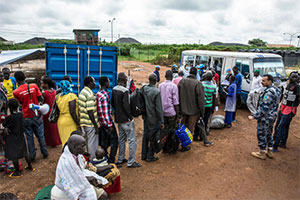 One Thousand Internally Displaced Persons (IDPs) Relocated from Tomping Camp in South Sudan. Credit: UN Photo/Isaac Billy
It took hundreds of thousands of years for the world’s human population to cross one billion in 1804. Approximately 200 years later, the population has multiplied sevenfold. In 2023, the global population crossed 8 billion, and is expected to reach 9 billion before 2050. With the planet more crowded than ever, it is essential to keep track of population trends, urbanization, migration, and reproduction across the world.
Life expectancy has seen significant strides in the past century, largely due to economic development and increased standards of living. On the contrary, trends in global fertility are shifting, with certain regions in Africa and Asia reporting higher rates, while parts of Europe and North America report stagnant or lower rates. This is in part due to differences in sexual and reproductive healthcare, as well as societal and economic conditions around the world. For example, child marriage is prevalent in certain societies, where childbearing is also considered a familial duty. Meanwhile, stagnating economies frequently experience lower marriage and childbearing rates.
The increase in migration and urban development around the world is also linked to global population trends. By 2050, it is expected that approximately 66 percent of all people will live in cities. Furthermore, global crises such as warfare and natural disasters also prompt transnational migration. Transnational migration is linked to a variety of socioeconomic issues in both host and receiving countries: migrants often leave developing countries with less access to educational and economic opportunities and arrive in developed countries where they are frequently the targets of ethnic, racial, and cultural discrimination, and economic exploitation. Recent crises in Europe and the United States demonstrate the importance of advocating for migrants worldwide. As migrants from the Global South are increasingly stripped of their legal and civic rights in unlawful deportations, or targeted in acts of identity-based violence, it is essential to keep track of population trends and protect the human rights of migrant populations. Climate-related disasters are now a major driver of displacement, with nearly half of all new internal displacements in 2025 being disaster-related.
IPS is devoted to covering issues surrounding population trends, migration, and reproduction through its compelling articles, which use both statistics and human stories to provide readers with robust and informative viewpoints.

The Week with IPS

NEXT STOP - SDGs
Tracking global progress towards a sustainable world
Tracking global progress towards a sustainable world
