Languages
Wednesday, November 11, 2026



News and Views from the Global South
Population
ARGENTINA: An (Air) Accident Waiting to Happen?
Although the Argentine government is adamant that air transport safety is guaranteed, for the past 80 days the main airports in the country have been facing an unprecedented crisis. Air traffic controllers are operating without radars, flights are delayed or cancelled, and the risks are mounting.LEBANON: Violence Highlights Regional Polarisation
The violence in Lebanon's Nahr al-Bader Palestinian refugee camp that has killed more than 55 people in the past two days is focusing attention on a relatively unknown and shadowy Islamist group, Fatah al-Islam.ARGENTINA: The Long (Children’s) March Against Hunger
"There are lots of hungry, barefoot children in Argentina, but they don't talk about that in school, so I learn a lot when I come on these marches," said Aluminé Giuliani, a teenager participating in a nationwide children's march, which arrived in the Argentine capital Friday.LATIN AMERICA: Second Chance for Indigenous People After ‘Lost Decade’
Tensions between indigenous people, governments and transnational corporations will grow in the second International Decade of the World's Indigenous People, which began in 2005, say experts.BOLIVIA: Faster Internet Connections – For the Few
A varied crowd of academics, civil servants, and university and high school students gathered in the hall of the vice-presidential building to celebrate Internet Day. The main event was the launching of Internet II, a project to incorporate Bolivia into the cutting-edge Latin American Cooperation of Advanced Networks (CLARA).PORTUGAL: Some Missing Children More Equal than Others
Never before has the Portuguese idiom "para o inglês ver" (literally: for the English to see), which means putting on a front to impress outsiders and ward off criticism, been so apt as today in Portugal, when the entire country has its attention riveted on the case of a four-year-old British girl who disappeared from a hotel two weeks ago.CHILE: Pressing Hard for Full Recognition of Indigenous Rights
In the next few days, President Michelle Bachelet will throw all her political weight behind the motion for Congress to finally ratify the ILO convention recognising the collective and individual rights of indigenous people.LATIN AMERICA: For a Day Against Homophobia
"We don't want more or less rights than anyone else; we want exactly the same rights," says Mexican transsexual Sofía Valero, one of millions of Latin Americans who suffer discrimination and are at risk of gay bashings and murder because of their sexual orientation.BRAZIL: Dorothy Stang Sentence – More Than Symbolic?
Forty percent of the 1,237 murders linked to land disputes in Brazil between 1985 and 2001 took place in the northern state of Pará. But things could begin to change there if the sentence handed down to the rancher who ordered the killing of U.S.-born nun Dorothy Stang does not end up as merely symbolic, said French priest Henri Burin des Roziers.ARGENTINA: Privatised Railways – a Timebomb
A riot by commuters enraged over delays, who destroyed part of the busiest train station in Buenos Aires, has drawn attention to the profound crisis afflicting Argentina's privatised railways, which have severe shortcomings despite the huge subsidies they receive from the state.VENEZUELA: Museums Throw Open Their Doors to the Disabled
"We drew a fat woman with little dots. I like learning to draw. Maybe I'll be an artist later on," Lisette, a 15-year-old mentally disabled girl who goes every Friday from her school in the south of the Venezuelan capital to the Alejandro Otero Museum, told IPS.MIGRATION-SPAIN: ‘What Is Worse, the Risk or a Life Similar to Death?’
A new wave of African immigrants has left a number of victims behind on the route to Spain's Canary Islands, where 1,300 undocumented immigrants have arrived in the last five days.POLITICS-US: Military Panel Calls Warming a Major Threat
Senior retired military officers in the United States are urging immediate action on climate change to avoid a massive upsurge in regional and global instability that could threaten their country's security.RELIGION-BRAZIL: A New Saint to Help Stem the Loss of Adherents
"We have to say no to the media that ridicule the sanctity of marriage and virginity before marriage," Pope Benedict XVI said Friday as he canonised Friar Antonio de Sant'Anna Galvão, Brazil's first native-born saint, at an open-air mass attended by a huge crowd in this southern Brazilian city.HEALTH: HIV-Positive Women Activists in Latin America Stand Tall
Patricia Pérez, an activist from Argentina who was diagnosed HIV-positive in 1986, has been nominated for the 2007 Nobel Peace Prize for her activism on behalf of women living with the AIDS virus. But her case is an exception to the rule.LABOUR-SRI LANKA: Better Deal for Female Migrant Workers
Besieged by protests from local and international rights groups, the Sri Lankan government is reconsidering a ban on young mothers seeking employment abroad.
EDUCATION-BOLIVIA: Literacy Drive on Full Steam
Coipasa is ahead, with Chipaya on its heels. Right behind them are Urubichá and Guarayos. The competitors are not race horses but rural villages and towns in Bolivia racing to declare themselves free of illiteracy.CUBA: Children Use Art to Learn About Hunger
A Cuban child is drawing a train, heavily loaded with emergency food supplies that are about to be airlifted and dropped into areas where hunger is just a normal part of life. The drawing will be entered in an annual international competition called "WFP in Action," organised by the World Food Programme.RELIGION-BRAZIL: Not Much of a Stir over Pope’s Visit
Pope Benedict XVI's five-day visit to Brazil, which begins Wednesday, has not raised much of a stir, except for among the devout faithful and those who are closely involved with the Catholic Church.POPULATION-CHINA: Paying Up for Extra ‘Little Emperors’
The grey walls of Chinese houses in even the tiniest villages in this billion-plus country invariably display slogans extolling the wisdom of "fewer births, better quality of the nation". But a new counter-wisdom is on the rise in urban China, challenging the government's decades-old efforts to control the country's population growth.CHILE: Fine Tuning the Fight Against Domestic Violence
The trial of Alfredo Cabrera, a Chilean man accused of murdering his six-year-old daughter by throwing her from the window of their seventh floor apartment after trying to kill his partner, will open Wednesday, amidst a clamour for him to be handed the maximum sentence.« Previous Page — Next Page »





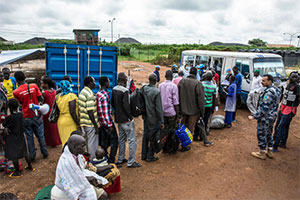 One Thousand Internally Displaced Persons (IDPs) Relocated from Tomping Camp in South Sudan. Credit: UN Photo/Isaac Billy
It took hundreds of thousands of years for the world’s human population to cross one billion in 1804. Approximately 200 years later, the population has multiplied sevenfold. In 2023, the global population crossed 8 billion, and is expected to reach 9 billion before 2050. With the planet more crowded than ever, it is essential to keep track of population trends, urbanization, migration, and reproduction across the world.
Life expectancy has seen significant strides in the past century, largely due to economic development and increased standards of living. On the contrary, trends in global fertility are shifting, with certain regions in Africa and Asia reporting higher rates, while parts of Europe and North America report stagnant or lower rates. This is in part due to differences in sexual and reproductive healthcare, as well as societal and economic conditions around the world. For example, child marriage is prevalent in certain societies, where childbearing is also considered a familial duty. Meanwhile, stagnating economies frequently experience lower marriage and childbearing rates.
The increase in migration and urban development around the world is also linked to global population trends. By 2050, it is expected that approximately 66 percent of all people will live in cities. Furthermore, global crises such as warfare and natural disasters also prompt transnational migration. Transnational migration is linked to a variety of socioeconomic issues in both host and receiving countries: migrants often leave developing countries with less access to educational and economic opportunities and arrive in developed countries where they are frequently the targets of ethnic, racial, and cultural discrimination, and economic exploitation. Recent crises in Europe and the United States demonstrate the importance of advocating for migrants worldwide. As migrants from the Global South are increasingly stripped of their legal and civic rights in unlawful deportations, or targeted in acts of identity-based violence, it is essential to keep track of population trends and protect the human rights of migrant populations. Climate-related disasters are now a major driver of displacement, with nearly half of all new internal displacements in 2025 being disaster-related.
IPS is devoted to covering issues surrounding population trends, migration, and reproduction through its compelling articles, which use both statistics and human stories to provide readers with robust and informative viewpoints.

The Week with IPS

NEXT STOP - SDGs
Tracking global progress towards a sustainable world
Tracking global progress towards a sustainable world
