Languages
Friday, November 27, 2026



News and Views from the Global South
Poverty & SDGs
UGANDA: Uneven Progress on Gender Equality
Uganda has been widely praised for having a constitution that reflects gender concerns. The 10-year-old document commits the country to affirmative action in the workplace, freedom from sexual discrimination and economic rights for women.DEVELOPMENT: Women’s Rights Crucial for UN Summit Agend(er)
Three international rights organisations have joined forces to ensure that women’s voices will be heard at the United Nations 2005 World Summit, scheduled to take place later this month (Sep. 14 to 16).RIGHTS-KENYA: Ensuring that “X” Marks the Gender-Friendly Spot
On the face of it, women in Kenya have a powerful tool at their disposal for dealing with politicians who fumble over the Millennium Development Goals (MDGs), an international set of objectives that tackle gender inequality, amongst other issues.POLITICS: Anger at Washington Simmers on Eve of UN Meet
A bid by the George W. Bush administration to introduce massive changes in the draft document to be signed by world leaders at a major United Nations summit this month is causing a deep sense of anger and frustration among many who hoped the event would solidify international efforts for peace and development.RIGHTS: Will World Leaders Face the “Pink Collar” Underclass?
Even as the global marketplace has brought new opportunities and jobs for some, much of the world's working poor remains ensnared in an informal economy where low-paying and unreliable jobs perpetuate poverty.DEVELOPMENT: Now an Africa Concert Speaks Out
An all-Africa concert on making poverty history will seek to speak - or sing - the language of aid concerts, but with an African voice.DEVELOPMENT: Millennium Goals Should Reflect Racial Disparities, Say Experts
The Millennium Development Goals (MDGs) should be modified to reflect racial and ethnic inequalities, instead of just social and economic disparities, said Brazilian expert Edna María Santos Roland.POLITICS: Who Deserves a Seat on New Human Rights Council?
When the United States, one of the self-declared champions of human rights, ran for a seat in the 53-member U.N. Human Rights Commission back in May 2001, it suffered a humiliating defeat and was ousted from the panel for the first time since its creation in 1947.DEVELOPMENT: Connecting Nature, Power and Poverty
In a significant challenge to neo-liberal orthodoxy, a major Washington-based think tank is calling for greater local and democratic control over environmental resources as the most effective means to lift some two billion people out of rural poverty.SOUTHERN AFRICA: Aid to a Region Plagued by Hunger
Aid agencies have welcomed an announcement by the European Commission (EC) that it will donate an additional 5.4 million dollars to help meet food requirements in Zimbabwe, Lesotho and Swaziland.DEVELOPMENT: Jobless Growth Continues to Plague Asia
Continued underemployment and unemployment in Asia have conspired to expose a glaring flaw in the pretty picture that is often painted of this region, as an economic success story with impressive growth figures.MEXICO: Activists Sceptical About New Anti-Poverty Programme
For Mexico's poorest 50 municipalities, which are overwhelmingly home to indigenous people, the battery of social programmes implemented in the past 30 years have meant little to nothing.DEVELOPMENT: Are Water Wars a Fantasy, or a Future Reality?
The Middle East, one of the world's perennial war zones, has traditionally been blessed with a surfeit of oil and cursed by a scarcity of water.BURMA: Junta Stymies Millennium Development Goals
Who says the Millennium Development Goals or MDGs can be boring? Not if a military regime comes in the way of one of the global targets prescribed by the United Nations-halting the spread of AIDS by 2015.DEVELOPMENT: Hopes ‘Fade’ for Millennium Meet
The United Nations summit next month on promoting the millennium development goals could end up delaying progress, a leading British charity says.LABOUR-NIGER: Gold Miners Exploit Children
Abdou Adamou spends his days in a pit 50 to 80 metres below ground at the Komabangou gold prospecting site. His job involves hacking up rocks and raising them to the surface with a bucket.DEVELOPMENT: Squatters Show the Way to Better Sanitation
-Mohammad Shamsuddin, still grimaces when he recalls the ''swarming flies and mosquitoes, over-flowing soak-pits, bucket latrines and the sludge and the sewage'' as also the quarrels in Orangi as to whose rubbish and waste was causing the foul smell.LATIN AMERICA: Untreated Wastewater Making the Seas Sick
Latin American and Caribbean nations seem hardly to worry about treating the massive discharge of garbage, fossil fuels and pesticides into their maritime waters. Millions of dollars are lost as a result, in the deterioration of ecosystems, reduction of fish populations and harm to human health.MILLENNIUM DEVELOPMENT GOALS: Glossing Over Womens’ Issues
As world leaders gear up to review contributions to the Millennium Development Goals (MDGs) at the United Nations general assembly in September, activists in this least developed country worry for core concerns of women everywhere.LATIN AMERICA: Campesinos Bear Brunt of Poverty
Without dynamic, sustained and inclusive economic growth, accompanied by strong social policies, the rural population in Latin America and the Caribbean is doomed to disappear, warns a new FAO regional office report.DEVELOPMENT: Heal the Planet, Heal Ourselves
Ten years ago, Costa Rica received a modest 25,000-dollar United Nations grant to expand the use of biomass technology, which transforms the energy from organic matter into fuel.« Previous Page — Next Page »


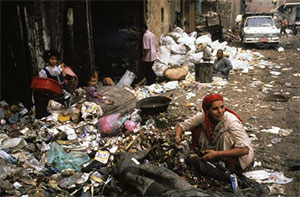 Romani people in Cairo, Egypt, forage through trash. Credit: UN Photo/Armineh Johannes
In 2015, the United Nations adopted the Sustainable Development Goals (SDGs) in an effort to promote “peace and prosperity for people and the planet.” To achieve that goal, it is essential to provide equal opportunities and access to basic services to all people. The 2025 UN SDG Report found that 35% of the 169 SDG targets are on track or making moderate progress, while 18% have reversed compared to the 2025 baseline. One in ten people still live in extreme poverty, one in eleven experience food insecurity, and over 1.1 billion people live in slums without access to clean water and sanitation. It is imperative to acknowledge the societal, technological, economic, and political issues that sustain poverty in countries around the world. Eradicating poverty will require significant frameworks in policy and governance on a national and international scale to ensure that all people will have equal access to basic services and economic opportunities by 2030. Furthermore, a dramatic reduction of United States foreign aid in 2025, including the termination of 83% of USAID programmes, threatens to erode years of fragile development gains.
Throughout the world, violent conflict and natural disasters also contribute to extreme poverty. The complete destruction of infrastructure and blockage of aid has significantly impoverished Palestine since October 7th. The destructive impact of Hurricane Maria in Puerto Rico left $91 billion in damage. An inadequate US government response also revealed significant and enduring questions within the issue of mitigating poverty: how do we rebuild infrastructure after its destruction? How do we restimulate economic development and bring in financial aid after disasters? Similar questions have been raised in the realm of regional cooperation, as devastating floods have wrecked hundreds of thousands of homes across multiple Southeast Asian nations in the past few years. Furthermore, the COVID-19 pandemic has greatly exacerbated the global poverty crisis, particularly in developing countries, setting back the United Nations goal of eradicating poverty by 2030.
IPS is committed to providing comprehensive features that focus on the persisting environmental, sociopolitical, and systemic issues that sustain poverty, and the steps taken worldwide towards poverty eradication.

The Week with IPS

NEXT STOP - SDGs
Tracking global progress towards a sustainable world

