Languages
Thursday, October 8, 2026



News and Views from the Global South
Financial Crisis

Helping Women, Period
The United Nations Headquarters and Brooklyn Bridge were lit up on Thursday night not to help tourists navigate the major landmarks but to bring attention to a key issue that many women and girls face today: period poverty.
Model Trade Deal Con
In early 2016, the Trans-Pacific Partnership (TPP) Agreement -- involving twelve countries on the Pacific Ocean rim, including the USA -- was signed in New Zealand. Right after his inauguration in January 2017, newly elected US President Donald Trump withdrew from the TPP, effectively killing the agreement as its terms require the participation of both the US and Japan.
Intellectual Property Regime Undermines Equity, Progress
Over the last few decades, people in the developing world have been rejecting the intellectual property (IP) regime as it has been increasingly imposed on them following the establishment of the World Trade Organization (WTO) including its trade-related intellectual property rights (TRIPs) regime. IP rights (IPRs) have been further enforced through ostensible free trade agreements (FTAs) and investment treaties among two (bilateral) or more (plurilateral) partners.
Stock Market Turmoil May Expose Flaws in Global Finance
Was last week’s global stock market sell-off only a “correction” or does it signify a new period of financial instability, caused by major flaws in the world financial system?
Tackling Inequality Talk Is Easy
At this year’s Davos World Economic Forum (WEF), Canada’s Prime Minister, Justin Trudeau warned the world’s business leaders and fellow politicians, “tackle inequality or risk failure”.
Tackling Inequality – The Myth that Davos Can Change the World
When the World Economic Forum (WEF) concluded in Davos, Switzerland last week, the outcome of the annual talk-fest was seemingly predictable—plenty of unrestrained platitudes but, surprisingly, less of the American populist, protectionist rhetoric.
Aid Group Shines Spotlight on the Neglected
Though 2017 was marked by stories of humanitarian disasters around the world, many crises remain under the radar with devastating consequences for those affected, a new report says.
Wealth Concentration Continues to Increase
As the ‘masters of the universe’ gather for their annual retreat at Davos, the World Economic Forum (WEF) has just published its Inclusive Development Index (IDI) for the second time.
Trade Multilateralism Set Back yet Again
As feared, the Eleventh Ministerial Conference (MC11) of the World Trade Organization (WTO) in Buenos Aires, Argentina, on 10-13 December 2017, ended in failure. It failed to even produce the customary ministerial declaration reiterating the centrality of the global trading system and the importance of trade as a driver of development.
Billionaires, Fiscal Paradise, the World’s Debt, and the Victims
Among Bloomberg's many profitable activities is a convenient Bloomberg Billionaires Index that has just published its findings for 2017. It covers only the 500 richest people, and it proudly announces that they have increased their wealth by 1 trillion dollars in just one year. Their fortunes went up by 23% to top comfortable 5 trillion dollars (to put this in perspective, the US budget is now at 3.7 trillion). That obviously means an equivalent reduction for the rest of the population, which lost those trillion dollars. What is not widely known is that the amount of the circulation of money stays the same; no new money is printed to accommodate the 500 richest billionaires!
The Political Responsibility in the Collapse of Our Planet
On 20 December, Europe’s 28 Ministers of Environment met in Brussels, to discuss the plan for reducing emissions prepared by the Commission, to comply with the Paris Agreement on climate change. Well, it is now clear that we have lost the battle in keeping the planet as we have known it. Now, of course, this can be considered a personal opinion of mine, devoid of objectivity.
Production Diversity, Diet Diversity and Nutrition in Sub -Saharan Africa
Lack of diet diversity is viewed as the major cause of micronutrient malnutrition in Sub-Saharan Africa. Imbalanced diets resulting from consumption of mainly high carbohydrate based-diets also contribute to productivity losses and reduced educational attainment and income. Consequently, micronutrient malnutrition is currently the most critical for food and nutritional security problem as most diets are often deficient in essential vitamins and minerals. In Tanzania, for example, most rural and urban households consume mainly staples as their main food, which are high in carbohydrates, but low in micronutrients and vitamins. Staple food items increase energy availability but do not improve nutritional outcomes if not consumed together with micro-nutrient rich foods.
Shedding Diplomacy, Roberto Savio Speaks about Fear as a Tool to Gain Power
At the outset my thanks to Dr Hanif Hassan Ali Al Kassim, and Ambassador Idriss Jazairy who lead the Centre for Human Rights Advancement and Global Dialogue for organizing this panel discussion at a critical moment in history. The Centre, is one of the few actors for peace and cooperation between the Arab world and Europe. As a representative of global civil society, I think it will be more meaningful if I speak without the constraints of diplomacy, and I make frank and unfettered reflections.
Are Value Chains a Pathway to Nutrition in Sub-Saharan Africa?
Although difficult to ascertain whether it is a trend reversal, two recent FAO reports (2017a, b) show a rise in hunger globally as well as in Africa. The number of undernourished (NoU) in the world suffering from chronic food deprivation began to rise in 2014 –from 775 million people to 777 million in 2015 – and is now estimated to have increased further, to 815 million in 2016. The stagnation of the global average of the proportion of undernourished (PoU) from 2013 to 2015 is the result of two offsetting changes at the regional level: in Sub-Saharan Africa, the share of undernourished people increased, while there was a continued decline in Asia in the same period. However, in 2016, the PoU increased in most regions except Northern Africa, Southern Asia, Eastern Asia, Central America and the Caribbean. The deterioration was most severe in Sub-Saharan Africa and South-Eastern Asia (FAO 2017a,b).
Strengthening Governments to Cope with PPPs
Public-private partnerships (PPPs) have emerged in recent years as the development ‘flavour of the decade’ in place of aspects of the old Washington Consensus. Instead of replacing the role of government or consigning it to the garbage bin of history, corporations are increasingly using governments to advance their own interests through PPPs.
Beware Public Private Partnerships
Public-private partnerships (PPPs) are essentially long-term contracts, underwritten by government guarantees, with which the private sector builds (and sometimes runs) major infrastructure projects or services traditionally provided by the state, such as hospitals, schools, roads, railways, water, sanitation and energy.
A Cop Out at COP23?
Despite a few victories, the UN’s annual climate change conference ended without achieving its goals or injecting a sense of much needed urgency.
Coping with Foreign Direct Investment
Foreign direct investment (FDI) is increasingly touted as the elixir for economic growth. While not against FDI, the mid-2015 Addis Ababa Action Agenda (AAAA) for financing development also cautioned that it “is concentrated in a few sectors in many developing countries and often bypasses countries most in need, and international capital flows are often short-term oriented”.
Beyond Piketty: on income inequality
Have demonetisation and the GST aggravated income inequality? With the Gujarat State elections barely a few weeks away, the debate on the Indian economy has become increasingly polarised. While the official view of demonetisation unleashed in November 2016 elevates it to a moral and ethical imperative, the chaos caused by the goods and services tax (GST) launched on July 1, 2017, is dismissed as a short-run transitional hiccup. Both policies, it is asserted, are guaranteed to yield long-term benefits, unmindful of large-scale hardships, loss of livelihoods, closure of small and medium enterprises and slowdown of agriculture. Critics of course reject these claims lock, stock and barrel. Lack of robust evidence is as much a problem for the official proponents of these policies as it is for the critics. Hence the debate continues unabated with frequent hostile overtones.
Finance Following Growth
Economists of all persuasions recognize the critical role of finance in economic growth. The financial sector’s stability and depth are widely considered important in this connection.
Emerging Markets at Risk Again
Emerging market governments often draw lessons from previous financial crises – or at least claim to do so – to prevent their recurrence. However, such preventive measures are typically designed to address the causes of the last crisis, not the next one. Hence, some measures adopted may inadvertently become new sources of instability and crisis.« Previous Page — Next Page »





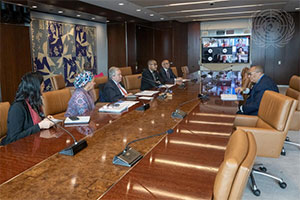 Secretary-General Meets with Members of Debt Expert Group. Credit: UN Photo/Eskinder Debeb
Financial crises are often defined by banking panics, recession, loss of market value, and deflation. Various financial crises at the turn of the 20th century, such as the Asian Crisis of 1997-1998 and the 2007-2008 Global Financial Crisis, have had immense impacts on the world economy. The COVID-19 pandemic also caused a financial crisis when mass lockdowns triggered staggering unemployment rates, a stagnation of economic growth, and led to the 2020 stock market crash. With the Russian invasion of Ukraine, the world has also witnessed a global energy crisis with shortages and increased prices in oil, gas, and electricity markets. According to UNCTAD’s World of Debt 2025, global public debt surpassed $100 trillion in 2024, with developing country debt growing twice as fast as developed economies since 2010. Burdens of debt servicing come with economic slowdowns and demands of austerity from lenders, with some economists arguing that this will lead to a new “lost decade” for the Global South. IPS brings you worldwide coverage of these financial developments and how we should manage these crises.

The Week with IPS

NEXT STOP - SDGs
Tracking global progress towards a sustainable world
Tracking global progress towards a sustainable world
