Languages
Saturday, October 31, 2026



News and Views from the Global South
Financial Crisis

ECONOMY: Nobel Honours Man Who Told Bush to "Please Go Away"
Paul Krugman, a professor at Princeton University who is best known for his New York Times columns - frequently involving scathing assaults on the policies of the George W. Bush administration - was awarded the 2008 Nobel Memorial Prize in Economic Sciences for his research on international trade and economic geography.ECONOMY: What Role Can the IMF Play Today?
Having failed, to date, to play an active role in the current global financial crisis, the International Monetary Fund (IMF) may become a symbol of the end of an era and the need for a different system, more suitable to today’s new world order.ECONOMY-SOUTH AMERICA: Day-to-Day Impact of Crisis Not Yet Felt
The financial crisis that originated in the United States demonstrates, more clearly than any previous such event, the distance between capital markets and ordinary citizens, especially in developing countries.ECONOMY-CHINA: Flirting With Land Tenure Reforms
Faced with a deepening global financial meltdown, the Chinese communist party is contemplating far-reaching internal reforms capable of insulating the country from the worst effects of the crisis such as by loosening its grip over land ownership.
Q&A: Central American "Exports, Production, Employment" Hit by Crisis
The financial crisis in the United States and Europe could cause a fall in Central American exports, tourism, property investments and remittances sent by migrant workers to their families, Costa Rican economist Eduardo Lizano says in this interview with IPS.ECONOMY: It’s a U.S. Mess for the World to Mop Up
As leaders of nations around the globe tried frantically to address their ailing economies, British Prime Minister Gordon Brown paused long enough to comment about how Britain may have gotten into this mess.
ECONOMY-US: Shelters and Soup Kitchens Hold Crisis Front Lines
Wall Street may be in the throes of agony, but business is booming at the Holy Apostles Soup Kitchen a bit farther north in the Manhattan neighbourhood of Chelsea.FINANCE-US: Helping People One Paycheque From Disaster
A decade ago, few could envision that making a charitable donation would be as simple as a mouse click.ECONOMY-CHINA: Opportunity in Wall Street Distress
The Wall Street fire-sale has prompted China economic pundits to call on Beijing to avail of the opportunity to acquire stakes in United States financial institutions and further its influence on global financial power.
Q&A: Money Crisis May Hit Development Assistance
The global financial crisis and rising food prices are certain to impact Latin America despite the growth in recent years, says Pamela Cox, the World Bank's vice-president for Latin America and the Caribbean.ECONOMY-US: This Sucker Could Go Down
Crises seem to awaken the inner poet of the commentariat, and the Crash of 2008 is no exception.
ECONOMY-US: Bailing Out a Boat Full of Holes
The U.S. Treasury's bonanza from Congress to hand out 700 billion dollars to Wall Street is not what the country needs to right its shaky economy, many independent experts say.ENVIRONMENT: Climate Action Could Escape Financial Crisis
Enter the global financial crisis - exit action on climate change? That lingering apprehension is not shared by Pamela Cox, the World Bank's vice-president for Latin America and the Caribbean.ENVIRONMENT: Twisted As Unnaturally as the Banks
The financial meltdown in most of the industrialised world presents an opportunity for a new economic model that would end short-sighted search for high returns, according to leading economists attending the IUCN World Conservation Congress here.TRADE-LATAM: Saved by Diversification
South America’s tendency towards trade diversification over the past few years may spare the region the worst repercussions from the U.S. financial crisis, unlike Mexico, which will definitely feel the effects, as its northern neighbour absorbs a majority of its exports, say experts.
OBAMA: "Subsidising Big Oil Makes No Sense"
Democratic presidential nominee Sen. Barack Obama sat down with IPS correspondent Bankole Thompson again on Thursday for a one-on-one interview in Grand Rapids, Michigan, where over 15,000 enthusiastic Obama supporters turned out to hear his message of change at downtown's Calder Plaza.CARIBBEAN: Bracing for U.S. Sneeze
While United States lawmakers debate the pros and cons of providing a 700-billion-dollar bailout for floundering financial firms, Caribbean countries are bracing for the cold that will follow the proverbial sneeze in Washington.ECONOMY-MEXICO: Analysts Warn of Knock-On Effects
Mexico's economy is wobbling because of the financial problems in its northern neighbour, with which it is closely interlinked. Unemployment is up, companies have put their plans on ice, the government has stopped putting out tenders, remittances from migrants are down, and exports have shrunk.ECONOMY-LATAM: Crisis Means Slower Growth Ahead
The financial crisis shaking the United States will have repercussions in the rest of the world, which means "tough times lie ahead for Latin America," the permanent secretary for the Latin American Economic System (SELA), José Rivera, told IPS.
U.S.: Obama Solidifies Lead Amid Turmoil in Washington
With just five weeks before the Nov. 4 presidential elections, Democratic candidate Sen. Barack Obama has built a strong lead that his rival, Republican Sen. John McCain, could find difficult to reverse.DEVELOPMENT: No "Bailout" for the World's Poorest
As a spreading financial crisis threatens to deepen the economic recession in the United States, the news of an unprecedented 700-billion-dollar bailout package reverberated through the corridors of the United Nations last week as over 100 world leaders gathered in New York for the annual talk-fest: the 63rd session of the General Assembly.« Previous Page — Next Page »





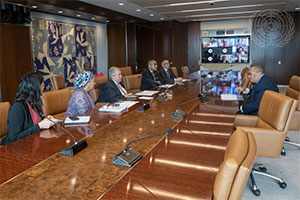 Secretary-General Meets with Members of Debt Expert Group. Credit: UN Photo/Eskinder Debeb
Financial crises are often defined by banking panics, recession, loss of market value, and deflation. Various financial crises at the turn of the 20th century, such as the Asian Crisis of 1997-1998 and the 2007-2008 Global Financial Crisis, have had immense impacts on the world economy. The COVID-19 pandemic also caused a financial crisis when mass lockdowns triggered staggering unemployment rates, a stagnation of economic growth, and led to the 2020 stock market crash. With the Russian invasion of Ukraine, the world has also witnessed a global energy crisis with shortages and increased prices in oil, gas, and electricity markets. According to UNCTAD’s World of Debt 2025, global public debt surpassed $100 trillion in 2024, with developing country debt growing twice as fast as developed economies since 2010. Burdens of debt servicing come with economic slowdowns and demands of austerity from lenders, with some economists arguing that this will lead to a new “lost decade” for the Global South. IPS brings you worldwide coverage of these financial developments and how we should manage these crises.

The Week with IPS

NEXT STOP - SDGs
Tracking global progress towards a sustainable world
Tracking global progress towards a sustainable world
