Languages
Friday, October 2, 2026



News and Views from the Global South
Labour

UN Food Systems Summit: Breakthrough or Missed Opportunity?
UNSG Antonio Guterres convened the first-ever UN Food Systems Summit which took place on 23-24 September. The Summit preparation had a well-designed structure with remarkable and appreciated leadership of Amina Mohammed, UN DSG. Due to the hard work of the UN Special Envoy, Agnes Kalibata, and her whole Team, the organisation and logistics of the Summit was excellent.
Inflation Bogey Blocking Recovery
The bogey of inflation has been revived. Dubious pre-pandemic economic progress, fiscal constraints and vaccine apartheid were bad enough. Now, ostensibly anti-inflationary measures also threaten recovery and sustainable development.
Inclusive Education to Break the Cycles of Poverty
In September 2021, children in the northern hemisphere returned to school after the summer break. For some, the end of the holidays signaled a return to normalcy and to the joys of learning after facing months of school closures due to the Covid-19 pandemic. For the majority of children in the Global South, however, the return to reality looked grimmer.
India: Gaps in the Government’s Plan to Help Unorganised Workers
The Government of India launched the e-Shram portal with the mandate of registering 380,000,000 unorganised workers in the country. The portal aims to bridge the gap in unorganised workers’ ability to access social welfare and employment benefits by issuing an e-Shram card (or Shramik card) upon registration.
China and the UN at 50- What We Can Achieve Together
China was one of the architects of the United Nations and was the first signatory of the UN Charter in San Francisco in 1945. But it was only in October 1971, with the Chinese delegation led by Mr. Qiao Guanhua, that China’s representation at the UN resumed. Since that time, the UN has had the great privilege of witnessing and supporting China in achieving one of the greatest periods of socio-economic progress in world history.
Afghan Women – The Emerging Narrative and Why it is Wrong
The USA and its allies have repeatedly stated that promoting women’s rights was one of the key reasons they were in Afghanistan. The US military top brass, in a letter to marines stated that they were in Afghanistan “for the liberty of young Afghan girls, women, boys, and men who want the same individual freedoms we enjoy as Americans”.
Ivorian Cocoa Farmers Are Beating a System To Reduce Child Labour: Here’s How
The evidence of child labour on cocoa farms in West Africa became public knowledge in the late 1990s. This followed press reports documenting the existence of hazardous child labour on cocoa farms. Pressure on the cocoa industry to end child labour has been growing ever since, particularly from civil society and more recently from both US and European regulators.
The Plight of Haiti
I assume channel surfing and internet browsing contribute to a decrease in people’s attention span. I am not familiar with any scientific proof, though while working as a teacher I found that some students may be exhausted when five minutes of a lesson has passed and begin fingering on their smartphones. They might also complain if a text is longer than half a page, while finding it almost impossible to read a book.
Delivering On the Promise of Health For All Must Include Gender Equality and SRHR
Gender-responsive universal health coverage (UHC) has the proven potential to transform the health and lives of billions of people, particularly girls and women, in all their intersecting identities. At tomorrow’s kick-off to the 2023 UN High-Level Meeting (HLM) on UHC, Member States and stakeholders will review progress made on the 2019 HLM’s commitments and set a roadmap to achieve UHC by 2030. We, as the co-convening organizations of the Alliance for Gender Equality and UHC, call on Member States to safeguard gender equality and sexual and reproductive health and rights (SRHR) as part of UHC implementation, especially in light of the gendered impacts of the COVID-19 pandemic.
Seizing the Post-Pandemic Opportunity to Transform Food Systems
The global food system needs a massive overhaul – this was clear before the Covid pandemic and it is even more true today. Feeding the world in a sustainable and healthy way is entirely possible but it is also inextricably linked to tackling the climate crisis by reaching net zero emissions, and to halting the dizzying decline in bio-diversity which is currently threatening the survival of one million plant and animal species.
On the Verge of Change
Current food systems are no longer fit for the 21st century. Inequitable distribution, poor nutritional habits, and climate change are three issues breaking down our global food systems today, forcing us to look for solutions to transform them. Food aid – very much part of our global food systems – needs to be responsive to the challenges that lie ahead.
The UN Food Systems Summit – Food Processing, Consumption, Supply Chain, Loss and Waste
Food processing extends shelf-life and can transforms raw food into attractive, marketable products. It can also prevent contamination. The transformation can involve numerous physical and chemical processes such as mincing, cooking, canning, liquefaction, pickling, macerating, emulsification, irradiation and lyophilization. Frozen processed and raw food changes transport and storage requirements radically; while the packaging of food, both raw and processed, is an industry unto itself.
The UN Food Systems Summit and Some Issues of Concern
Why is the UN holding a Food Systems Summit? Two issues that need discussion at the international leadership level are: Long before the Covid crisis was upon us, the number of hungry people in the world was increasing. Why ? What is the cause of this disturbing trend? And, can a country really claim to be food secure, unless it produces or can buy enough food to feed its population and its people can access sufficient quantities to keep themselves fit and healthy? Disquietening questions as extreme weather begins to show the destructive power that climate change will have on the planet and its people.
Integrating ITMDs into Healthcare Could offer a Solution for the Pandemic Crisis in Canada
Last year, as the world grappled to survive the Covid-19 Pandemic, Megan Fernandas an accountant living in Toronto, was trying to face her biggest fear, not the COVID-19 virus, but missing her doctor's appointment after surviving a rigorous fight against stage 2 breast cancer.
The Covid-19 Youth Employment Crisis in Asia & the Pacific
A pre-pandemic report published by the International Labor Organization, ILO, the Global Employment Trends for Youth 2020, offered a sober analysis on the job market prospects for youth.
Raise Retirement Ages
Raise retirement ages! That’s the simple, clear and unavoidable message that economics and demographics are sending to governments around the world.
A Tale of Two Internationally Trained Medical Doctors in Canada
Wagma Saad, is an Internationally Trained Medical Doctor (ITMD) from Kabul Medical University, Afghanistan, currently living in Canada with her family. Saad graduated in 2016, an education that didn’t come easily to her. With numerous restrictions, blocks and challenges placed at every step, fighting numerous social and political battles, she chased her passion for science and medicine, and after seven years at medical school, she finally got to call herself a doctor.
The Main Contradiction of the Modern Era
The main contradiction of the modern era, and indeed of all human history, is not between capitalism and socialism, and not even between authoritarianism and democracy, but between individualism and collectivism, between public and personal interests. Countries that are getting ahead in the economic race allow themselves the luxury of individualism, prioritizing human rights, which ultimately undermines their political and economic power and causes their decline and the rise of more collectivist civilizations. It is literally the story that is as old, as the world itself…
Is Canada Missing out on Leveraging ITMDs in Its Healthcare Plans?
With elections right round the corner in Canada, Prime Minister Justin Trudeau recently said that a re-elected Liberal government would spend billions in the coming years to hire family doctors. This report says, Justin Trudeau promised that the Liberals would spend $3 billion over four years starting in 2022 to hire 7500 family doctors and nurses as well as tax and student loan incentives for health professionals who set up shop in rural or remote communities and also pledges an extra $6 billion to wrestle with wait lists.
Why Do Organizations Fail to Keep Workplace Harassments in Check
“Sexual harassment is not about sexual attraction, it is about power. If an individual uses power plays to subjugate other people, when we have such dynamics going on in the workplace, what we need is a system that fights back against it, which unfortunately a lot of workplaces, they allow it to persist,”, says Adrienne Lawrence, anchor and legal analyst in an interview given to me here.
Olympian Turned Volunteer Keeps Traffic Running in Busy Lagos
Bassey Etim Ironbar is a rare example of an Olympian that transformed from an athlete to a volunteer who does menial jobs like sweeping the streets and clearing debris from open sewers.« Previous Page — Next Page »


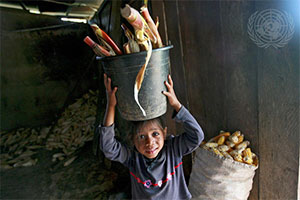 Timorese Girl with Fresh-Picked Corn. Credit: UN Photo/Martine Perret
A global common denominator is the need for a decent job. The economic realities of each country determine just how difficult it is to find one. Despite the labour movement's achievements, serious challenges persist: gender discrimination, child labour, worker migration, the digital divide and AI automation, evaporating pensions, unsafe workplaces, corporate pressure against union organising, negative impacts of trade agreements, and the precariousness of informal employment. The 2025 UN SDG Report identifies jobs and social protections as one of the six priority areas requiring urgent action, with progress either stalled or reversing in many developing nations.
In recent years, the fight to protect labour equality has taken on new dimensions with the rise of Environmental, Social and Governance standards. With the Social aspect aiming to promote equality and human rights, ESG principles have strengthened labour advocacy within corporate and governmental regulatory landscapes. In particular, ESG has become much more institutionalized in emerging economies such as Brazil and China. IPS follows the world’s workers as they confront these challenges - their setbacks and their successes.

The Week with IPS

NEXT STOP - SDGs
Tracking global progress towards a sustainable world
Tracking global progress towards a sustainable world
