Languages
Thursday, November 19, 2026



News and Views from the Global South
Labour
LABOUR-PHILIPPINES: Nurses’ Exodus Making Health System Ill
Philippine President Gloria Macapagal Arroyo brimmed with pride when the leaders of Singapore and China said at the recent SARS summit that Filipino nurses were performing admirably during the health crisis, but that praise also draws attention to one of the country's biggest illnesses - the exodus of its best nurses.THAILAND: Discrimination Makes Work Environment Hostile Terrain
For women and tribal communities, the work environment in Thailand continues to be hostile terrain due to overt and covert forms of discrimination, say experts.LABOUR-FRANCE: Workers March for a Welfare State
Unions took the French government head on Tuesday through scores of protests around the country to demand their dues in a welfare state.LABOUR: ILO Denounces Race, Gender, Age, HIV/AIDS Discrimination
Every minute, around the world, there are incidents of flagrant discrimination in the workplace against women, persons with HIV/AIDS, members of ethnic groups, the elderly and others, says the International Labour Organisation (ILO) in a new report.LABOUR-LATAM: Flexibility Makes it Tougher to ‘Earn Your Bread’
''You shall earn your bread by the sweat of your brow'' - even if you cannot find a stable, permanent job that pays a living wage.RIGHTS-BRAZIL: Half-Million Girls Work as Domestic ‘Slaves’
A campaign is underway in Brazil to quash the notion that hiring a girl to work in one's home is "normal". The estimated half-million female minors working as maids - often without pay - are the focus of a new effort by national and international institutions to stop child labour.BANGLADESH: Curbs on Women Migrants Eased, but Debate Unfinished
Bangladesh's decision to relax the latest restrictions on women seeking work abroad has rekindled a debate on the government's policies on women's rights, labour export, and its ability to protect its migrant workers./MAY DAY/RUSSIA: Red Fades to a Pale Shade of Pink
May Day celebrations in Russia became a picture of changed times since the Soviet days./MAY DAY/IRAN: Workers Protest Ban on Demonstrations
Workers around Teheran who had planned to demonstrate May Day against low minimum wages, now plan to protest because they were not allowed to demonstrate./MAY DAY/ BOLIVIA: Growing Discontent among Already Desperate Workers
Bolivian workers will celebrate International Labour Day Thursday but amidst uncertainties about the future of their jobs and deep frustration, which threatens this impoverished country's democratic stability./MAY DAY/ SPAIN: Women Bear Brunt of Growing Unemployment
Unemployment in Spain rose to 11.73 percent in the first quarter of this year - the highest rate among the 15 European Union (EU) countries. But women have been hit hardest, according to a new government survey./MAY DAY/ LABOUR-LATAM: Brazil an Exception to Trade Union Crisis
The hard times that have befallen Latin American trade unions, dating to the early 1990s, have been aggravated in recent years by political factors in the region, but Brazil has proved a notable exception./MAY DAY/FRANCE: The Spectre of 2020 Haunts Powerful Unions
The Labour Day comes two weeks too early for French unions. They are in the midst of rallying workers against a government plan to deprive them of their well-deserved comfort in old age. Opposition to the planned 'reform' will also be the central issue on May 1 - ahead of what is scheduled to be "a day of action, of protests, and of strikes, to force the government to modify its choices on the issue of pensions"./MAY DAY/GERMANY: Anger at ‘Agenda 2010’
Perhaps it is hardly surprising that a Pop Song making cruel fun of Chancellor Gerhard Schroeder should recently shoot straight to the top of the charts and become Germany's No.1 hit./MAY DAY/ CENTRAL AMERICA: More than 1.9 Million Child Workers
More than 1.9 million children in Central America face a serious threat to their chance of obtaining an education and pulling out of the vicious circle of poverty because they have to earn their daily bread./MAY DAY/US-CENTRAL AMERICA: Anxiety Plagues Immigrant Workers
The United States government has not yet announced whether or not it plans to grant a new extension of the Temporary Protected Status (TPS) enjoyed by 347,000 Central American immigrants, which expires in the next few months./MAY DAY/THAILAND: Gov’t Eyes Crackdown on Undocumented Workers
As the Thai government's harsh crackdown on the drug trade draws to an end, the country's law enforcement officials have named a new group to face the heat of a similar high profile 'war' - undocumented migrant workers./MAY DAY/LABOUR: A Drop in the Membership of South Africa’s Largest Federation
The Congress of South African Trade Unions (COSATU), the largest labour federation in the country, has been weakened by a financial crises and a drop in its membership ahead of a showdown with the government over the country's economic policy./MAY DAY/IRAN: Labour Week After a Year Without Pay
Karamat Aqaee was laid off work as an accountant from the Ahvaz Steel Company in Khozestan in the south of Iran eight years ago. His views were found to be incompatible with the ideology of the Islamic government./MAY DAY/RIGHTS-BRAZIL: Rural Slavery Tough to Root Out
An estimated 25,000 men, women and children continue to work today as slave labourers in rural Brazil, despite persistent complaints by human rights organisations and promises by the new government to eradicate the practice over the next four years.ARGENTINA: Eviction of Workers Creates Tension Ahead of Elections
Some 20 protesters remained under arrest Tuesday after police and demonstrators clashed outside a factory in the Argentine capital Monday, creating a tense climate ahead of next Sunday's presidential elections.« Previous Page — Next Page »


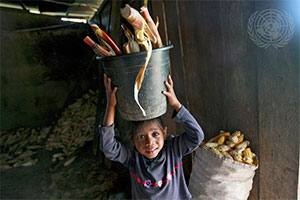 Timorese Girl with Fresh-Picked Corn. Credit: UN Photo/Martine Perret
A global common denominator is the need for a decent job. The economic realities of each country determine just how difficult it is to find one. Despite the labour movement's achievements, serious challenges persist: gender discrimination, child labour, worker migration, the digital divide and AI automation, evaporating pensions, unsafe workplaces, corporate pressure against union organising, negative impacts of trade agreements, and the precariousness of informal employment. The 2025 UN SDG Report identifies jobs and social protections as one of the six priority areas requiring urgent action, with progress either stalled or reversing in many developing nations.
In recent years, the fight to protect labour equality has taken on new dimensions with the rise of Environmental, Social and Governance standards. With the Social aspect aiming to promote equality and human rights, ESG principles have strengthened labour advocacy within corporate and governmental regulatory landscapes. In particular, ESG has become much more institutionalized in emerging economies such as Brazil and China. IPS follows the world’s workers as they confront these challenges - their setbacks and their successes.

The Week with IPS

NEXT STOP - SDGs
Tracking global progress towards a sustainable world
Tracking global progress towards a sustainable world
