Languages
Friday, November 20, 2026



News and Views from the Global South
Labour
LABOUR-BRAZIL: Truck Strike Continues Despite Gov’t Concessions
The Brazilian government made good on some of its promises to truckers, which should have put an end to their strike - now in its fourth day - but the concessions only seem to underscore the power of the truckers' movement, even when its leadership is divided.AGRICULTURE-COSTA RICA: Large Landholdings to Return, Warn Unions
Costa Rica, long famed for its social tranquillity, is on the verge of serious agrarian conflict as unions and peasants fight reform measures they say would return rural lands to the hands of the wealthy few.LABOUR-BRAZIL: Truckers and Landless Launch Protests
Activists from the Landless Movement (Movimento dos Sem Terra - MST) took over several government buildings Tuesday while truckers continued their strike, setting Brazil on edge just days after a relatively calm Labour Day.LABOUR-CUBA: A May 1st with Protests, Not Parades
This May first, International Labour Day, the Cuban government is organising popular demonstrations to demand that the United States return the shipwrecked boy Elián González and to protest the recent United Nations (UN) condemnation of the island's human rights situation.LABOUR-MEXICO: Independent Unions Gear Up for First of May
Demands that the freedom to organise be respected and for a living wage for the 42.5 of every 100 Mexicans who scrape by on less than two dollars a day will be the main focus of demonstrations by the members of Mexico's more than 200 independent trade unions on the First of May.LABOUR-CENTRAL AMERICA: More Bad News than Good
The behaviour of Central America's labour market in the 1990s left more challenges than improvements, warns an International Labour Organisation (ILO) economist, who added that the region not only needs a faster growth rate, but its labour policies also must have a clear direction.LABOUR-LATAM: Market Interests Thrash Workers’ Rights
The controversial approval of labour reforms in Argentina, just days before International Labour Day, has established Latin America's most recent milestone in the growing predominance of market interests over union rights.ARGENTINA: Reforms Legitimate De Facto Labour Setbacks
Government-sponsored labour reforms aimed at making hiring and firing easier in order to make conditions in Argentina more attractive to investors, basically legitimate an already precarious employment scene, say analysts.LABOUR-LATAM: Doctors Also Emigrate in Search of Work
The Chilean government recently made the contentio us decision to hire foreign doctors to work in its public health centres, a nd the results expose the new face of Latin American labour migrations, whi ch are no longer the exclusive domain of unskilled workers.DEVELOPMENT: Agriculture Workers Too Poor to Buy Food, Say Unions
A coalition of 40 trade union delegations, led by the 124-million strong International Confederation of Free Trade Unions (ICFTU), warns that much of the world's food is now produced under "unacceptable and unsustainable" conditions.LABOUR-CANADA: Harsh Working Conditions Suck the Glamour Out of Internet Jobs
Those dream jobs on the Internet may appear glamorous to those on the outside, but the long hours and low pay have many e-commerce workers wondering if things weren't better on the old factory floor.LABOUR-EUROPE: Unions Call for Equitable Distribution of Wealth
The European Trade Union Confederation (ETUC) is going before the European Union (EU) at its special summit, held Thursday and Friday in Lisbon, to demand the implementation of measures that ensure better distribution of the benefits arising from economic growth and greater respect for social and labour-related advances.LABOUR-US: Unionists from 20 Countries Ponder General Electric’s Globalisation
Union leaders from 20 countries are gathering here this week to co-ordinate efforts to deal with the aggressive globalisation strategy of the US-based multinational giant, General Electric Company (GE).LABOUR-PHILIPPINES: Less Work for Home-Based Workers
Just a decade ago, Sitio Angel Central in the Philippine province of Laguna was living up to its name, producing papier mache angels by the thousands per week.ECONOMY-MEXICO: Foreign Investors Pledge Billions
Foreign companies have promised to invest 12.38 billion dollars in Mexico this year, 24 percent more than in 1999, while the government reaffirms its commitment to economic liberalisation.LABOUR: Int’l Union Central to Denounce Violations before UN
The world's largest labour union will demand before the United Nations Commission on Human Rights that a social dimension be included in reconstruction programmes for war- torn countries such as Kosovo and East Timor.LABOUR: Immigrants Face Major Obstacles Finding Jobs, Says ILO
Foreign workers and their families face "significant and disturbing levels of discrimination in access to employment" in western Europe and other parts of the industrialised world, according to research by the International Labour Organisation (ILO).RIGHTS-SRI LANKA: Globalisation Erodes Power of Labour Courts
A run-down building in the Sri Lankan capital, infested with bats and littered with heaps of rubbish, houses six of the country's 24 labour tribunals.LABOUR-BRAZIL: Housing Stipend for Judges Highlights Wage Gap
A new housing allowance for judges, who had threatened to go on strike, accentuated the enormous income gap in Brazil and put the government in an even more difficult position regarding widespread demands for wage hikes.LABOUR-MEXICO: Exploitative Conditions Worsen in ‘Maquiladoras’
Labour conditions in "maquiladoras" or foreign assembly plants in Mexico became even more exploitative in 1999, and workers' complaints rose by 25 percent, according to an independent trade union.LABOUR: Information Society Transforms Media, Entertainment
The changes in the media and entertainment industries arising from today's new technologies are irreversible, and have had a major impact on jobs and working conditions, says a new study by the International Labour Organisation (ILO).« Previous Page — Next Page »


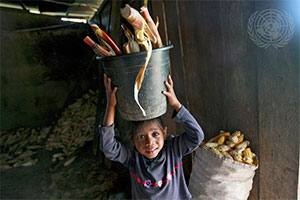 Timorese Girl with Fresh-Picked Corn. Credit: UN Photo/Martine Perret
A global common denominator is the need for a decent job. The economic realities of each country determine just how difficult it is to find one. Despite the labour movement's achievements, serious challenges persist: gender discrimination, child labour, worker migration, the digital divide and AI automation, evaporating pensions, unsafe workplaces, corporate pressure against union organising, negative impacts of trade agreements, and the precariousness of informal employment. The 2025 UN SDG Report identifies jobs and social protections as one of the six priority areas requiring urgent action, with progress either stalled or reversing in many developing nations.
In recent years, the fight to protect labour equality has taken on new dimensions with the rise of Environmental, Social and Governance standards. With the Social aspect aiming to promote equality and human rights, ESG principles have strengthened labour advocacy within corporate and governmental regulatory landscapes. In particular, ESG has become much more institutionalized in emerging economies such as Brazil and China. IPS follows the world’s workers as they confront these challenges - their setbacks and their successes.

The Week with IPS

NEXT STOP - SDGs
Tracking global progress towards a sustainable world
Tracking global progress towards a sustainable world
