Languages
Sunday, October 18, 2026



News and Views from the Global South
Trade & Investment

Free Speech and the Hong Kong Protests
Sometime in the summer of 1974, I was leaning against the gunwale of the ferry between Calais and Dover, watching the moonlight streaming dark waters. When I turned to the left I found that a Chinese lady also looked out over the calm sea. What she told me changed my world view.
Bretton Woods Institutions: From Solution to Problem
July 2019 saw the 75th anniversary of the historic conference of 44 countries held at the Bretton Woods (BW) resort in New Hampshire during July 1-22, 1944. Conference At BW, John Maynard Keynes, representing the UK, and Harry Dexter White, for the USA, both sought a new international monetary system following the Great Depression, which many attributed to the functioning of the gold standard before World War II.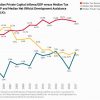
Foreign Private Investment in Low-Income Countries: More Important Than You Think
In a world of stagnating public aid, limited fiscal space, and rising public debt in low-income countries (LICs), can they realistically expect to rely more on private finance from foreigners? What does the evidence suggest?
Privatization Increases Corruption
International financial institutions (IFIs) have typically imposed wide-ranging policy reforms – called ‘conditionalities’ – in exchange for country governments to secure access to financial assistance. While IFIs may demand anti-corruption policies, other IFI policy conditionalities, such as the privatization of state-owned enterprises (SOEs), can create new rentier opportunities, undermining government will and capacity to curb corruption.
Facebook and Friends Threaten to Libralize the World
On 17 June, a Facebook white paper proposed a new global digital currency it plans to launch in the first half of 2020. The Libra will be managed by a ‘not for profit’ Swiss-based Facebook-led consortium of ‘for profit corporations’, with Uber, eBay, Lyft, Mastercard and PayPal among its founding members.
Rwanda: Open for Business
Claire Akamanzi spends her days working on innovative ways to bring more business to her country. As CEO of the Rwanda Development Board (RDB), a multiagency governmental department billed as a “one-stop shop” for investors, Akamanzi has seen the country earn accolades for its business-friendly environment, recently winning the #2 spot regionally in the World Bank’s ease of doing business rankings.
Industrial Policy Finally Legitimate?
For decades, the two Bretton Woods institutions have rejected the contribution of industrial policy (IP), or government investment and technology promotion efforts, in accelerating and sustaining growth, industrialization and structural transformation. Finally, two International Monetary Fund (IMF) staff members, Reda Cherif and Fuad Hasanov, have broken the taboo. They embrace industrial policy, arguing against the current conventional wisdom that East Asian industrial policies cannot be successfully emulated by other developing countries.
Financialization Undermines Real Economy
The relationship between finance and the real economy is arguably at the root of the contemporary economic malaise. Unlike earlier acceptance of simple linear causation, recent recognition of a curvilinear relationship between finance and economic growth, implying ‘diminishing returns’, has important implications.
Could the Election of Qu Dongyu as FAO´s General-Director be a Turning-point for Sustainable Agricultural Development?
Agriculture is the bedrock of sedentary human civilization, without it we would have no governments or nations. It was food surplus generated by agriculture that enabled people to live in cities and form regimes able to organize food production in such a manner that some community members could engage in other activities than direct food production and thus give rise to the ideologies, techniques and goods which now constitute and govern our existence.
Kenya’s March Towards Demographic Dividend with Investments in Health Sector Partnering with The Netherlands
Demographic dividend is a term which is increasingly preoccupying discussions among development economists and the donor community in general in Kenya. The term refers to countries with the greatest demographic opportunity for development and those that are ushering in a period in which the working-age population has good health, quality education, decent employment and a lower proportion of young dependents. Smaller numbers of children per household generally lead to larger investments per child, more freedom for women to enter the formal workforce and more household savings for old age. When this happens, the national economic payoff can be substantial, and this is the demographic dividend.
A Bad Free Trade Agreement Is Worse than Nothing
With growing economic conflicts triggered by US President Donald Trump’s novel neo-mercantilist approach to overcoming his nation’s economic malaises, many voices now argue that bad free trade agreements are better than nothing. After US withdrawal following Trump’s inauguration in early 2017, there is considerable pressure on signatory governments to quickly ratify the Comprehensive and Progressive Trans-Pacific Partnership (CPTPP), the successor to the TPP.
From Tony Blair to Mette Frederiksen
Social Democrats, who had been steadily disappearing following the crisis of 2008, have been making a small comeback in the last year. Now they are in power in Spain, Portugal, Sweden, Finland and, most recently, in Denmark.
Sharing the Burden of Refugees; the World Can Do Better
As the world marks World Refugee Day on June 20th to celebrate the strength, courage and perseverance of refugees, a glaring concern remains just how inadequate the global response to the refugee crisis has been.
An Economic No-Brainer: Empower Women, Empower Economies
As the first woman to lead the International Monetary Fund (IMF), and a leader in advocating for increased investment and action toward gender equality, Christine Lagarde helps Deliver for Good explore the steps needed to build sustainable financing & economic opportunities for girls and women.
Financialization Promotes Dangerous Speculation
Financialization has involved considerable ‘innovation’, often of opaque, complex and poorly understood financial instruments. These instruments typically have large debt components involving leveraging, deepening connections across markets and borders.
The Art of the Deal: What Trump May Teach Us
A friend of mine who became wealthy as an art dealer but eventually lost his fortune told me: "Money isn´t everything, but it helps." This made me think of Donald Trump, who likes to describe himself as an entrepreneur, i.e. ”owner of a business enterprise who, by risk and initiative, attempts to make profits."1 The keyword is profits. According to Trump, success is measured through wealth. Like chess and poker, entrepreneurship is about winning and losing. Trump characterizes people he dislikes as losers, while he considers himself to be a winner.
South Africa’s First Carbon Farm
Land restoration could attract large private investments in the fight against climate change over the coming decades, if Governments and the United Nations put the right incentives and conditions in place.
Driving Financialization
The emergence and growth of financialization from the 1980s has been driven by several factors operating at various levels – national and international, ideological and political, and of course, technological. The 1971 collapse of the Bretton Woods (BW) international monetary system arguably paved the way for financial globalization.
Restoring Our Degraded Planet
On the 1st of March 2019, we saw one of the rare moments in history when the entire world comes together and agrees on a joint way forward. The United Nations General Assembly recognized the urgent need to tackle the compounded crisis of climate change and biodiversity loss, and passed a resolution to proclaim 2021-2030 as the UN Decade on Ecosystem Restoration. With the aim to restore at least 350 million hectares of degraded landscapes by 2030 – an area the size of India – the UN Decade is a loud and clear call to action for all of us. And it is a great opportunity for the UN-REDD Programme and its partner countries to build on 10 years worth of relevant experience with safeguards, impactful policies and measures, and attracting private and public investments.
Transforming Society, Financialization Destroys Social Solidarity
Finance has not stopped at dominating the real economy. The tentacles of finance have reached into significant, if not most parts of society. Gerald Davis characterises modern society, where finance is dominant, as a ‘portfolio society’, in which aspects of social life have been securitized and transformed into a kind of capital or investment to be managed.
Lost in Globalisation
Do not panic! This is not about telling you how bank accounts and pension funds have been used to finance the production of nuclear bombs (they call it ‘investment’).« Previous Page — Next Page »





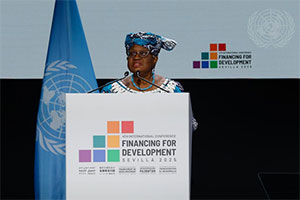 Opening of 4th International Conference on Financing for Development. Credit: UN Photo/Mariscal
International trade and investment are crucial elements of the world economy. While they can be powerful stimulators of development, they can also lead to global imbalances and dynamics of exploitation. In 2025, international trade entered a period of immense disruption, driven in part by a new wave of United States tariffs that reshaped global supply chains and investment flows. The increase in the US tariff rate, the highest since the 1930s, has forced bilateral renegotiations with global trading partners. Furthermore, the debt crisis in developing nations has accelerated while Official Development Assistance (ODA) has substantially dropped 7.3% in 2024.
In the 21st century, advancements in economic diversification in formerly colonized nations have propelled them into more central roles in the global economy. For example, both China and Mexico were able to develop their manufacturing sector and channel this development into booming export flows, thus advancing into the position of emerging economies. Foreign investment also plays an essential role in providing capital for developing countries, although they are oftentimes accompanied by social and environmental exploitation. For example, rising Chinese investments in natural resources in Latin America have often been met with tension as these investment projects fail to properly mitigate environmental risks and protect workers’ rights. In a more multifaceted vein, Sino-African relations have led to infrastructure development in Sub-Saharan Africa while also heightening the region’s economic dependency on China. IPS reports on global news in trade and investment, while shining a light on the nuanced nature of these endeavors.

The Week with IPS

NEXT STOP - SDGs
Tracking global progress towards a sustainable world
Tracking global progress towards a sustainable world
