
Saturday, November 28, 2026



News and Views from the Global South
Environment
ENVIRONMENT: Java’s Forest Way Station For Protected Animals
''Early morning is the best time to listen to nature's orchestra,'' said Andi Prima Setiadi, director of the Cikananga Animal Rescue Centre. ''You'll hear singing you have never heard elsewhere.''ENVIRONMENT-MALAWI: Wildlife Officials Brace for 2004 Ivory Sale
Conservationist David Bradfield has an interesting story to tell about one of his visits to Malawi’s capital, Lilongwe.AGRICULTURE-PARAGUAY: Legalisation of GM Crops Imminent
Paraguay's Agriculture Ministry indicated that it is about to authorise the production and sale of transgenic crops, which are already widely cultivated despite a legal ban.DEVELOPMENT-AFRICA: Scientists Called to Look Beyond the Lab
A panel of prominent women scientists has argued that African researchers need to get out of their laboratories and enter the world of policy-making if they want to be of real benefit to their fellow Africans. The women say that researchers must also learn to market their ideas.Ecobreves – BRAZIL: Fighting Ozone Pollution
The Sao Paulo government's environmental clean-up agency aims to reduce the proportion of olefins (volatile hydrocarbons) in gasoline from 30 to five percent in order to fight urban ozone pollution.
African Forage Invades Brazilian Pampas
African lovegrass has taken the place of native forage plants in several Brazilian states, and has spread to Uruguay and Argentina. Agronomists are experimenting with using buffalo to control it.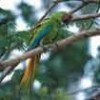
A Corridor of Hope for the Great Green Macaw
This endangered bird is the emblematic species of a nature protection effort aimed at saving crucial ecosystems in Nicaragua and Costa Rica.
'It's inhuman that borders are only open to capital'
The North American Free Trade Agreement has encouraged illegal migration, says Mexican peasant Lucas Benítez, winner of the Robert F. Kennedy Human Rights Award, in a conversation with Tierramérica.Transnational Oil Companies
Thirty thousand Indians from the Ecuadorian Amazon were able to put the U.S.-based petroleum giant ChevronTexaco in court on charges of environmental destruction.Ecobreves – CHILE: Aymaras Grow Food for Vicuñas
Thirty indigenous ranchers in Chile's extreme north will be the first beneficiaries of a project for growing forage plants to feed vicuñas (Vicugna vicugna), a member of the South American Andes llama family.Ecobreves – CUBA: Coffee Grown with Its Own Waste
Coffee growers in eastern Cuba have significantly increased production with the application of fertilizer made from the waste material produced in processing the coffee for consumption.Ecobreves – UNITED STATES: Fires Threaten Wildlife
Experts warn that it will take months or years for condor, deer, bear and other species to recover from the destruction of their habitat that occurred in the forest fires of late October in the U.S. state of California.Ecobreves – COSTA RICA: Bio-Pesticides on the Rise
The use of biological pesticides in Latin America could represent nine percent of the global total by 2008, with a value of 100 million dollars, said experts taking party in a symposium hosted by the Tropical Agricultural Research and Higher Education Center (CATIE), in Costa Rica.Ecobreves – NICARAGUA: Zoo's Residents in Danger
Some 78 species of Nicaraguan fauna at the National Zoo lack the appropriate habitat for development and reproduction, the zoo's director, Marina Sacasa, told Tierramérica.Ecobreves – GUATEMALA: Mayan Sites Protected
Congress has declared the Guatemalan Mayan archeological sites of Yaxhá, Nakum and Naranjo protected areas. Located in the northern department of El Petén, bordering Mexico, they are frequent targets for looters and vandals.Ecobreves – HONDURAS: Ex-Ambassador Visits Threatened Forest
Former U.S. ambassador to Honduras and director of the Center for International Policy, Robert White, has called for protection of the forests in the northeast department of Olancho and the resolution of the June murder of environmentalist Carlos Reyes.TRADE: Friends of the Fish Try to Sink Subsidies
An informal group of nations calling themselves the "Friends of the Fish" are attempting to sink fishing industry subsidies, charging that they distort the international market - as do farm subsidies - and contribute to the degradation of the world's marine resources.ENVIRONMENT-CHILE: Gov’t Continues to Push for Aluminium Plant
Environmentalists in Chile are fighting a new offensive by the government to revive a plan to build an aluminium smelter in a pristine wilderness area in the southern part of the country, after the foreign mining company involved pulled out of the project.THAILAND: Official Breathes Life into Crackdown on Wildlife Trade
A stocky Thai police officer is gradually becoming the rage here for his mission - to destroy a melange of restaurants, tourist shops, markets and slaughterhouses where dead or caged wildlife is prized.ENVIRONMENT: Relaxed U.S. Rules Fuelled Toxic ”Ghost Ships”
The Bush administration's relaxation of U.S. environmental regulations enabled the four rusty World War II-era ships that were the subject of a UK High Court ruling Wednesday to set sail for Britain to be turned into scrap.ENVIRONMENT-MERCOSUR: Precious Water Underfoot
The Guaraní Aquifer, perhaps the world's largest underground freshwater reservoir, lies under the territories of Argentina, Brazil, Paraguay and Uruguay. Experts warn that this vital treasure could suffer irreversible harm from contamination and unregulated exploitation.« Previous Page — Next Page »


Through our global network of local writers, we are continuing our award-winning coverage of global and local environmental challenges, with a focus on the people for whom the ecosphere matters in a direct way: rural dwellers who have little means to protect themselves against adverse conditions; communities that need to switch to sustainable development in order to survive; poor women and children, who are the most vulnerable in natural disasters. Sponsored by the United Nations Environment Program (UNEP), the United Nations Development Program (UNDP) and The World Bank (WB), IPS also maintains the award-winning Tierramérica, a specialised information service on environment and development.

The Week with IPS

Tracking global progress towards a sustainable world


