Languages
Friday, November 20, 2026



News and Views from the Global South
Global Geopolitics

WORLD SOCIAL FORUM: Crisis Could Usher In Another World
In the societies of the future, young people may not start to work until the age of 25, there will be lifelong education for everyone, with university graduation as the starting point rather than the end goal, while working hours could be reduced to 12 hours a week for all.POLITICS: U.N. Faulted for Toothless Sanctions in Civil Wars
The United Nations estimates that at least 40 percent of civil wars during the last 60 years have been fought either over natural resources - including diamonds, gold, timber, oil, gas, and cocoa - or sustained by revenues from rich minerals and commodities.US-CHINA: Spat Escalates Over Internet Freedom
The stern warning given to China by U.S. Secretary of State Hillary Clinton condemning internet censorship and responding to allegations that Chinese hackers had accessed Google email addresses has received a pointed response from the Chinese government, raising questions over what the next move will be for Google, the United States, and U.S. firms that do business in China.U.S.: Obama Faces Increasingly Daunting Picture Overseas
While President Barack Obama's first State of the Union Address Wednesday night will almost certainly focus on the economy, unemployment, and other pressing domestic issues, an increasingly worrisome international situation is likely to be tugging at the back of his mind.RECESSION AND RECOVERY: Diamonds Are for the Poor – Part 3
Diamonds haven't been among the first concerns at the World Social Forum these last 10 years. But through the recession and the still tottering recovery, a new sparkle in that business is pointing the way to a brighter world that is also better in a WSF sort of way.RECESSION AND RECOVERY: Cities Going One Way, Nations Another – Part 2
Some signs are emerging of a new trend shown up by the recession: local governments (and the people) are going one way, national ones another.RECESSION AND RECOVERY: The Lucky Are Unemployed – Part 1
The agreed, if dubious, solution to the financial crisis was to get people and governments - in the richer countries - to borrow more in order to spend more. What is not in doubt is the growing numbers of people who will be able to neither borrow nor spend.ASIA: As Economy Turns, Turning Off Stimulus Tap Is a Challenge
As the global financial crisis triggered alarms across Asia, Singapore responded with a government programme to aid its vulnerable workforce. The affluent city- state pumped in three billion U.S. dollars in an employment protection programme.CLIMATE CHANGE: ‘Copenhagen Accord Not Legal, Kyoto Protocol Is’
While the BASIC bloc countries - Brazil, South Africa, India and China - will submit their plans for voluntary mitigation actions by the Jan. 31 deadline stipulated by the Copenhagen Accord, they have taken care to emphasise that the agreement, reached at the end of the December climate change summit in the Danish capital, has no legal basis.ENVIRONMENT: Indian Glaciologist Fires Back at Climate Sceptics
"It is a fact that global warming is happening. If the Arctic Sea ice is melting, how can the Himalayan glaciers not be melting?" glaciologist Syed Iqbal Hasnain asked indignantly.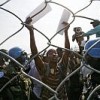
HAITI: Military Playing Large Role in Relief Efforts
As international attention turns to the long-term reconstruction of earthquake-stricken Haiti, U.N. officials pledged that the Haitian government would have full involvement and authority over the process.BIODIVERSITY: Words Are Not Enough
Words are not enough to stop the rapidly unraveling web of life, agreed heads of state and international conservation organisations at a high-level meeting that ended here last Friday.
DEVELOPMENT: Yemen to Lead South in U.N. Negotiations
The republic of Yemen, categorised by the United Nations as one of the world's "least developed countries" (LDCs), will lead the largest single coalition of developing nations this year: the 130-member Group of 77 (G77).
Q&A: “U.S. Should Invest in New U.N. Women’s Agency”
One year after U.S. President Barack Obama's inauguration, how has his administration fared in terms of advancing an agenda for women's rights around the world?Q&A: ‘Saving Tigers is Good for Ecosystems, Biodiversity’
The first Asian ministerial meeting to protect the tiger, one of the world’s most storied animals, is poised to test a new commitment between government leaders, the World Bank and the global conservationist movement.
WORLD SOCIAL FORUM: Back Seat Driver of Social Change
The World Social Forum (WSF) is only "a tool" and must not be confused with the global movement for another world, says Chico Whitaker, one of the founders of this meeting which is celebrating its tenth year with a seminar to assess its track record Jan. 25-29, in its southern Brazilian place of origin, Porto Alegre.WORLD SOCIAL FORUM: Positive Reviews, On Balance
Nearly a decade after its inception, and in spite of some reverses, on balance the World Social Forum (WSF) has proved a resounding success as a platform for planet-wide debate, from the point of view of the people most affected by the world's problems.CLIMATE CHANGE: After Copenhagen, Back to Basics for BASIC Bloc
As environment ministers from Brazil, South Africa, India and China (BASIC) prepared to meet in the Indian capital on Sunday to draw up a post-Copenhagen strategy, there were great expectations on the role they could play in pushing a consensus on how the world should go about dealing with climate change.WORLD SOCIAL FORUM: Brazil – Another Power Is Possible
The birthplace of the World Social Forum (WSF), conceived as an alternative to international meetings pursuing free-market economics, Brazil is on its way to becoming a major economic power, analysts say. The question is, what kind of model will it adopt to avoid the behaviour it has previously criticised?DEVELOPMENT: Hunger Feeds More Hunger
German philosopher Friedrich Nietzsche was way off the mark when he wrote the famous line "what does not destroy me, makes me stronger" - at least when it comes to hunger.RIGHTS: Defenders Under Sustained Attack Worldwide
Abusive governments around the world escalated their attacks against local human rights defenders and other independent monitors during 2009, according to the 2010 edition of Human Rights Watch's annual 'World Report' released here Wednesday.« Previous Page — Next Page »


Is the world dominated by three great empires -- the U.S.A, China and the European Union? How much power do the great behemoths of the south -- India, Brazil, and South Africa -- wield? And where does Russia fit in that equation? Are we in the middle of a new Cold War? What are the implications of the armed conflict with Georgia? What about the new axis: Venezuela-Russia? And what role does Turkey play? What about issues like Climate Change and other global forces like the food crisis and the high energy prices? How is all this reshaping the world's forces? IPS looks for some answers.

The Week with IPS

NEXT STOP - SDGs
Tracking global progress towards a sustainable world
Tracking global progress towards a sustainable world
