
Monday, October 26, 2026



News and Views from the Global South
Globalisation

Within a Parallel Universe – Monsters of the Dark Web
Human existence includes dreams, thoughts, ideas, music, stories, religion, and other immaterial ”things”. They constitute an important part of our habitat, i.e. the dwelling place of any living organism, consisting of both organic and inorganic surroundings. I learned this when I many years ago found myself among the undulating heights of Cordillera Central, which rise diagonally across the island of Hispaniola, shared by Haiti and the Dominican Republic.
Public-Private Partnerships Fad Fails
After the failure and abuses of privatization and contracting-out services from the 1980s, there has been renewed appreciation for the role of the state or government. Earlier promoters of privatization have taken a step backward, only to take two more forward to instead promote public-private partnerships (PPPs).
Privatization Solution Worse than Problem
Privatization has not provided the miracle cure for the problems (especially inefficiencies) associated with the public sector. The public interest has rarely been well served by private interests taking over from the public sector. Growing concern over the mixed consequences of privatization has spawned research worldwide.
Coping With World Bank-Led Financialization
The World Bank has successfully promoted its ‘Maximizing Finance for Development’ (MFD) strategy by embracing the United Nations’ Sustainable Development Goals, internationally endorsed in September 2015. It has also secured support from the G20 of twenty biggest economies, and effectively pre-empted alternative approaches at the third UN Financing for Development summit in Addis Ababa in mid-2015.
Privatization Promotes Collusion and Corruption
At the risk of reiterating what should be obvious, the question of private or public ownership is distinct from the issue of competition or market forces. Despite the misleading claim that privatization promotes competition, it is competition policy, not privatization, that promotes competition.
Civil Society Leaders Meet Amid Protests, Attacks on Rights
Amid rising attacks on rights campaigners, and mass protests in countries such as France and Serbia, civil society groups are urging governments to ensure the protection of “democratic values” and freedom of expression.
Has Privatization Benefitted the Public?
In most cases of privatization, some outcomes benefit some, which serves to legitimize the change. Nevertheless, overall net welfare improvements are the exception, not the rule. Never is everyone better off. Rather, some are better off, while others are not, and typically, many are even worse off. The partial gains are typically high, or even negated by overall costs, which may be diffuse, and less directly felt by losers.
The Myth About the Race for Artificial Intelligence
UMEA, Sweden, 26 March 2019 (IPS) -- At this year’s Davos economic forum, US executives warned that China may be winning the so-called Artificial Intelligence (AI) race with Europe. In another recent article, Bloomberg pointed out that countries are rushing to not be left behind.
South-South Cooperation: a Path to Implementing UN’s 2030 Agenda
I see five issues that will be central to implementing the Paris Agreement on climate change and achieving the 2030 Agenda for Sustainable Development. South-South Cooperation can offer solutions to all of them. First, rising inequality both between and within countries is eroding trust and deepening a sense of injustice. Globalization has enabled many people to escape poverty – but its benefits are not shared equitably and its costs fall disproportionately on the poor and vulnerable.
Communication, a Key Tool for South-South Cooperation
Communication can be a key tool for the development of cooperation among the countries of the global South, but the ever closer relations between them do not receive the attention they deserve from the media.
South-South Cooperation Now Triangulates with the North
It sounds like a contradictory play on words, but the countries of the industrialised North are currently the big supporters of South-South cooperation, as was demonstrated at the United Nations Second High-Level Conference on this subject, held in the Argentine capital.
South Florida’s Underserved Refugee Communities
South Florida has long been known as a haven for refugees and migrants. Widely referred to as the “gateway to Latin America”, 1 in every 5 Florida residents is an immigrant. Significantly, the “sunshine state” welcomes 1,000 new settlers every day.
”As global citizens, we cannot turn a blind eye to the increasing spread of hatred and intolerance”
(Geneva Centre) - The 2019 International Day for the Elimination of Racial Discrimination and this year’s theme devoted to tolerance, empathy towards the Other and celebration of diversity, comes at a timely moment. Religions, Creeds and Value Systems: Joining Forces to Enhance Equal Citizenship Rights.” The conference sought to capitalize on the fundamental convergence of religions, creeds and value systems to mitigate the marginalization of communities worldwide with the goal of eliminating xenophobia and all forms of intolerance. The conference produced an outcome declaration aimed at moving towards greater spiritual convergence to support equal citizenship rights and resulted in a consensual global vision to promote this goal. The Geneva Centre will shortly be issuing a two-volume publication on the world conference. The Geneva Centre wishes on this International Day for the Elimination of Racial Discrimination to join hands with all those involved in such a noble endeavor.
Belt and Road Initiative vs Washington Consensus
With the Washington Consensus from the 1980s being challenged, President Donald Trump withdrawing the United States from the Trans-Pacific Partnership (TPP), and China pursuing its Belt and Road Initiative (BRI), most notably with its own initiatives such as the multilateral Asian Infrastructure Investment Bank (AIIB), the political and economic landscape in East Asia continues to evolve. Jomo Kwame Sundaram was interviewed about likely implications for developing countries in the region and beyond.The Geneva Centre co-organizes a UN Library Event on Leadership in Modern Multilateralism
(Geneva Centre) - Multilateralism must be people-driven. The current rise of populism around the world is inextricably linked to a feeling of being excluded and kept out of decision-making processes broadly shared by ordinary people. These were the main conclusions of a joint event between the Geneva Centre for Human Rights Advancement and Global Dialogue and the UNOG Library entitled Leadership in Modern Multilateralism. The debate was held on 12 March 2019 at the United Nations Office in Geneva in the Library Events Room at Palais Des Nations.
Promoting Privatization
Privatization has been central to the ‘neo-liberal’ counter-revolution from the 1970s against government economic interventions associated with Roosevelt and Keynes as well as post-colonial state-led economic development. Many developing countries were forced to accept privatization policies as a condition for credit or loan support from the World Bank and other international financial institutions, especially after the fiscal and debt crises of the early 1980s. Other countries voluntarily embraced privatization, often on the pretext of fiscal and debt constraints, in their efforts to mimic new Anglo-American criteria of economic progress.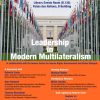
The Geneva Centre is co-organizing with the UNOG Library a discussion on Leadership in Modern Multilateralism
The Geneva Centre for Human Rights Advancement and Global Dialogue has partnered with the UNOG Library in the organization of the upcoming Library event entitled Leadership in Modern Multilateralism.
A World Party
I have been a member of the first international party: the Transnational Radical Party, founded in 1956 by Marco Pannella and Emma Bonino. Then in 1988, I was a witness of the large protest, in Berlin West, against the meeting of the International Monetary Fund and the World Bank, a precursor of the “Battle of Seattle” in 1988, where 40.000 protesters disrupted the annual meeting of the two world’s financial institutions. I was even detained for a day by the police, even if was just a witness: my condition of foreigner made me automatically suspect.
Seas of Death and Hope
The Mediterranean Sea is currently a sea of death. On the 20th of June every year, i.e. The World Refugee Day, an organization called UNITED for Intercultural Action publishes a “List of Deaths”, summarising information on where, when and under which circumstances a named individual has died due to the “fatal policies of fortress Europa”. The data are collected through information received from 550 network organisations in 48 countries and from local experts, journalists and researchers in the field of migration. The list issued in 2018 accounted for 27 000 deaths by drowning since 1993, often hundreds at a time when large embarkations capsize. These deaths account for 80 per cent of all the entries,1 there are probably thousands more dead, corpses that were never found and/or not accounted for.
Is UN Planning to Replace Humans with Machines & Robots?
The United Nations-- once facetiously described as an institution whose bloated bureaucracy moves at the leisured pace of a paralytic snail -- is steadily zooming into the field of fast-paced, cutting-edge digital technology where humans may one day be replaced with machines and robots.
A New Spectre is Haunting Europe
After Theresa May’s defeat in the British parliament it is clear that a new spectre is haunting Europe. It is no longer the spectre of communism, which opens Marx’s Manifesto of 1848; it is the spectre of the failure of neoliberal globalisation, which reigned uncontested following the fall of the Berlin Wall, until the financial crisis of 2009.« Previous Page — Next Page »





The international flow of capital and the emergence of diverse blocs and alliances are dramatically reshaping lives and the environment all around us, with the world's poorest paying the price of prosperity for the few. But the globalisation process offers unprecedented advantages too. Since WWII the possibilities for international cultural, social and economic interaction have increased at an explosive rate. The effects of these trends on trade, geopolitics, environment, media and many other fields are interconnected and extremely complex. IPS news agency seeks to analyse the free trade initiatives' impact on the individual, as well as the behaviour of corporations, international finance institutions and the multilateral system, giving visibility to the perspectives of a more diverse range of people, including civil society and the individual.

The Week with IPS

Tracking global progress towards a sustainable world
