Languages
Monday, October 12, 2026



News and Views from the Global South
Financial Crisis
POPULATION: Global Financial Crisis Threatens Family Planning
The spreading global financial crisis is threatening to undermine another one of the U.N.'s major development and health goals: family planning.POLITICS: Arab-Latin American Ties Hailed
Latin American leaders have underscored the importance of economic and political ties with the Arab world in a summit meeting with their Arab counterparts in Qatar. Tuesday's meeting, the second Arab-Latin American summit, in Doha, the Qatari capital, followed the conclusion of the Arab League conference in the city.G20: One Size Does Not Fit All
There is on the face of it a fairness in the language hanging over the G20 summit that is quite seductive. "A global crisis requires a global solution," everyone who matters seems to be saying, at least towards the richer end of the G20 spectrum. Such talk is getting louder by the day as heads of state and government head for a meeting in London Thursday to address the global economic crisis.AFRICA: ‘‘G20 Should Use Crisis as Opportunity to Fix Inequity’’
The daunting task of making Africa the centre of attention awaits Ethiopia’s Prime Minister Meles Zenawi when the Group of 20 (G20) rich and emerging economies meet in London tomorrow.DEVELOPMENT: More Urgent Measures Needed from IDB
The financial, environmental and social crises shaking the world today face the Inter-American Development Bank (IDB) with demands and expectations it cannot meet, because of the limitations seen at its 50th annual meeting, which ended Tuesday in this Colombian city.ECONOMY: Global Public Backs Major Reforms
The international economic system needs a broad overhaul, said a strong majority of 70 percent of respondents to a global poll.G20: Next Time, Perhaps…
If the draft declaration of the G20 meeting in London is anything to go by, the most specific outcome of this summit is that there will be another one later in the year.G20: Japan Carries African Concerns To London
Japan, the world's second largest economy, is calling for global initiatives to reactivate financial flows to Africa, including government grants, concessional loans and lines of credit.ECONOMY: Zoellick Seeks New Trade Fund Amid Grim Outlook
For the first time since the Great Depression, global economic production will decline in 2009, according to the latest estimates by the World Bank, which also predicted a tough and uncertain 2010.POLITICS: Arab-Latam Bid for a Diverse World
The Moors invaded and conquered much of the Iberian Peninsula in 711AD. By the time they were driven out of Granada in 1492, the Arabs had left an indelible racial and cultural imprint. Both the Spanish and Portuguese languages have a marked Arabic influence.LATIN AMERICA: IDB Capital Boost – Drop of Water in Sea of Crisis
The United States’ cautious backing has cleared up doubts about a new increase in the Inter-American Development Bank’s (IDB) capital, which has been called for by the multilateral lending institution’s governors as well as by the countries of Latin America.CLIMATE CHANGE: G20 Leaders Wrangle Over Kyoto Successor
Senior legislators from the G20 bloc of the world’s biggest economies launched an international commission in Washington Monday to help lay the political groundwork for a global deal on climate change in Copenhagen this December.ECONOMY: High Stakes, Modest Outlook for G20
Talks on the global economic crisis, to be held Thursday, could prove a timely reminder of the perils of hype.EUROPE: Financial Crisis Takes Political Toll
The weak governments in Hungary and the Czech Republic have fallen, raising questions on the future of liberal economic reform and the influence of the U.S., the European Union and Russia in the region.WORLD: Investors Eyeing South-South Trade to Help End Crisis
Despite the challenges that the global economic crisis poses to Africa and other developing regions in the southern hemisphere, South-South trade still offers huge opportunities as there is room for growth beyond the current levels.MIDEAST: Building New Bridges to Latin America
In the shadows of a critical Arab summit in Doha this week, a parallel Arab- South American heads of state meeting is expected to seal key political and economic cooperation agreements between the two regions.FINANCE: Tax Havens in Spotlight at G20 Meet
This could be the moment when a fatal blow is delivered to the world's tax havens. Or it could be another largely cosmetic change that allows offshore financial centres such as Switzerland, the Cayman Islands and Liechtenstein to deflect attacks on the system by sacrificing the few tax miscreants that governments catch in their nets.
POLITICS: "People Come First" Say Progressive Leaders
Countries must put people first if they are to prevent the economic recession from becoming a social recession, concluded the two-day gathering of self-styled progressive world leaders that ended Saturday in this Chilean resort city.DEVELOPMENT: IDB Falls Short of Its Name, Say Activists
The 50th annual meeting of the Inter-American Development Bank (IDB) has drawn harsh criticism from a parallel civil society counter-assembly in this Colombian city.ECONOMY: Entwined with U.S., Canada Tries to Minimise Exposure
Canadian Prime Minister Stephen Harper has no choice but to project optimism about his nation's ability to pull out of the economic recession by next year, although various economists and a former central bank chairman have all offered grimmer forecasts that the downturn will persist for a longer period.LATIN AMERICA: Half Century of Failed Development Policies – NGOs
As it gets ready to commemorate its 50th anniversary at an assembly in Medellín, Colombia, the Inter-American Development Bank (IDB) has come under heightened criticism from civil society groups which argue that its financing often goes against sustainable development and effective measures to overcome poverty.« Previous Page — Next Page »





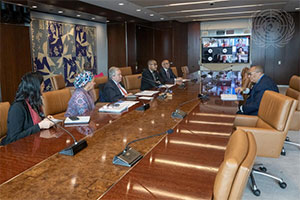 Secretary-General Meets with Members of Debt Expert Group. Credit: UN Photo/Eskinder Debeb
Financial crises are often defined by banking panics, recession, loss of market value, and deflation. Various financial crises at the turn of the 20th century, such as the Asian Crisis of 1997-1998 and the 2007-2008 Global Financial Crisis, have had immense impacts on the world economy. The COVID-19 pandemic also caused a financial crisis when mass lockdowns triggered staggering unemployment rates, a stagnation of economic growth, and led to the 2020 stock market crash. With the Russian invasion of Ukraine, the world has also witnessed a global energy crisis with shortages and increased prices in oil, gas, and electricity markets. According to UNCTAD’s World of Debt 2025, global public debt surpassed $100 trillion in 2024, with developing country debt growing twice as fast as developed economies since 2010. Burdens of debt servicing come with economic slowdowns and demands of austerity from lenders, with some economists arguing that this will lead to a new “lost decade” for the Global South. IPS brings you worldwide coverage of these financial developments and how we should manage these crises.

The Week with IPS

NEXT STOP - SDGs
Tracking global progress towards a sustainable world
Tracking global progress towards a sustainable world
