Languages
Friday, October 9, 2026



News and Views from the Global South
Financial Crisis

HAITI: Hunger Still Severe on Food Riots Anniversary
A year after riots over soaring food prices in Haiti made headlines around the world, conditions for many in this impoverished country have only worsened.AMERICAS: An OAS with Cuba – Or None at All, Says ALBA
Cuba, the only country excluded from the Fifth Summit of the Americas that opened in Port of Spain on Friday, received strong backing for its demand for unconditional talks with the United States from eight governments of the region who met in the northeastern Venezuelan city of Cumaná.
MIGRATION: Financial Crisis Eroding Remittance Lifeline
The Geneva-based International Organisation for Migration (IOM) has warned that the current financial crisis is threatening to claim another casualty: international migration.ECONOMY: Coffee Weathering the Crisis
Former Costa Rican president Rodrigo Carazo (1978-1982) said that at times of global recession, economies like that of his country, dependent on what he called "dessert" exports - like bananas or coffee - would be hit the hardest because they are among the first products people stop buying when money gets tight.LATIN AMERICA: “Crisis as Opportunity” – WEF Meeting
Economic and political leaders from Latin America and the Caribbean are trying to help come up with responses to a problem for which they do not feel responsible – the global economic crisis – although they do want to be part of the solution.SRI LANKA: Economic Crisis Ramping Up, As War Winds Down
Government troops are closing in on the last remnants of Tamil Tiger resistance in northern Sri Lanka as an upsurge of more that two years of fighting winds down. But, the country’s economic woes aren’t over. More and more pressure it being put on President Mahinda Rajapaksa’s cash-strapped administration.BALKANS: SOS Shops Tell the Economic Story
The new century brought new growth across the Balkans after the turbulent 1990s. But the advance is proving short-lived as the global recession hits the region hard.BRAZIL: “Employment Crisis Is Over” – Labour Minister
The effects of the economic recession on employment in Brazil have already been overcome, Labour and Employment Minister Carlos Lupi said, citing statistics that show more hirings than firings since February.ECONOMY-US: Foreclosing on God
The red brick St. Andrews Anglican Church in wealthy Easton, Maryland, was known for its open door. It hosted family movie nights, and weekend spaghetti dinners. Most people had no idea anything was amiss, until the bank took the key, and the church building was foreclosed and sold at auction.ECONOMY-CUBA: Keeping the Wolf from the Door
The global recession poses new economic threats to Cuba, hitting its principal exports and reducing its chances of obtaining external financing, although officials seem confident that the situation will remain within manageable limits.FIJI: ‘Returning’ Military Leader Gags Media
Fiji is maintaining an uneasy calm days after its president abrogated the constitution, promulgated emergency regulations, and reinstated the 2006 coup leader, Commodore Frank Bainimarama, as interim prime minister.ECONOMY: U.N. Summit Seeks Collective Response to Crisis
The president of the 192-member U.N. General Assembly, Miguel d'Escoto Brockmann, dismisses the G20 bloc of economically advanced countries as unrepresentative of the international community.ECONOMY-VIETNAM: Global Crisis Hits Craft Villages
The hero of one of Vietnam’s most famous fairytales, Thanh Giong, chased invaders from the nation using a bamboo staff and brought peace and prosperity to the nation.DEVELOPMENT: U.N. Triples Allotment for Population
The 1994 landmark International Conference on Population and Development (ICPD), held in the Egyptian capital of Cairo, fixed a target of 20.5 billion dollars for investments in population programmes worldwide for the year 2010.ECONOMY-EL SALVADOR: Passing the Poisoned Chalice
Warnings about the dire state of the Salvadoran economy and its weak position for coping with the global recession were ignored by outgoing President Antonio Saca for political reasons in an election year, analysts say, as they point out the difficulties that lie ahead for the new government.ROMANIA: Pushed by Crisis Into Dubious Borrowing
The Romanian government is borrowing close to 20 billion euros from international financial institutions in order to stem the effects of the global financial crisis. But few in the country seem to know precisely how the money will be used and whether it will have a more positive than constricting effect.G20: Where Is the Money, and Who Is the Moneylender
It seemed like a lot of money at the time. The leaders of the group of eight richest countries, the G8, met in Gleneagles in Scotland and announced 50 billion dollars in new aid, half of that for Africa and half for the rest of the world.
AFRICA: Arbitration Mechanism Demanded to End Scourge of Debt
International debt campaigners are calling for the establishment of a debt arbitration mechanism to respond to the difficulties that many countries of the South are increasingly facing as they attempt to service debt arrears to international lenders.G20: Give or Take a Trillion or Two
The ease with which leaders spoke of trillions of dollars at the G20 summit in London Thursday was no doubt intended to signal to the world just how serious leaders are about getting the economy right again. That these fabulous figures may never add up is another matter.ECONOMY: Insurance to Even Provide Cover Against Global Crisis
The global economic crisis makes it even more imperative that investors ascertain the economic and legal conditions in foreign countries.
Q&A: "If I Were Chairman of the U.S. National Intelligence Council"
Appointed two months ago by the Director of National Intelligence Adm. Dennis Blair to chair the National Intelligence Council (NIC), the body charged with producing analyses on key issues on behalf of all 16 agencies of the U.S. intelligence community, ret. Amb. Charles "Chas" Freeman withdrew his name in mid-March after a sustained campaign against the appointment by right-wing leaders of the so-called "Israel Lobby" concerned about his past criticism of Israel’s relations with its Arab neighbours, and particularly its treatment of Palestinians in the Occupied Territories.« Previous Page — Next Page »





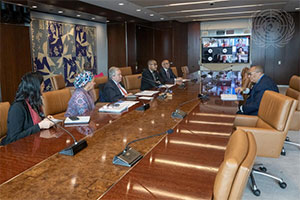 Secretary-General Meets with Members of Debt Expert Group. Credit: UN Photo/Eskinder Debeb
Financial crises are often defined by banking panics, recession, loss of market value, and deflation. Various financial crises at the turn of the 20th century, such as the Asian Crisis of 1997-1998 and the 2007-2008 Global Financial Crisis, have had immense impacts on the world economy. The COVID-19 pandemic also caused a financial crisis when mass lockdowns triggered staggering unemployment rates, a stagnation of economic growth, and led to the 2020 stock market crash. With the Russian invasion of Ukraine, the world has also witnessed a global energy crisis with shortages and increased prices in oil, gas, and electricity markets. According to UNCTAD’s World of Debt 2025, global public debt surpassed $100 trillion in 2024, with developing country debt growing twice as fast as developed economies since 2010. Burdens of debt servicing come with economic slowdowns and demands of austerity from lenders, with some economists arguing that this will lead to a new “lost decade” for the Global South. IPS brings you worldwide coverage of these financial developments and how we should manage these crises.

The Week with IPS

NEXT STOP - SDGs
Tracking global progress towards a sustainable world
Tracking global progress towards a sustainable world
