Languages
Saturday, September 26, 2026



News and Views from the Global South
Food and Agriculture

No African Development from Western Trade Policies
The World Bank’s 1981 Berg Report provided the blueprint for structural adjustment, including economic liberalisation in Africa. Urging trade liberalisation, it promised growth from its supposed comparative advantage in agriculture.
Food Inflation: a Key Challenge To Sustain the Achievements of Latin America and the Caribbean
Just a few years ago, at the height of the COVID-19 pandemic, millions of families in Latin America and the Caribbean did not know whether they would have enough food for the next day. The shutdown of economies, massive job losses, and the sharp rise in prices pushed food insecurity to levels not seen in decades.
From Reforestation to Low-Emission Food, Climate Action Starts with Seeds
When you think of climate action, images of wind farms, solar panels, bicycles or electric vehicles may come to mind. Perhaps lush forests or green landscapes. What you may not think of is the humble seed.
‘The North Korean Human Rights Movement Is Facing Its Greatest Crisis since It Began in the 1990s’
CIVICUS discusses North Korea’s closed civic space with Hanna Song, Executive Director of the Database Center for North Korean Human Rights (NKDB). Based in Seoul, South Korea, NKDB documents systematic human rights violations in North Korea through testimonies from escapees, and has built the world’s largest private database of such abuses.

Food Insecurity Rising in Africa, Falling in Latin America and Caribbean
The 2025 State of Food Security and Nutrition in the World (SOFI) report shows a modest global decline in hunger since 2022, with 673 million people facing hunger in 2024, indicating a decrease of 22 million compared to 2022. While progress is seen in Asia and South America, hunger is rising in Africa and Western Asia.
The Humanitarian Sector is at a Breaking Point: Here’s How to Fix It
As world leaders convene in New York, September 22-30, for the 80th session of the UN General Assembly, they will confront a humanitarian sector in crisis. With only 9% of the $47 billion requested for global humanitarian needs currently funded, the sector faces what UN Emergency Relief Coordinator Tom Fletcher calls "a crisis of morale and legitimacy" alongside devastating funding cuts. So where do we go from here?
Inside Africa’s Big Bet on Youth to Feed the Continent and Who’s Actually Getting Funded
Winnie Wambui leans forward on the panel stage, microphone in hand, scanning the room until she spots a raised hand.
We Can’t Meet Our Climate Goals Without Financing Agrifood Systems
Despite absorbing a quarter of climate-related losses and having the potential to reduce one-third of global emissions, agrifood systems receive less than 8% of climate finance. This imbalance threatens progress in addressing global climate challenges. If we’re serious about solutions, we need to start where the impact—and the promise—is greatest: investing in the systems that feed the world.
Climate Change is Deepening Child Poverty in Latin America and Caribbean
2025 has been marked by a significant escalation of the climate crisis and its effects on vulnerable populations, as the World Meteorological Organization (WMO) warn that average global temperatures could exceed the 1.5°C threshold within the next five years. In Latin America and the Caribbean, rising temperatures and emissions continue to strain access to essential services and deepen poverty, particularly among children.
We Are Making Progress in the Fight Against Hunger, but Not Everyone Equally
In perspective, good news: world hunger is beginning to decline. The State of Food Security and Nutrition in the World 2025 (SOFI 2025) reported a drop in the proportion of people suffering from hunger, from 8.5% in 2023 to 8.2% in 2024. Latin America and the Caribbean has played a pivotal role in this progress.
Seeding Strength: Farmer Cooperatives and the Future of Food Systems
“The future of agriculture lies not in the hands of a few giants, but in the joint hands of many.” This quote captures the spirit of farmer cooperatives—values-driven, collectively run enterprises rooted in solidarity and self-help. As global food systems grow more fragile and inequitable, cooperatives offer a compelling model: putting people before profits, and communities before corporations, while advancing social equity, economic empowerment, and environmental sustainability.
Climate Change Breaking the Journalists Who Tell its Story
My family lost six herds of cattle during the devastating El Niño-driven drought that swept Zimbabwe in 2024. The loss was as emotional as it was financial. Guilt gnawed at me.
Africa’s Moment: From Addis to the World, Food Systems Must Change Now
The global food system is under pressure from every direction – climate, conflict, inequality, and economic instability. But in Addis Ababa this July, something shifted. At the UN Food Systems Summit +4 Stocktake (UNFSS+4), over 3,500 people from 150 countries came together to confront the lack of progress and push forward solutions that can no longer wait.
Peacebuilding: The Missing Peace in COP30 Climate Ambition
Peacebuilding, conflict prevention, and crime prevention are no longer niche security concerns—they are global imperatives for sustainable climate action. From the migration crisis in Venezuela to the deforestation-driven conflicts in the Amazon, to organised crime in Central America, the ripple effects of instability and environmental degradation are felt far beyond national borders. In 2025, nearly 80% of countries experiencing risks to peace remain off-track to meet the Sustainable Development Goals (SDGs). Addressing these challenges isn’t just about safeguarding peace, stability and development. It’s also about ensuring sustainable climate action.
Bending the Curve: Overhaul Global Food Systems to Avert Worsening Land Crisis
Current rates of land degradation pose a major environmental and socioeconomic threat, driving climate change, biodiversity loss, and social crises. Food production to feed more than 8 billion people is the dominant land use on Earth. Yet, this industrial-scale enterprise comes with a heavy environmental toll.
Women in Sudan are Starving Faster than Men; Female-Headed Households Suffer
The food crisis in Sudan is starving more day by day, yet it is affecting women and girls at double the rate compared to men in the same areas. New findings from UN-Women reveal that female-headed households (FHHs) are three times more likely to be food insecure than ones led by men.
Solar-Powered Fish Farming Feeds Indigenous Communities in the Peruvian Amazon
"Our organization is showing that it is indeed possible to move toward energy transition and not depend on oil," said Elaina Shajian, president of the Regional Coordinator of Indigenous Peoples of San Lorenzo (Corpi-SL), in the Peruvian Amazon.
Why Crop Diversity Matters for the Future of Food
Across continents and cultures, seeds and plants hold more than the promise of a harvest—they carry the wisdom of generations, the hopes of communities, and the keys to a more resilient future. Yet the diversity of the seeds and plants we grow, eat, and depend upon, is under growing strain.
IPC Alert Declares the Worst Famine Conditions in Gaza since October 2023
Amidst the ongoing conflict in Gaza, the risk of famine among rising need of consumption and nutrition have reached their worst levels since the start of the conflict. Without urgent analysis to latest report from the Food Security Classificat “IPC ALERT: Worst-case scenario of Famine unfolding in the Gaza Strip”.
As Heatwaves and Floods Surge, U.S. Agriculture Faces a Growing Crisis
Recent weeks have seen an increase in extreme weather events. From heat waves occurring across the Midwest states to flash flooding in Texas, Maryland, and New York.
‘After Decades of Making Huge Profits, Companies Shouldn’t Be Allowed to Leave Behind a Toxic Legacy’
CIVICUS speaks with Matthew Renshaw, a partner at a UK law firm that represents Nigerian communities taking legal action against Shell over environmental damage caused by its operations in the Niger Delta.
« Previous Page — Next Page »


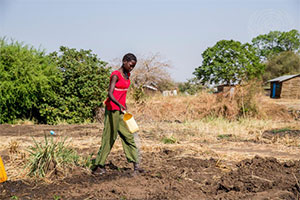 Farming on the Outskirts of Juba. Credit: UN Photo/JC McIlwaine
Promoting human and planetary health is a central focus of the United Nations, as laid out in the 2030 Sustainable Development Goals (SDGs). World hunger and unsustainable farming practices continue to be pressing concerns for the world. According to the 2025 State of Food Security and Nutrition in the World report by the Food and Agriculture Organization (FAO), 673 million people faced hunger in 2024. There are stark regional disparities, with the FAO projecting that 60% of the world population facing hunger will reside in Africa by 2030. Globally, the prevalence of food insecurity has remained consistently higher for women than men.
Sustainable and efficient national food systems are essential in preserving health, education, environmental well-being, peace, economy, and security. However, creating sustainable food systems can be a challenging endeavor, as food production takes a heavy toll on the environment. The agricultural sector accounts for a significant portion of greenhouse gases. Finding safe, sustainable, and ethical strategies to feed the world is crucial in ensuring planetary longevity. A recent initiative from 2023, the EU Regulation on Deforestation-free Products (EUDR), seeks to advocate for sustainable food systems. The main driver of deforestation is the expansion of agricultural land used to produce commodities like cattle, wood, cocoa, coffee, etc. The EUDR is part of the 2020 European Green New Deal and the EU Biodiversity Strategy for 2030 and aims to limit Europe’s consumption of products linked with deforestation by requiring that companies prove that their products are deforestation-free. Despite aiming to achieve major strides in sustainability, policies such as EUDR also raise socioeconomic concerns for targeted countries. Many emerging Latin American economies are impacted by the policy, and have raised the question of how developing countries can grapple with the tensions between economic development and advancing sustainability.
IPS has been at the forefront of providing compelling and insightful stories on communities facing hunger as well as the cost of food production. IPS uses statistics from FAO, the World Food Programme (WFP) and the International Fund for Agricultural Development (IFAD) to bring relevant and hard-hitting facts to readers. This gathering of information and data from such organizations helps bring the best stories from IPS journalists working in the different regions in consultation with experts on the ground.

The Week with IPS

NEXT STOP - SDGs
Tracking global progress towards a sustainable world
Tracking global progress towards a sustainable world