Languages
Sunday, October 11, 2026



News and Views from the Global South
Green Economy

Education Cannot Wait Interviews Adenike Oladosu, ECW Global Climate Champion and BBC 100 Women 2024
Adenike Oladosu is a leading Nigerian ecofeminist, climate justice leader and researcher. She was appointed as an ECW Global Climate Champion on World Environment Day in June 2024. In December of last year, Adenike was honored by #BBC100Women, selected as one of the BBC’s 100 most influential and inspiring women from around the world. She was also a finalist for the Pritzker Emerging Environmental Genius Award.

This Year’s Three UN Summits Set the Stage for COP30 to Transform Food Systems
This year has been a landmark one for climate and environment policy. Starting with the UN’s COP16 biodiversity talks in October, followed by the COP29 climate talks in November, and closing with the desertification COP16 in December, few years have offered such critical moments back-to-back.
2024 Is The Hottest Year Ever Recorded
The World Meteorological Organization (WMO) warns that 2024 is on track to be the hottest year in recorded history, surpassing 2023. This can be attributed to heightened reliance on fossil fuels and the reluctance of industries worldwide to pivot to green energy practices. The rapid acceleration of global temperatures has alarmed scientists, with many expressing concern over the environmental, economic, and social implications of the worsening climate crisis.
New Law in Cuba Makes Investing in Renewable Energy Sources Mandatory
With Decree 110, published on 26 November, Cuba made it mandatory for major consumers, whether they are state or private entities, to invest in the use of renewable energy sources, while the energy crisis facing the country worsens.
COP29: Advancing work for Climate Finance and for Climate-Adapted Agri-Food Systems
Frustrations over the pace of climate action and the size of the finance target agreed in Baku are valid from the perspective of low-income countries, especially Small-Island Developing States (SIDS). It is also important to recognize that there has been real progress in some countries at the agri-food-nutrition-climate-water-nature-livelihoods intersection, and this seems to be particularly the case in some countries in the Alliance of Champions for Food Systems Transformation (ACF).
Redefine Business Success to Include Nature
Sustaining nature is not just an environmental goal—it is an essential component of sustainable business—and requires that we redefine business success to include the wise stewardship of nature.
How an App Transformed Farming for Rural Tanzanian Women
In the sun-scorched soils of Moshi, where every drop of rain counts, two female farmers have defied the odds through technology. Mwajuma Rashid Njau and Mumii Rajab, once locked in a daily struggle to survive, have found a mobile phone their best ally.
Giving the Ocean a Fighting Chance Through the Great Blue Wall
The Ocean is our life source, but for decades it has been repeatedly marred by humankind. With the disposal of pollutants into the Ocean, overexploitation of Ocean resources and the human-driven increase of global temperatures, the Ocean is changing and not for the better. Our Oceans are warming, corals are dying, fish stocks are declining, toxic chemicals are being released into the Ocean – these eAects are clearly visible today, but there is hope. There are organisations from all around the world that are fighting to save our Ocean.
Solar Project Causes Social and Environmental Conflict in Rural El Salvador
With machete in hand, Salvadoran farmer Damián Córdoba weeds the undergrowth covering the trunk of what was once a leafy tree to show the deforestation taking place on the Santa Adelaida farm, where a company seeks to install a solar park in western El Salvador.
Solar and Wind Power Wealth Does Not Reach Consumers in Chile
Chile, a country rich in solar and wind energy and with huge photovoltaic power stations and wind turbines in its elongated territory, managed to change its grid by incorporating renewable energies, which account for an installed capacity equivalent to 43.8 % of its electricity production.
Money Talks: Why COP29 New Collective Quantified Goal on Climate Finance Matters
The industrial revolution set the ball rolling towards global warming. Today, developing nations are on the frontlines of a climatic carnage and its snowballing effects. Developed nations bear a financial responsibility to provide climate finance to developing nations, as financing the transition to a low-carbon economy is an urgent, critical matter.
Latin America: Pass on Renewables, Fail on Efficiency
The Latin American and Caribbean region is a student with good grades in renewable energy, but not in energy efficiency, and has a long way to go in contributing to global climate action and overcoming the vulnerability of its population and economies.
4 Reasons Why the Climate Coalition Will Win Despite Trump
The nation which more than any other caused the climate crisis will leave it to the rest of the world to sort out the mess. That is a takeaway from the US election last week.
Leather Cooperative Stops Unemployment in Northeast Brazil
The small community of Ribeira stands out in the Northeast, the poorest region of Brazil. There is no unemployment here. One in five inhabitants make a living directly or indirectly from the Arteza Cooperative of Tanners and Leather Artisans.
Brazil Promotes a Freer Global Biofuels Market
Holding this year's presidency of the Group of 20 (G20) large industrial and emerging economies is allowing Brazil to push forward the dream of creating a global biofuels market without the current trade barriers.
Mexican Cooperative Promotes Energy Transition on Indigenous Lands
What began as a search for fair prices for indigenous handicrafts in 1985 has evolved into a women's organisation in Mexico that promotes climate justice while advocating for land and environmental rights.
Solar Energy Saves Dairy Cooperative in Brazil’s Semi-Arid Region
“Ixe! If it wasn't for solar energy, we would have closed down, you can be sure. We had to stop due to the pandemic on 15 March 2020, but the energy costs were fixed,” said Erika Cazuza, administrative and financial manager of the Brazilian Cooperative of Rural Producers of Monteiro (Capribom).
Small Farmers Reap Growing Benefits From Solar Energy in Chile
The production of solar energy by means of panels installed on small farmers' properties or on the roofs of community organisations is starting to directly benefit more and more farmers in Chile.
IMF isn’t doing enough to support Africa: billions could be made available through special drawing rights
At the 2021 UN Climate Summit, Barbados prime minister Mia Mottley called for more and better use of special drawing rights (SDRs), the International Monetary Fund’s reserve asset.
The Future of Food Security Lies Beyond COP29’s Negotiation Tables
Climate change has thrown our food systems into chaos. Extreme weather events and dramatic climate variations are hammering food production and supply chains across the world. As global leaders gear up for COP29, there’s plenty of buzz about climate action. But can we really expect these slow-moving, bureaucratic negotiations to deliver tangible and swift results to decarbonize and insulate our agri-food systems? Most likely not. But do not despair. While the COP29 talks unfold, crucial climate solutions for transforming food systems are already taking root on the ground.
Biogas, a Circular Energy, Advances in Brazil Thanks to Local Arrangements
“I don't know of a more sustainable technology for the transformation of society than biogas,” said Professor Alex Enrich-Prast, an activist for this energy alternative with a highly diversified and decentralised expansion in Brazil.« Previous Page — Next Page »





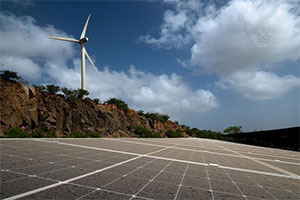 Renewable Energy in Cabo Verde. Credit: UN Photo/Mark Garten
A green economy is an economic model that aims to reduce environmental risks and build a sustainable future. Many of the UN SDGs seek to facilitate a green economy, such as ensuring access to affordable and reliable clean energy, building sustainable cities and communities, and implementing urgent action to combat climate change. Various key negotiations have strived to achieve a green economy, such as the Green New Deal and the Inflation Act of 2022. COP30, held in Belém, Brazil in 2025, agreed to mobilize $1.3 trillion annually for climate action and launched the Belém Mission to 1.5°C. However, the conference was not able to develop a fossil fuel reduction roadmap. Recent years have witnessed a sharp transformation in the geopolitical landscape of international sustainability cooperation. In March 2025, the United States stepped back from formal multilateral support for the SDGs, while China is on the rise as an international leader in renewable energy production. The actions of these global powers may shape shifting alliances on environmental governance. IPS is dedicated to sharing timely news on international developments in building a sustainable future.

The Week with IPS

NEXT STOP - SDGs
Tracking global progress towards a sustainable world
Tracking global progress towards a sustainable world
