Languages
Friday, November 20, 2026



News and Views from the Global South
Labour
UNITED STATES-LABOUR: Part-Time Workers Enjoy Rare Spotlight/REPEAT
The United Parcel Service (UPS) strike is putting the larger plight of part-time workers, the fastest growing segment of the U.S. labour force, in the limelight.RUSSIA: Pacific Coast Health Strikes Raise Spectre Of Cholera
The combination of a strike by both doctors and garbage collectors in the Pacific coast city of Vladivostok raise the very real threat of an outbreak of cholera or equally dangerous disease, warn local health experts.US-LABOUR: UPS Strike Is a Key Turning Point
A strike by the International Brotherhood of Teamsters against the United Parcel Service (UPS), the largest U.S. package-delivery company, is shaping up to be a major test of organised labour's strength, union analysts say.COLOMBIA-LABOUR: UNDP and Unions Promote New Labour Relations
The Colombian government, the U.N. Development Programme (UNDP), and the local business sector and labour are seeking a "New Culture of Labour Relations".US-LABOUR: Migrant Farm Unionists Scent Victory
The major agricultural workers union in the United States is confident of victory in its long fight to unionise migrant Mexican strawberry workers.LABOUR-LATIN AMERICA: Informal Work Sector Dominates Business
The number of workers in "informal" jobs throughout Latin America is now more half the total work force and its time governments did something about easing the legal obligations of employers, says the World Labor Organisation (WLO).THAILAND-LABOUR: New Party Comes to Workers’ Rescue
As Thailand convulses under its worst economic turmoil in decades, a group of union leaders are organising what the political spectrum here has always lacked: a party to represent labour interests.CHINA-LABOUR: Hurt by Economic Reforms, Workers Unite In Protest
China extols its workers as the "masters of society", but millions of its labourers face the grim prospect of unemployment and are increasingly taking to the streets in protest.CANADA-RIGHTS: Companies Fare Poorly on Workers’pRights
Echoes of recent allegations of U.S. companies running "sweatshops" in Latin America and Asia can now be heard in Canada where most firms operating abroad have a poor record in addressing the rights of their foreign workers, according to business study published here.INDIA-HEALTH: Run By Workers, a Hospital They Can Afford
Deep in the industrial heart of this teeming eastern Indian city is a hospital, built and managed by workers, and for workers.LABOUR: A ‘World of Difference’ – but not Two Worlds, Says Bank
The president of the World Bank, James Wolfensohn, said Thursday that while the industrialised North and developing South were an inseparable whole rather than two coexisting worlds, there was "a world of difference" between them.HONDURAS-LABOUR: Mass Fainting Triggers Investigation
Representatives of trade unions and the private business sector in Honduras announced Wednesday that they would launch an in-depth investigation of labour conditions in the "maquilas" or overseas assembly plants.BRAZIL-LABOUR: Problems in Ending State-sponsored Employment
The Government has found that the privatization of Brazil's state-held assets was relatively easy compared to the task of reducing state employment rolls, especially since it has yet to find a way to create replacement jobs.THAILAND-LABOUR: Economic Slowdown Brings Labour Tension
Thailand's current reversal of economic fortunes is fueling violent tension between workers and employers, threatening to disrupt an industrial scene once viewed as the most peaceful in South-east Asia.U.S.-LABOUR: Gay Auto Workers Fight Bias
When Ron Woods arrived at work Apr. 23, he found a disparaging letter about gays posted near his supervisor's office. He asked@another supervisor to remove the letter, but several hours later, the letter reappeared -- enlarged, xeroxed, and plastered throughout the office.ARGENTINA-LABOUR: Adjustments Run into Human Barriers
President Carlos Menem insists that the protests racking Argentina will not force changes in his government's economic policy. But the structural adjustments are increasingly running up against human barriers, as demonstrators raise roadblocks around the country.FIJI-WOMEN: Factory Jobs Abound, But The Women Look Elsewhere
Foreign investors are pouring money into the local garments industry, but the women for whom the new jobs are intended are shunning the factories, prompting Fiji to import Asian workers instead.LABOUR-LATAM: Spectre of Unemployment Haunts Latin America
Market reforms, privatisation and monetary stability may have improved the economies of Latin American nations but there is a growing fear among labour officials of increasing unemployment.MEDIA-SOUTH AMERICA: Race Against Time for Women Journalists
Any South American woman seeking a career in journalism had better make her decision very early. Employers lose interest in women aged between 35 and 50 years of age - regardless skills and accomplishment - according to a media survey here.CHINA-LABOUR: Worker’s Suicide Exposes Unemployment Time Bomb
The reported suicide of a jobless migrant this week underscores the brewing tensions that are simmering in China, as its flagging state enterprises continue to lay off hundreds of thousands of workers.ARGENTINA-LABOUR: Protests, Roadblocks Continue to Spread
Argentina's soaring unemployment has hit towns in several outlying provinces particularly hard, and the protests racking the country have increasingly incorporated roadblocks to draw government attention to the plight of large sectors of the population.« Previous Page — Next Page »


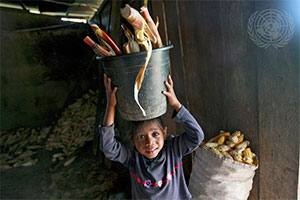 Timorese Girl with Fresh-Picked Corn. Credit: UN Photo/Martine Perret
A global common denominator is the need for a decent job. The economic realities of each country determine just how difficult it is to find one. Despite the labour movement's achievements, serious challenges persist: gender discrimination, child labour, worker migration, the digital divide and AI automation, evaporating pensions, unsafe workplaces, corporate pressure against union organising, negative impacts of trade agreements, and the precariousness of informal employment. The 2025 UN SDG Report identifies jobs and social protections as one of the six priority areas requiring urgent action, with progress either stalled or reversing in many developing nations.
In recent years, the fight to protect labour equality has taken on new dimensions with the rise of Environmental, Social and Governance standards. With the Social aspect aiming to promote equality and human rights, ESG principles have strengthened labour advocacy within corporate and governmental regulatory landscapes. In particular, ESG has become much more institutionalized in emerging economies such as Brazil and China. IPS follows the world’s workers as they confront these challenges - their setbacks and their successes.

The Week with IPS

NEXT STOP - SDGs
Tracking global progress towards a sustainable world
Tracking global progress towards a sustainable world
