Languages
Friday, September 25, 2026



News and Views from the Global South
Trade & Investment

African Development Bank Plans for a Self-sufficient, Integrated and Industrialised Continent
Arama Sire Camara, a fruit and vegetable seller in the province of Kindia, some 135 km from the Guinean capital of Conakry, feels safer trading well into the night thanks to the Rural Electrification Project, financed by 21-million-dollar investment by the African Development Bank. “With lighting on the road at night and illuminating our goods, it means we are safer, especially with all the cars on the road. You can work for longer after nightfall, and so we can make more of our products,” she says.
Dumping Fossil Fuels to Drive Green Development
Disinvestments in fossil fuels amounting to 11 trillion dollars – eight times the global GDP – have been recorded in the last six months of this year, according to a new report.
Exclusive: Winnie Byanyima Speaks about Inequality in Africa and Next Steps at UNAIDS
 While the 28th World Economic Forum (WEF) on Africa is being held in Cape Town, South Africa this week, the international aid and development charity Oxfam released its latest report: A tale of two continents: fighting inequality in Africa.
Ensuring Fairer International Corporate Taxation
Large transnational corporations (TNCs) are widely believed to be paying little tax. The ease with which they avoid tax and the declining corporate tax rates over the decades have deprived developing countries of much needed revenues besides undermining public faith in the tax system.
The Arctic: Earth´s Last Frontier
The last frontier for utilizing and maybe even exhausting Earth´s natural resources is opening up in the Arctic and some of the world´s wealthiest nations are trying to secure their piece of the cake. Some act openly, others are more secretive – recently one of the competitors entered the game in a remarkably unwieldy manner.
Trade, Currency War Weapons Double-Edged
The US-China trade war has flared up again less than two weeks after US President Donald Trump delayed new tariffs of US$160 billion on Chinese imports until December, purportedly to avoid harming the holiday shopping season.
South Must Also Set International Tax Rules
Recently, Christine Lagarde, outgoing Managing Director of the International Monetary Fund (IMF), argued that developing ‘countries need a seat at the table’ to design rules governing international corporate taxation. This acknowledges recent IMF findings that developing countries lose approximately USD200 billion in potential tax revenue yearly, about 1.3 per cent of their GDP, due to companies shifting profits to low-tax locations. Oxfam estimated in 2018 that extreme poverty could be eradicated for USD107 billion annually, i.e., about half the lost revenue.
‘Beggar Thy Neighbour’ Policy Advice
The harmful effects of falling corporate tax rates have been acknowledged in a recent International Monetary Fund (IMF) research paper. This trend, since the early 1980s, has been especially detrimental for developing countries, which rely on direct taxation much more than developed economies.
The Moral Responsibility for Arms Trade
“I don’t want to see a single war millionaire created in the United States as a result of this world disaster.” 1 These were the words of US President Franklin D. Roosevelt on 22 May 1940 when he learned of individuals profiting because of the booming arms trade industry during the Second World War. Seven decades down the line, President Roosevelt’s warning against the rise of the military-industrial complex and war profiteers is more relevant than ever and a telling testimony that for many in safe places war means profit. But, should the pursuit of economic profit be allowed to supplant ethical considerations, especially when weapons often end up in the hands of terrorists, human rights violators and criminal governments?
Bretton Woods Institutions: Enforcers, Not Saviours?
According to their own internal evaluations, both the World Bank (WB) and the International Monetary Fund (IMF) have huge credibility deficits due to the policy conditionalities and advice they have dispensed to developing countries in recent decades.
Boom or Bust -Education Will Determine Africa’s Transformation
August 12, marks International Youth Day, and the theme for this year is ‘making education more relevant, equitable and inclusive’, is particularly apt for Africa. Consider this. Every 24 hours around 35,000 African youth are looking for work.
Europeans Mobilising for New IMF Head
In the grand European political reshuffle of 2019, it turned out that Christine Lagarde was the answer to the conundrum of who should replace Mario Draghi at the European Central Bank. But her move opens another question. Who succeeds Lagarde at the International Monetary Fund?
Free Speech and the Hong Kong Protests
Sometime in the summer of 1974, I was leaning against the gunwale of the ferry between Calais and Dover, watching the moonlight streaming dark waters. When I turned to the left I found that a Chinese lady also looked out over the calm sea. What she told me changed my world view.
Bretton Woods Institutions: From Solution to Problem
July 2019 saw the 75th anniversary of the historic conference of 44 countries held at the Bretton Woods (BW) resort in New Hampshire during July 1-22, 1944. Conference At BW, John Maynard Keynes, representing the UK, and Harry Dexter White, for the USA, both sought a new international monetary system following the Great Depression, which many attributed to the functioning of the gold standard before World War II.
Foreign Private Investment in Low-Income Countries: More Important Than You Think
In a world of stagnating public aid, limited fiscal space, and rising public debt in low-income countries (LICs), can they realistically expect to rely more on private finance from foreigners? What does the evidence suggest?
Privatization Increases Corruption
International financial institutions (IFIs) have typically imposed wide-ranging policy reforms – called ‘conditionalities’ – in exchange for country governments to secure access to financial assistance. While IFIs may demand anti-corruption policies, other IFI policy conditionalities, such as the privatization of state-owned enterprises (SOEs), can create new rentier opportunities, undermining government will and capacity to curb corruption.
Facebook and Friends Threaten to Libralize the World
On 17 June, a Facebook white paper proposed a new global digital currency it plans to launch in the first half of 2020. The Libra will be managed by a ‘not for profit’ Swiss-based Facebook-led consortium of ‘for profit corporations’, with Uber, eBay, Lyft, Mastercard and PayPal among its founding members.
Rwanda: Open for Business
Claire Akamanzi spends her days working on innovative ways to bring more business to her country. As CEO of the Rwanda Development Board (RDB), a multiagency governmental department billed as a “one-stop shop” for investors, Akamanzi has seen the country earn accolades for its business-friendly environment, recently winning the #2 spot regionally in the World Bank’s ease of doing business rankings.
Industrial Policy Finally Legitimate?
For decades, the two Bretton Woods institutions have rejected the contribution of industrial policy (IP), or government investment and technology promotion efforts, in accelerating and sustaining growth, industrialization and structural transformation. Finally, two International Monetary Fund (IMF) staff members, Reda Cherif and Fuad Hasanov, have broken the taboo. They embrace industrial policy, arguing against the current conventional wisdom that East Asian industrial policies cannot be successfully emulated by other developing countries.
Financialization Undermines Real Economy
The relationship between finance and the real economy is arguably at the root of the contemporary economic malaise. Unlike earlier acceptance of simple linear causation, recent recognition of a curvilinear relationship between finance and economic growth, implying ‘diminishing returns’, has important implications.
Could the Election of Qu Dongyu as FAO´s General-Director be a Turning-point for Sustainable Agricultural Development?
Agriculture is the bedrock of sedentary human civilization, without it we would have no governments or nations. It was food surplus generated by agriculture that enabled people to live in cities and form regimes able to organize food production in such a manner that some community members could engage in other activities than direct food production and thus give rise to the ideologies, techniques and goods which now constitute and govern our existence.« Previous Page — Next Page »


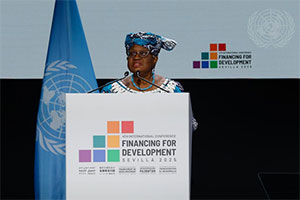 Opening of 4th International Conference on Financing for Development. Credit: UN Photo/Mariscal
International trade and investment are crucial elements of the world economy. While they can be powerful stimulators of development, they can also lead to global imbalances and dynamics of exploitation. In 2025, international trade entered a period of immense disruption, driven in part by a new wave of United States tariffs that reshaped global supply chains and investment flows. The increase in the US tariff rate, the highest since the 1930s, has forced bilateral renegotiations with global trading partners. Furthermore, the debt crisis in developing nations has accelerated while Official Development Assistance (ODA) has substantially dropped 7.3% in 2024.
In the 21st century, advancements in economic diversification in formerly colonized nations have propelled them into more central roles in the global economy. For example, both China and Mexico were able to develop their manufacturing sector and channel this development into booming export flows, thus advancing into the position of emerging economies. Foreign investment also plays an essential role in providing capital for developing countries, although they are oftentimes accompanied by social and environmental exploitation. For example, rising Chinese investments in natural resources in Latin America have often been met with tension as these investment projects fail to properly mitigate environmental risks and protect workers’ rights. In a more multifaceted vein, Sino-African relations have led to infrastructure development in Sub-Saharan Africa while also heightening the region’s economic dependency on China. IPS reports on global news in trade and investment, while shining a light on the nuanced nature of these endeavors.

The Week with IPS

NEXT STOP - SDGs
Tracking global progress towards a sustainable world
Tracking global progress towards a sustainable world


