Languages
Friday, October 23, 2026



News and Views from the Global South
Trade & Investment
Africa and India – Sharing the Development Journey
Africa, like India, is a continent of rich and compelling diversity. Both continents share a similar landscape, a shared colonial history, and similar economic and demographic challenges. This helps both India and Africa work especially well with each other.
Unlocking the Diaspora Development Potential
 ‘Diaspora is the biggest development community that exists in the world’, according to Pedro De Vasconcelos, manager of IFAD‘s Financial Facility for Remittances. However, its potential is still largely untapped.

Using Agriculture and Agribusiness to Bring About Industrialisation in Africa
No region of the world has ever moved to industrialised economy status without a transformation of the agricultural sector. Agriculture, which contributes 16.2% of the GDP of Africa, and gives some form of employment to over 60% of the population, holds the key to accelerated growth, diversification and job creation for African economies.
World Bank Must Stop Encouraging Harmful Tax Competition
One of the 11 areas that the World Bank’s Doing Business (DB) report includes in ranking a country’s business environment is paying taxes. The background study for DB 2017, Paying Taxes 2016 claims that its emphasis is “on efficient tax compliance and straightforward tax regimes”.
Reclaiming the Bandung Spirit for Shared Prosperity
"The despised, the insulted, the hurt, the dispossessed—in short, the underdogs of the human race were meeting. ... Who had thought of organizing such a meeting? And what had these nations in common? Nothing, it seemed to me, but what their past relationship to the Western world had made them feel. This meeting of the rejected was in itself a kind of judgment upon the Western world!." —Richard Wright, The Color Curtain [University Press of Mississippi, 1956].
Dispute Settlement Becomes Speculative Financial Asset
Investor-state dispute settlement (ISDS) provisions in bilateral investment treaties (BITs) and free trade agreements (FTAs) have effectively created a powerful and privileged system of protections for foreign investors that undermines national law and institutions.
Economic Recovery Crucial to Sustainable Development
More than eight years after the global financial crisis exploded in late 2008, economic growth remains generally tepid, while ostensible recovery measures appear to have exacerbated income and other inequalities. Yet, despite the G-20 group of the world’s largest economies raising the level, frequency and profile of its meetings, effective multilateral cooperation and coordination remains a distant dream.
Feast and Famine in Africa’s Dubai
As balmy night settles over Djibouti City, the arc lights come on at its growing network of ports as ships are offloaded 24 hours a day and trucks laden with cargo depart westwards into the Horn of Africa interior.
Positive Signs as Asia-pacific Moves Towards Global Development Goals
With just over a year since the adoption of a historic blueprint to end poverty and protect the planet, positive signs have already started to emerge among countries in the Asia-Pacific region as they push ahead with the implementation of the 17 Sustainable Development Goals (SDGs).
Can the SDGs be financed?
Investment in the least developed countries (LDCs) will need to rise by at least 11 per cent annually through 2030, a little more than the 8.9 per cent between 2010 and 2015, in order for them to achieve the Sustainable Development Goals (SDGs). The United Nations’ World Economic Situation and Prospects (WESP) 2017 focuses on the difficulties in securing sufficient financing for the SDGs given the global financial system and current economic environment.
The Challenge Ahead: Harnessing Gene Editing to Sustainable Agriculture
The role of genetic engineering in agriculture and food has generated enormous interest and controversies, with large-scale embrace by some nations and wholesale bans by others.
Investing in Zimbabwe’s Smallholder Farmers
To take his mangoes to Shurugwi, 230 kms south of Harare, requires Edward Madzokere to hire a cart and wake up at dawn. The fruit farmer sells his produce at the nearest “growth point” at Tongogara (the term for areas targeted for development) where the prices are not stable.
Secret Tax Deals Increased Dramatically After Luxleaks
Despite the LuxLeaks scandal, the number of secret tax deals is skyrocketing. Such deals between companies and governments across Europe increased by almost 50 percent the year after the scandal broke.
Argentina and UAE Agree to Strengthen Economic Ties
Argentina and the United Arab Emirates (UAE) agreed Friday Mar. 17 to explore the possibility of this South American country receiving investment from the Gulf nation, particularly tourism and health, while they pledged to strengthen bilateral relations and increase trade.
From Barriers to Bridges: Transformation of the Kenya-Ethiopia Border Region
Consider this. The communities around the Kenya-Ethiopia border in Moyale-Borona area, have long been associated with internecine violence, extreme poverty, and environmental stress. These have led to disastrous societal consequences, including displacement, criminality and violent extremism.
Brazil and the UAE Determined to Explore New Bilateral Frontiers
The foreign minister of the United Arab Emirates (UAE), Sheikh Abdullah bin Zayed Al Nahyan, made his fifth visit to Brazil Thursday, Mar. 16, in search of new opportunities to exploit the enormous potential in relations between the two countries.
Most Financial Inflows Not Developmental
Recent disturbing trends in international finance have particularly problematic implications, especially for developing countries. The recently released United Nations report, World Economic Situation and Prospects 2017 (WESP 2017) is the only recent report of a multilateral inter-governmental organization to recognize these problems, especially as they are relevant to the financing requirements for achieving the Sustainable Development Goals (SDGs).
At 60, Ghana Looks to a Future Beyond Aid
Ghana turned 60 years old this week. The West African country gained independence from Britain on Mar. 6, 1957, and remains a study in contradictions.
Half a Century of Struggle Against Underdevelopment
The idea of creating Inter Press Service (IPS) arose in the early 1960s in response to awareness that a vacuum existed in the world of journalism, which had two basic aspects.
Another Town in El Salvador Votes No to Mining
The citizens of Cinquera municipality in Cabañas delivered a resounding vote against mining, on Sunday February 26th, when 98 percent of residents voted in favour of becoming El Salvador's fifth "territory free of mining."
Avoid Patent Clauses in Trade Treaties that can Kill Millions
Recently a very interesting article on why there are inequalities in access to health care and how medicine prices are beyond the reach of many people was published in The Lancet, one of the most prestigious medical journals in the world.« Previous Page — Next Page »





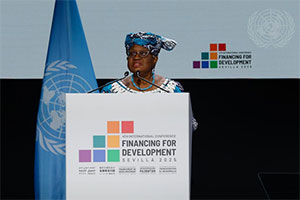 Opening of 4th International Conference on Financing for Development. Credit: UN Photo/Mariscal
International trade and investment are crucial elements of the world economy. While they can be powerful stimulators of development, they can also lead to global imbalances and dynamics of exploitation. In 2025, international trade entered a period of immense disruption, driven in part by a new wave of United States tariffs that reshaped global supply chains and investment flows. The increase in the US tariff rate, the highest since the 1930s, has forced bilateral renegotiations with global trading partners. Furthermore, the debt crisis in developing nations has accelerated while Official Development Assistance (ODA) has substantially dropped 7.3% in 2024.
In the 21st century, advancements in economic diversification in formerly colonized nations have propelled them into more central roles in the global economy. For example, both China and Mexico were able to develop their manufacturing sector and channel this development into booming export flows, thus advancing into the position of emerging economies. Foreign investment also plays an essential role in providing capital for developing countries, although they are oftentimes accompanied by social and environmental exploitation. For example, rising Chinese investments in natural resources in Latin America have often been met with tension as these investment projects fail to properly mitigate environmental risks and protect workers’ rights. In a more multifaceted vein, Sino-African relations have led to infrastructure development in Sub-Saharan Africa while also heightening the region’s economic dependency on China. IPS reports on global news in trade and investment, while shining a light on the nuanced nature of these endeavors.

The Week with IPS

NEXT STOP - SDGs
Tracking global progress towards a sustainable world
Tracking global progress towards a sustainable world
