Languages
Wednesday, November 18, 2026



News and Views from the Global South
Europe
Q&A: ‘Review of All Life Sentences after a Set Time’
The guns of state firing squads are today silent in Central Asia.RIGHTS-HUNGARY: Activists Seek to Reverse Draconian Law
A Hungarian rights organisation is seeking to return the country to the days when all life prisoners had a right to a review of their sentences, giving hope to eight who have been sentenced to imprisonment until they die.FRANCE: Passionate About Principled Trade
Just like humanitarian relief, fair trade is a field that attracts passionate individuals with complex world views. Most are not in it for the money. But it is also rife with controversy, as personalities driven by conviction often clash over principles and practice. No two fair traders are alike, which probably explains many of their arguments.ROMANIA: Two Decades of Democracy Brings Disappointment
The chaotic political programmes of the parties and a new electoral system discouraged more Romanians than usually from casting a vote in Sunday's parliamentary elections. The main opposition force, the Social-Democrats, obtained the best result, but with none of the parties achieving a clear majority, the centre-right forces might still coalesce to form the new government.TRADE: Cote d’Ivoire Succumbs to EU
Cote d'Ivoire became the first country in Africa to sign an economic partnership agreement (EPA) with the European Union this week, prompting fears that the accord will prevent the country from developing closer ties with its neighbours.RUSSIA-LATIN AMERICA: Economic Manoeuvres Overshadow Naval Ones
Aboard the Russian submarine destroyer Admiral Chabanenko, docked at the port of La Guaira, 20 km north of Caracas, Presidents Dmitry Medvedev of Russia and Hugo Chávez of Venezuela announced the start of joint naval manoeuvres Thursday in the Caribbean.ENVIRONMENT: Europe Eases the Way for Cars
José Manuel Barroso, the European Commission's president, has a penchant for large cars. At the same time as he was publicly encouraging citizens to be more sparing in their use of energy, it emerged in 2006 that his vehicle of choice was a Volkswagen Touareg.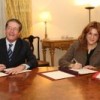
MEDIA: IPS Signs Development Aid Agreement with Spain
Federico Mayor Zaragoza, chair of the IPS Board of Directors, and Soraya Rodríguez, Spain’s Secretary of State for International Cooperation, representing that country’s Foreign Ministry, signed an agreement for media coverage of development-related issues Wednesday.CLIMATE CHANGE: EU Saying, Not Doing, the Right Things
Senior European Union figures are portraying themselves as champions of sound ecological policies ahead of the international climate change negotiations that begin in Poznan, Poland Dec. 1. Stavros Dimas, Europe's environment commissioner, this week described a series of measures being considered by the bloc's 27 governments as "easily the most far-reaching legislative package on fighting climate change anywhere in the world."
POLITICS: Russia-Georgia Conflict Left Legacy of Displaced
As the European Union launches a probe into the conflict between Georgian and Russian troops in the breakaway regions of South Ossetia and Abkhazia last August - with much of the blame now being cast on Georgia for firing the first shots - thousands of civilians remain displaced and homeless at the start of winter.UKRAINE: War Brings Elections, Crisis Postpones Them
The Georgian-Russian war has detonated a political war in Ukraine. The governing coalition has collapsed, and new elections loom in a country struck by a grave economic crisis and facing accusations of trading illegal arms with Georgia.NICARAGUA-RUSSIA: Ortega Embraces Kremlin
The government of Nicaragua is seeking Russia’s support in a strategy that some analysts view as risky for the future diplomatic relations of this Central American nation.RIGHTS: Proposals on Right to Information Kept Hidden
New concerns have arisen over the weakness of model legislation being drafted by the Council of Europe on the right of access to information.DEVELOPMENT: After Accra, Some Action
The cynics do not exactly have a pleasant surprise waiting for them, but there are indications that the Accra Agenda for Action could be leading to the beginning of some action on gender equality in aid.RIGHTS: Landmines Banned, And Still Kill Thousands
Ten years after an international ban on the use of landmines was agreed, the weapons still claimed thousands of lives during 2007, a new report has calculated.EUROPE: Criticising Bush, And Copying Him
Outgoing U.S. President George W. Bush has been unpopular in Europe, but his policies in fighting the 'war on terror' have found many takers.RIGHTS: How Child Friendly Is Africa
Forget all those Gross Domestic Product rankings for a moment. Think, as a new survey in Africa sets out, of ranking countries by how friendly they are to children.CUBA: Foreign Aid Helps Fund Cultural Activities
In Cuba, international aid is promoting the advancement of cultural projects, adopting an approach that enriches the traditional perspective on development with a dimension closer to the needs of the human spirit.TRADE: Sailors At Sea Over Violence
The oil tanker Sirius Star may be the largest ship to have been hijacked so far, but piracy is far from rare. In all 251 such incidents worldwide have been reported this year to the Piracy Reporting Centre (PRC) of the International Maritime Bureau.ECONOMY: Don’t Bank On Them
Public confidence in Belgian banks has eroded considerably over the past few months. A series of multi-billion euro rescue plans, reports of lavish executive bonuses and investigations into whether shareholders were misled about solvency levels have fuelled fears that the savings of the hard-pressed ordinary citizen are anything but safe.GERMANY: Recreating the Experience of the Uprooted
The lighting is dim. The murmur of water can be heard, the ship’s horn blows and the gangway unfolds. The long journey of the German emigrant is about to begin.« Previous Page — Next Page »


The Week with IPS

NEXT STOP - SDGs
Tracking global progress towards a sustainable world
Tracking global progress towards a sustainable world
