Languages
Sunday, October 25, 2026



News and Views from the Global South
G20
WORLD: IMF Has Long Way to Go – Even After "Istanbul Decisions"
The International Monetary Fund (IMF) may be performing better during the current economic crisis than during the Asian crisis of the late 1990s, but it still has "a long way to go".AFRICA: Broken Promises Litter the Aftermath of Global Crisis
It seems that, once again, Africa and the rest of the developing world have been short-changed, given the broken promises in the wake of the global economic implosion.TRADE: Govt’s May Need to Do for Workers What They Did for Banks
The finding by the World Trade Organisation (WTO) and the International Labour Organisation (ILO) that the dropping of trade tariffs leads to jobs being lost in the formal sector while informal jobs grow is another confirmation of the adverse consequences of forced trade liberalisation.ECONOMY: Recovery Will Be Jobless
The annual meetings of the World Bank and the International Monetary Fund (IMF) ended Wednesday in Istanbul in a climate of cautious hope for the economy and with a mixed bag of opportunities and challenges for the two institutions.POLITICS: China Resists U.S.’s ‘Covert' Trade Agenda
As the United States talks about rebalancing global growth, China sees a covert agenda of trade protectionism. And while Beijing seems to agree that there is a price to pay for its new ascent as a global power, it bristles at suggestions that it needs to let its export powerhouse fade from prominence by allowing its currency, the yuan, to appreciate faster.FINANCE: IMF Loan Policies Worsening Crisis, NGOs Say
While world leaders banter about International Monetary Fund and World Bank business in Istanbul, NGOs critical of the way the Bretton Woods institutions operate are not letting up pressure.ECONOMY: ‘Too Early To Declare Success’
The official opening of the annual meetings of the World Bank and the International Monetary Fund (IMF) is scheduled for Oct. 6, but political activities and tension have already taken control of the daily life of Istanbul.FINANCE: World Bank Head Acknowledges Shifting Global Order
The world economic crisis has called attention to shifting international power structures as emerging economies gain more influence and the failure of globalisation to assist the poorest countries becomes clear, said World Bank President Robert B. Zoellick in anticipation of the bank's annual meeting in Istanbul, Turkey next week.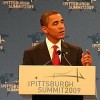
G20: Leaders Agree on Reforms, Poor Still "Out in the Cold"
World leaders at the two-day G20 Summit in the U.S. city of Pittsburgh agreed to work cooperatively to recover from the global economic crisis and create structural reforms with long-term growth as the goal.IRAN: New Nuke Charges Raise Stakes in Upcoming Talks
Charges by U.S. President Barack Obama and the leaders of France and Britain Friday that Iran is building a secret underground plant to enrich uranium appear certain to heighten tensions just days before critical talks between Tehran and its three accusers, as well as Germany, China and Russia.
G20: Rising Above the G8
Something that was perhaps only half-expected has happened in Pittsburgh: the G20 has moved on from being an event to becoming an institution.G20: Europeans Resist More Clout for South in IMF
An initiative to reform the International Monetary Fund (IMF) voting structure is causing tension at the G20 here as European delegations resist a U.S.-spearheaded effort to give greater clout to emerging economies, primarily because it would decrease European voting power.G20: IMF Finds a New Unpopularity
When some Eastern European states faced economic collapse as the financial crisis took hold, the International Monetary Fund (IMF) stepped in and offered governments huge loans.POLITICS: Obama's Deal-Making Skills Tested at U.N., G20
U.S. President Barack Obama will make his way Thursday from the U.N. General Assembly in New York to "Steel City" – Pittsburgh, Pennsylvania - to host the G20 Summit in what has been billed as a week that will put his ability to lead in the international arena to its fullest test.G20: An Emerging Development
Almost before anyone knew it, a new language has become current leading up to the two-day G20 meet in Pittsburgh that divides the world in ways that seem suitable at the high table of the day. The new tiers are the developed, the emerging, and of course the poor.
ECONOMY: "Put Africa on the G20 Agenda in Pittsburgh"
With South Africa being the only African country with a seat on the Group of 20 (G20), while serving as co-chair of the working group on reforming the International Monetary Fund, it has "a moral obligation towards the continent to call for more responsible management of the global financial system".G20: Stiglitz and Sen Come In Too Late
A new report on Measurement of Economic Performance and Social Progress presented earlier this month in Paris by Nobel prize winners Joseph Stiglitz and Amartya Sen is a late, and quite modest contribution to an old debate, many experts say.
POLITICS-US: Activists, Big Business Converge on G20 Meet
As media and government delegates prepare for the G20 Summit to be held Sep. 24-25 in Pittsburgh, local business and activist groups are promoting clashing visions of days to come.
G20: Cementing a Southern Alliance
Major developing countries are again preparing to stand together on critical issues at the G20 heads of government meeting in Pittsburgh Sep 24-25.FINANCE: World Bank, NGOs Exhort G20 Not to Forget the Poorest
The World Bank and major non-governmental organisations (NGOs) are calling on leaders who will gather for next week's Group of 20 (G20) Summit in Pittsburgh not to forget the needs of the world's poorest countries, which have been severely affected by the last year's financial crisis.
Q&A: "Political Elites Ensure Continuing Flight of Dirty Money"
Illegal capital flight in the form of corrupt, criminal and illicit commercial proceeds out of developing economies could be as high as one trillion dollars a year.« Previous Page — Next Page »





The Week with IPS

NEXT STOP - SDGs
Tracking global progress towards a sustainable world
Tracking global progress towards a sustainable world
