Languages
Wednesday, October 21, 2026



News and Views from the Global South
Iraq
IRAQ: It Could be More Than Three Years to US Departure
Washington and Baghdad signed a security agreement earlier this month allowing the U.S. to maintain a military presence in Iraq for another three years. But while Baghdad officials hailed the pact as the "beginning of the end" of the U.S.-led occupation, Egyptian commentators - like much of the Iraqi opposition - say the agreement simply reflects U.S. strategic interests.MEDIA: Deaths Down, But Iraq Still Top Danger Zone
The improved security in Iraq has had benefits for everyone there. This has included fewer Iraqi civilian deaths, U.S. casualties, and, says a new report, journalists.POLITICS: U.S. Military Defiant on Key Terms of Iraqi Pact
U.S. military leaders and Pentagon officials have made it clear through public statements and deliberately leaked stories in recent weeks that they plan to violate a central provision of the U.S.-Iraq withdrawal agreement requiring the complete withdrawal of all U.S. combat troops from Iraqi cities by mid-2009 by reclassifying combat troops as support troops.BOOKS-US: When Neocons Ruled Washington
In the first two pages of his book on the neoconservative movement, historian Stephen Sniegoski tells us that U.S. Mideast policy during the George W. Bush presidency has been "colossally erroneous" and "disastrous to U.S. interests", that the Iraq War is a "blunder of colossal proportions", and that an attack on Iran is a "highly likely" "disaster" unless the country "eschews all elements of the Middle East war policy".SPECIAL SERIES: Iran's Regional Power Rooted in Shi'a Ties
As Barack Obama's national security team assesses the challenge of Iran's role in the Middle East, it confronts a paradox: Iran is seen as having ambitions of regional hegemony, but it lacks the military power normally associated with such a role.SPECIAL SERIES: Is a U.S.-Iran Deal on the Middle East Possible?
Would a negotiated agreement between Iran and the Barack Obama administration be feasible if Obama sent the right signals? The answer one gets from Iranian officials and think tank analysts is, "Yes, but..."IRAQ: Looking After Pockets, Not Patients
A nurse at Baquba General Hospital asked Ahmed Ali, who co-authored this report, for a bribe to look after his sick baby. It was hardly an exceptional demand. Patients around Iraq have begun commonly to speak of the need to bribe medical staff to get some form of care.RIGHTS: Politics Still Reign Over Principles at U.N.
The United Nations Wednesday commemorated the 60th anniversary of the landmark Universal Declaration of Human Rights (UDHR) against the backdrop of widespread political repression - most notably in Zimbabwe, Sudan, Burma (Myanmar), Iraq, Afghanistan and in the Israeli-occupied territories of West Bank and Gaza.US-IRAQ: Immunity Recedes for Private Contractors
The virtually total impunity from prosecution accorded to private contractors in Iraq may be coming to an end.RIGHTS-EUROPE: Scandal over CIA “Renditions” Flights Revived
Portuguese European Parliament member Ana Gomes will ask the EU legislative body to restart the debate on stopovers in EU territory by secret CIA flights carrying prisoners captured in Afghanistan.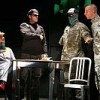
THEATRE-US: Undead GIs Pay a Visit to Bush
It might seem odd at first to compare them, but "Beast", a brutal, surreal black comedy about the Iraq war, has something in common with "The Files", a stunning, sardonic docudrama about the repression of cultural freedom by the Polish communist secret police.BOOKS-US: Cloak-and-Dagger, Inc.
When Barack Obama visits the Virginia headquarters of the Central Intelligence Agency in the not-too-distant future, he might want to scan the room to see how many of them sport green badges, the telltale sign that they are contractors and not federal employees.RIGHTS: Ret. Officers Urge Obama to Expunge “Stain of Torture”
As a group of retired military leaders prepared to urge U.S. President-elect Barack Obama to quickly put an end to the harsh interrogation practices inflicted on security prisoners, a new United Nations report charged that Iraqi authorities were committing "grave human rights violations" in their treatment of thousands of detainees.U.S.: Diplomacy, Multilateralism Stressed by Obama Team
Introducing the top figures in his national security team in Chicago Monday, U.S. President-elect Barack Obama promised a "new dawn of American leadership" that will be marked by much greater emphasis on diplomacy and multilateralism than was accorded by the incumbent, George W. Bush.POLITICS-US: JFK Episode Suggests Obama’s Iraq Plan at Risk
The decision by President-elect Barack Obama to keep Robert M. Gates on as defence secretary has touched off a debate over whether Obama can pursue his commitment to rapid withdrawal from Iraq even though Gates has defended George W. Bush's surge policy and opposed Obama's 16-month timetable for withdrawal.US-IRAQ: Kurds Anxious Over Security Pact
Kurds are divided over a security pact between Iraq and the U.S., approved by a large majority in the Iraqi Parliament Thursday, in what appears to be a potential heavy blow to their major gains since the U.S.-led invasion of the country in 2003.POLITICS: Pact Will End Iraqi Dependence on U.S. Military
The text of the U.S.-Iraq Status of Forces Agreement (SOFA) signed by U.S. Ambassador Ryan Crocker and Iraqi Foreign Minister Hoshyar Zebari Monday closes the door to a further U.S. military presence beyond 2011 even more tightly than the previous draft and locks in a swift end to Iraqi dependence on the U.S. military that appears to be irreversible.POLITICS-US: Vets See Hope for a Broken System
Thirty-three-year-old Walter Williams was among the thousands of revelers who flooded into the streets of Oakland on Nov. 4 to celebrate Barack Obama's election as the 44th president of the United States.POLITICS: U.S. Task Force Found Few Iranian Arms in Iraq
Last April, top George W. Bush administration officials, desperate to exploit any possible crack in the close relationship between the Nouri al-Maliki government and Iran, launched a new round of charges that Iran had stepped up covert arms assistance to Shi'a militias.
RIGHTS: Women Leaders Reject "State of Living Death"
United in their fight against discrimination and inequality, three women from crisis-struck countries received the 2008 Gruber International Women's Rights Prize - Yanar Mohammed from Iraq, Sapana Pradhan Malla from Nepal, and Nadera Shalhoub-Kervorkian, a Palestinian woman living in the state of Israel.POLITICS-US: Obama Pressured to Back Off Iraq Withdrawal
The promotion of Robert M. Gates as President-elect Barack Obama's secretary of defence appears to be the key element in a broad campaign by military officials and their supporters in the political elite and the news media to pressure Obama into dropping his plan to withdraw U.S. troops from Iraq in as little as 16 months.« Previous Page — Next Page »





The Week with IPS

NEXT STOP - SDGs
Tracking global progress towards a sustainable world
Tracking global progress towards a sustainable world
