
Sunday, October 18, 2026



News and Views from the Global South

Chilean Astronaut Awaits His Turn: María Cecilia Espinosa
- Klaus Von Storch's space mission has been postponed since 2003, but the Chilean astronaut is confident that he'll soon be following the same path as his Brazilian colleague Marcos Pontes, who will be heading to outer space at the end of the month.
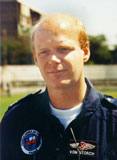
Klaus Von Storch -
Von Storch, Chile's first astronaut, continues preparing for a space mission that has been repeatedly put off since 2003. Promoted by the local corporation AstoChile, in partnership with the Russian Space Agency, the mission is to conduct environmental and medical experiments in space orbit over a period of 10 days.
An aerospace engineer and former member of the Chilean air force, Von Storch does not yet have a launch date, and he confesses that he won't truly feel like an astronaut until he flies higher than an altitude of 100 kilometers. But he congratulates fellow Latin American astronaut Marcos Pontes, of Brazil, who will reach outer space before him.
Tierramérica spoke with Von Storch by phone at his AstroChile offices in Santiago. Excerpts:
Tierramérica: What personal and professional traits made you the candidate for the AstroChile mission? Von Storch: The space agencies want the person who goes to outer space to be able to work in near zero gravity with all five senses clear. And I have been flying in acrobatic airplanes since I was 16. Furthermore, I train (periodically in Russia) with the crew that will be making the flight.
– What experiments will be conducted during the mission? – We are considering three main experiments, including a laser system to measure pollution, a study of genetic changes in plants, and a helmet for testing balance. We will also incorporate some medical tests that the Russians have requested to evaluate muscular and cardiac function.
– During Russian President Vladimir Putin's visit to Chile in 2004, a space agreement was signed with Russia. Was it just words? – On the contrary, it was fundamental (to the mission). The broad agreement signed made us partners in an international space collaboration, involving areas like astrophysics and planet research, environmental monitoring, biotechnology and space medicine, and manned space travel. We are working in the framework of the International Space Station (ISS).
– You were scheduled to travel to outer space in April 2003, then later in 2005. What happened? – We were affected by the crash of the Columbia space shuttle in 2003, because the crew that had to go to the ISS had to do so on the Russian ship in which we were to travel, so they had to change the dates of the flights. The window for space travel is open in March and April or October and November, because every six months the ship that will replace the old one at the ISS goes up. I hope the director of AstroChile, José Luis Cárdenas, who will travel to Russia this month, can negotiate the date of my mission.
– How much is Chile spending on this project? – Chile as a country does not contribute funding for this. The mission is financed with money from companies interested in developing science and technology, and organized by AstroChile, a non-profit organization. A confidentiality agreement, mainly with the Russian part, prevents me from specifying amounts. The discount applied to the mission implies that the price goes down according to the value of the experiments, which will have a global impact, reducing its real costs. A touristic trip (to outer space) might cost 20 million dollars, but it isn't comparable to a mission based on international cooperation.
– On March 31, the lieutenant colonel in the Brazilian air force Marcos Pontes will leave for space. Do you feel that the Chilean mission was postponed because of Brazil's mission? – Not at all. Brazil made a great effort to send Marcos Pontes to space, and he has been involved a couple more years than I have. He trained with the National Aeronautics and Space Administration (NASA) in the United States until last year, and since they saw the contiuing problems of the shuttles recently, they decided to shift it to the Russian ship. When President Putin went to Brazil, after his visit to Chile, President Luiz Inácio Lula da Silva himslef insisted on the inclusion of Marcos Pontes in the mission.
 Print
|
Print
|




