Friday, August 28, 2026



News and Views from the Global South
DEVELOPMENT-CUBA: Castro Wants to Know How His People Are Doing
Dalia Acosta
- The Fidel Castro government has ordered a survey that could serve as a diagnosis of Cuban society today, that is, if the interviewees feel they can respond openly to the pollsters’ questions.
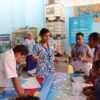
More than 6,000 students and professors have joined the University Social Work Brigades, which drew up a 36-question survey intended “to find out the opinions of Cuban families.”
Every household in Havana, home to 2.2 million people, is to receive a visit from a survey-taker.
“We must work with the citizens as if they were an atom of the whole, to determine the problems of each one,” Castro told the Brigades. “Your primary mission is to reach out to the people and help them,” he added.
This is the first time that such a complete study of Cuban living standards has been organised. The poll entails questions about the impacts of the island’s decade-long economic crisis and the public’s opinions about government policies.
The questionnaire, a copy of which was made available to IPS, states that it is a “visit of exchange with each household” to discuss several matters, but particularly those related to education and health services.
In addition to the main questionnaire, there is one that applies to families with minors, intended to ascertain the living conditions and family dynamic, as well as the status of the children’s schooling and health.
In all cases, the survey-takers take note of the address visited, the number of family members living together and, “by observation,” are to designate whether the individuals are white, black or mestizo (mixed race).
The survey questions refer to quality of education, the factors that influence the vocational interests – or lack thereof – among young adults, and each family’s access to public health services, including clinics, hospitals and pharmacies.
The poll also seeks opinions about personal safety and crime, the performance of local government and grassroots organisations, and the social services provided for the elderly.
“Does this household watch much television?” is one of the many questions intended to establish the population’s cultural and recreational preferences and their opinions on the state-run radio and television broadcasts.
In an unprecedented move, the survey includes questions about programmes Castro has promoted as part of an official campaign to make culture available “to the masses.”
The initiative includes courses by television on various subjects as part of a project known as “University for All”, accelerated training for art teachers and instructors, and mass education in computer technologies.
In determining public opinion about the round table discussions that the government broadcasts on national TV, and which often include the participation of Castro himself, the questionnaire assumes that the interviewee “surely has seen or heard the programme a few times.”
The pollsters, however, have the freedom to guide the conversation as they see fit and to directly ask the family or individual being interviewed whether or not they watch the round table discussions. They may even prompt the interviewees to be more critical than complacent in their responses.
“Already we have seen just about everything. Some people are very closed in their responses, and answer every question with ‘I don’t know, I don’t know,’ while others are obviously saying what they really think,” one of the students serving on the survey brigades told IPS.
The poll-takers are becoming aware of “the dissatisfaction with public health services, the poor quality of education compared with just a decade ago, the fact that young people prefer to earn money fast instead of studying, and that there are some corrupt police,” said the student.
The survey complements another more limited effort conducted two years ago by university students, the results of which proved alarming to the authorities, according to sources close to the government.
Among other details about living conditions in general, such as housing and access to basic services, the poll at that time found that income did not cover expenses in more than 77 percent of the households visited.
Cuba has yet to recover from the economic crisis of the 1990s, when the gross domestic product plummeted 34.8 percent in just three years, largely the effect of the disappearance of the Soviet Union and the European socialist bloc, which had been the island’s major export markets and sources of financing.
Experts predict it could take as long as 15 more years before the island recovers the standard of living prior to the depression.
With the present survey, the government intends to obtain the most precise diagnosis possible of the impact of the economic crisis on sectors like education and health, the areas in which the Castro-led government made greatest strides since taking power in 1959.
In addition to presenting the questionnaire, the members of the survey brigades provide each household with pamphlets titled “Take Care of Your Health” and “Educate Your Child”, which contain practical advice on nutrition, hygiene, and disease prevention, and information on the impacts of smoking and alcoholism.
Medical professionals throughout the island, meanwhile, have launched a study of children’s height and weight to evaluate levels of malnutrition among that population. The preliminary numbers from that process have already given cause for concern.
“The children who are eight or nine today were born during the worst moments of the crisis. The nutritional deficit affected them directly, as well as their mothers during pregnancy,” a doctor, 39, who requested her name withheld, told IPS.
 Print
|
Print
|