
Monday, September 21, 2026



News and Views from the Global South
HEALTH-SOUTH AFRICA: Like Apartheid ‘We Must Defeat TB’
Moyiga Nduru
- ”To get their freedom, South Africans fought apartheid without backing off. So let’s use the same method to defeat TB,” says a short video clip prepared for the country’s anti-TB campaign.
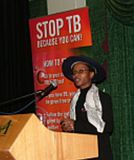
Lindiwe Mvusi, director of the TB Control Programme. (Photo: Moyiga Nduru) Credit: Inter Press Service
Last year 250,000 people were diagnosed with tuberculosis (TB) in South Africa, said Dr. Lindiwe Mvusi, director of the TB Control Programme, following a question posed by IPS, before the signing of an agreement to support the coalition, in Johannesburg at the weekend.
Mvusi said: ”Of late we have seen an increase in the infection rate due to HIV. This is because some patients are defaulting from treatment.”
”Some default due to poverty. They have nothing to eat or the tablets make them hungry. So when they don’t have food they don’t take treatment,” Mvusi explained. ”Some don’t disclose their status for fear that they would be dismissed from work. They are the breadwinners. So we feel that the private sector should assist us in resolving this problem.”
The CAT, backed by government, is made up of businesses, civil societies, non-governmental organisations and churches – almost the same kind of coalition forged at the height of apartheid that led to the latter’s demise in 1994.
To the delight of the campaigners, anti-apartheid icon, Nelson Mandela, who was himself diagnosed with TB while in prison for opposing apartheid, has already thrown his weight behind the campaign.
”We cannot win the battle against AIDS if we do not also fight TB. TB is too often a death sentence for people with AIDS,” Mandela told a news conference at the just ended 15th International AIDS Conference in the Thai capital Bangkok.
The global conference was held between Jul 11 to 16.
Said Mandela: ”We have known how to cure TB for more than 50 years. What we have lacked is the will and the resources to quickly diagnose people with TB and get them the treatment they need.”
Mandela thanked the Bill and Melinda Gates Foundation for supporting the Global Fund to Fight AIDS, TB and Malaria by donating 50 million dollars.
”However, it is going to take much more than the resources of the Gates Foundation to achieve the scale required to fund the fight against AIDS, TB and Malaria. We need to build the public private partnership that is the vision of the Global Fund,” added the former South African president.
According to Manto Tshabalala-Msimang, South Africa’s minister of health, the private sector and civil society are two very critical partners that can assist the government to manage and reduce the spread of TB in the country.
She lamented that South Africa does not have TB programmes in the workplace, something that, she said, the coalition is seeking to address.
Thsabalala-Msimang added: ”We have not brought TB infection rates down significantly, nor have we increased treatment successes.”
”South Africans infected with TB continue to default from treatment, or never seek diagnosis in the first place. This increases the pool of the TB bacillus in the country and adversely affects our efforts to minimise the existence of multi-drug resistant tuberculosis,” she pointed out to IPS.
She blames the failure to treat TB on stigma and ignorance.
”For example, if I am diagnosed with TB and show that I must take TB treatment, frequently those around me will assume that I must be HIV positive or that I live in poverty,” she explained.
”So as a patient, it won’t be easy for me to take my treatment every day, and as soon as I feel better – which I do almost immediately after beginning treatment – I’ll stop taking it,” Tshabalala-Msimang said.
Each year, nearly two million people, the majority of them in sub-Saharan Africa, die of TB, despite the availability of inexpensive treatments that are effective up to 95 percent of causes, according to the U.N. World Health Organisation (WHO).
More than 1.5 million TB cases occur in Sub-Saharan Africa each year. This number is rising rapidly, largely due to high prevalence of HIV, says the U.N. health agency.
In South Africa, TB is set to increase by 10 percent in 2010 due the HIV/AIDS pandemic, health officials say.
Poverty, a lack of basic health services, poor nutrition, and inadequate living conditions all contribute to the spread of TB.
In turn, illness and death from TB reinforces and deepens poverty in many communities, says The Stop TB Partnership – an international network involved in the fight against the disease.
The network says the average TB patient loses three to four months of work time as a result of TB. Lost earnings can total up to 30 percent of annual household income. Some families lose 100 percent of their income, it adds.
Partnerships with businesses are also taking shape within the Southern African Development Community (SADC).
In Namibia, for example, the Namibia Business Coalition on AIDS, formed in 2002 to raise resources and skills to address the pandemic both at the workplace and in the community, is actively involved in the fight against TB and HIV/AIDS.
The coalition is active in the Caprivi Strip, which borders three of the world’s worst affected countries – Zambia, Zimbabwe and Botswana.
The HIV-prevalence rate among pregnant women in the Caprivi region stands at 43 percent, much higher than that of the entire Namibia’s 22.5 percent, according to a 2002 ministry of health and social services report.
Private companies in Zambia have also formed the Zambia Business Coalition on TB and HIV/AIDS. Its goals include advocating business action on TB and HIV/AIDS, helping alleviate the impact of the disease on company employees, and strengthening and supporting responses aimed at prevention and control of HIV infection.
The coalition, under the patron of former President Kenneth Kaunda, now an active campaigner against AIDS, involves over 40 companies.
 Print
|
Print
|




