Wednesday, October 21, 2026



News and Views from the Global South
DEVELOPMENT-SOUTHERN AFRICA: Cassava – the New Flavour of the Month?
James Hall
- Cassava, a traditional West African crop, looks set to take root in Southern Africa.
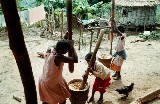
Girls prepare cassava for cooking in Malawi. Will the region follow suit? (Photo: Naashon Zalk) Credit: PictureNET Africa
“Cassava is the second most important food in Africa; in terms of total calories consumed, it is second in African people’s diets only to maize. But still there are nations where it is hardly known, despite its many benefits and good taste,” says a Swazi agricultural field officer, Nimrod Thwala.
The Institute of Tropical Agriculture is assisting NEPAD with the initiative.
“Cassava is the cheapest source of calories of all staple foods in Africa. This is because it is easy to grow, and is considered an exceptionally ‘robust crop,’ because it survives on limited water, marginal soil and challenging weather conditions that would wipe out other crops,” notes Thwala.
At present, Swaziland’s staple food is maize, much of it grown on the communal land that 80 percent of the population lives on.
Like most Southern African populations, Swazis were at first itinerate hunters and cattle breeders who moved their herds in search of new grazing. Maize was introduced by the Portuguese in the early nineteenth century: they brought the crop from their South American colonies in the hope that it would flourish in Africa.
It did – so much so that Swazis were transformed into a nation of farmers.
But like other countries in the region, Swaziland has suffered from drought in recent years. The United Nations World Food Programme, which is supplying food aid to a quarter of the population, predicts a fourth year of poor rains and diminished yields.
“Now is the time for Southern Africans to take cassava seriously,” says Thwala.
The benefits of cultivating cassava may extend well beyond the simple – if essential – matter of food provision. Poor families which are relieved of having to buy food when their maize crops fail should be able to invest more in health and education.
In addition, surplus cassava can made available for commercial sale – providing a source of income to families that previously had none. With less demand for supplies of maize meal, potatoes and other vegetables, the prices of these foods are expected to drop. Once again, this is to the advantage of poor communities.
“A friend from Ghana gave me some cassava to plant in the garden. They grew like weeds and needed very little attention, so it’s like free manna from heaven,” said Eva Kunene, a housewife in the Swazi town of Manzini.
An official in Swaziland’s agriculture ministry says cassava also has industrial applications.
“We see cassava as having the potential that sugar has in our country. Sugar is cultivated and sold in bulk, unrefined form at a price dictated by international commodity prices,” the official said.
“But we also have sugar processing plants that produce molasses, and candy companies like Cadbury’s that make chewing gum and sweets. These are ‘added value’ products that bring in greater returns for the economy, and foreign exchange,” the official added.
Cassava is currently found in certain confectionary, but is primarily used as a raw material in glue and starch. The plant can also be processed to produce ethanol, a fuel that may become more cost effective if the price of oil continues to climb.
The United States-based W.K. Kellogg Foundation is sponsoring the Pan African Cassava Initiative, which has already been the subject of consultations in Central, West, East and Southern Africa.
Various countries have embarked on feasibility studies to see how cassava can best be used by their people. Mozambique and Malawi have already completed their research, while Nigeria, Tanzania and Uganda are in the process of producing their studies. Zambia is expected to follow suit soon.
NEPAD will then focus on helping to provide the technical expertise needed to get the project off the ground. Funds from the Kellogg Foundation and other donor partners will be administered by the board of the cassava initiative, which includes representatives from Sierra Leone, Mozambique, Nigeria, Zimbabwe and South Africa.
Richard Mkandawire, NEPAD’s Agricultural Advisor, also sits on the board, along with a representative of the International Institute of Tropical Agriculture.
The success of the initiative in Southern Africa will hinge on whether people come to appreciate the potato-like texture and starchy taste of cassava.
Eva Kunene never ate cassava before she was an adult, and she admits it is an acquired taste. But now, she’s willing to buy the crop in the event that her own plants don’t flourish – a hopeful sign of consumer acceptance for a food with many uses in Africa.
NEPAD, a development initiative spearheaded by South African President Thabo Mbeki and other leaders, aims to attract more donor funding and investment to Africa – this in return for improving standards of governance on the continent.
 Print
|
Print
|