
Monday, October 12, 2026



News and Views from the Global South
ENVIRONMENT-KENYA: Will Good Fences Make for Good Neighbours?
Wanjohi Kabukuru* - IPS/IFEJ
- To fence, or not to fence: this debate has been underway for a decade as concerns Kenya’s oldest national park, located just 20 minutes from the centre of the capital – Nairobi. With urban development edging closer to the park, however, a decision one way or the other has become a matter of urgency.
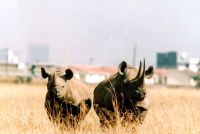
Development never far away: black rhino in the NNP, against the Nairobi skyline. Credit: Wanjohi Kabukuru
“A corridor links two conservation areas, while a dispersal area – simply put – provides room for wildlife spread. The Athi-Kapiti Plains are both a corridor and a wildlife dispersal area. But they…may eventually cease to be a dispersal area owing to the rapid growth of human settlements in the area,” says Paul Omondi, a social scientist at Moi University in Eldoret, north-west of Nairobi.
So, is fencing in the south the best way to maintain harmony between the NNP’s animals and communities such as Ongata Rongai and Athi River, which have swollen with people seeking work in quarries, flower farms and export processing zones?
For a group led by the influential East African Wildlife Society (EAWLS), an independent body, the answer is yes.
“Incidences of human wildlife conflict have become a common occurrence today in the area as human settlements and the new land use forms incompatible with wildlife replace and encroach into areas initially used by wildlife,” states a 2003 survey commissioned by EAWLS, and titled ‘To Determine the Availability of Land for Wildlife Migration in the Areas Bordering Nairobi National Park’.
According to Simon Makallah, one of the three authors of the study, much of the Kitengela corridor and Athi-Kapiti area is now virtually blocked to wildlife migration and dispersal.
Notes Omondi, who has studied the Kitengela conservation area closely for almost two decades: “If we had conservation-appropriate development in the south, perhaps we wouldn’t have to fence. (Since) no realistic action is taken, it should be fenced off to reduce unnecessary conflicts.”
Those against fencing in the NNP have coalesced around the country’s principal conservation agency, the Kenya Wildlife Service (KWS). Its director, Julius Kipng’etich, has hinted that KWS would like the land adjacent to the park in the south to be taken over by government.
Reclaiming this area would require roughly 2.8 billion dollars in the soaring real estate market that is currently being experienced, according to conservative estimates. The whole of the Athi-Kapiti Plains and some peripheral portions of the Kitengela area are now divided into privately owned plots.
An existing effort to cope without fences, the Kitengela Lease Programme, is yielding mixed results.
Launched in April 2000 by the Friends of NNP (a non-governmental organisation) and the Wildlife Trust – a U.S.-based conservation fund – the initiative targets landowners in a bid to safeguard the Kitengela migratory corridor and the Athi-Kapiti Plains.
Almost 120 owners have been persuaded not to develop their property in exchange for cash incentives. Protection has been bought at the rate of about four dollars per half-hectare for some 3,480 hectares, which is roughly four percent of the corridor.
However, the majority of Kitengela’s estimated 42,305 land owners have opted to take advantage of the real estate boom and sell their land.
Renowned conservationist Daphne Sheldrick believes that if the lease programme collapses, the NNP “will have to be fenced on its fourth boundary before all is lost, and what can naturally live within such constraints will – and what can’t, won’t.”
She cites the world famous Ngorongoro crater in Tanzania as an example of how wildlife can thrive in an enclosed space, the crater having a diameter of just 25 kilometres at its widest point: “Migrant species such as wildebeest, zebra and gazelles simply satisfy their urge to trek by going round and round the crater in an endless merry-go-round, grazing down the pastures in one section and then moving on to the next.”
About the NNP, she adds: “As long as all its indigenous components are represented, it will remain a priceless jewel for the country if humans have the wisdom to let nature work its wonders, and dictate what can and cannot live there naturally through a hands-off policy.”
(* This story is part of a series of features on sustainable development by IPS and IFEJ – International Federation of Environmental Journalists.)
 Print
|
Print
|




