
Wednesday, September 23, 2026



News and Views from the Global South
IRAQ: A Nail in Maliki Government's Coffin?
Ali al-Fadhily*
- The recent resignations of Iraq's Army Chief of Staff and several of his council military leaders underscore a continuing decomposition of Iraq's U.S.-backed government.
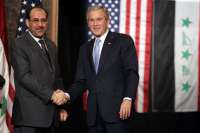
Al-Maliki and Bush at a Nov. 2006 press briefing in Amman, Jordan. Credit: White House/Paul Morse
Security, basic services, and all measurable levels of Iraq's infrastructure are worse now than under the rule of Saddam Hussein. Nevertheless, the U.S., Britain and Iran all continue to support this government.
"Politicians in this country are the best at serving their personal interests, and that is what has kept al-Maliki in power," Amjad Hussein, an Iraqi journalist in Baghdad told IPS. "Wherever I go in Iraq, people complain of the very bad living conditions caused by the wrong policies of this government. Even those who voted for the (Shia) Iraqi coalition bite their fingers in regret for the support they gave to this group of people who have led the country into darkness."
Withdrawals from the government by individual ministers and by political groups was the first sign of the end of al-Maliki's political life, but the U.S. government has remained insistent on keeping al-Maliki at the top of Iraq's leadership.
"I strongly believe that it was American pressure on the (Sunni) al-Tawafuq Sunni group that stopped them from withdrawal from the government," a senior member of al-Tawafuq told IPS on condition of anonymity. "I preferred to clear my conscience and so I have decided to end my political activities. I am looking for a way to take my family across the border for their safety. It is a sin to be a politician in Iraq nowadays."
On Aug. 1 Iraq's largest Sunni Arab political bloc, the Accordance Front, announced its withdrawal from the splintering government, dealing another huge blow to al-Maliki's hopes of maintaining a unity government.
The Front has 44 of parliament's 275 seats, and its withdrawal from the 14-month-old government is the second such action by a faction. Five ministers loyal to Shia cleric Muqtada al-Sadr quit the government in April to protest al-Maliki's reluctance to announce a timetable for the withdrawal of U.S. forces from Iraq.
One of the biggest blows to al-Maliki has come from the Iraqi army after Major General Babaker Zebari, a Kurd who was army chief of staff, resigned on Jul. 31 to leave for Kurdish controlled northern Iraq. The resignation of Maj. Gen Zebari was followed by the resignation of nine other generals in protest against "al-Maliki's interference with their professional work, and the weakness of the defence minister."
According to some reports al-Maliki rejected Zebari's resignation. The regional president of Iraqi Kurdistan, Massoud Barzani, will address the issue with al-Maliki during an upcoming meeting in Baghdad.
"Only those who have strong ties with Iran will stay with al-Maliki," one of the nine officers told a source close to IPS. "We would rather be assassinated by death squads than be part of this government that insists on being sectarian and Iranian by all measures."
Prime Minister Maliki is secretary general of the al-Dawa Party, and was in exile in Iran after leading insurgent groups against former Iraqi president Saddam Hussein.
Relations between Maliki and U.S. officials have also collapsed. Last weekend the Daily Telegraph in London reported that relations between the top U.S. general in Iraq, General David Petraeus, and al-Maliki are so bad that the Iraqi leader made a direct appeal U.S. President to George Bush for removal of Petraeus.
An Iraqi source said Maliki made the appeal to Bush through a video conference for Petraeus's military strategy of arming Sunni tribal fighters to battle al-Qaeda to be abandoned.
"He told Bush that if Petraeus continues, he would arm Shia militias," the official said. "Bush told Maliki to calm down."
Petraeus's spokesman Col. Steve Boylan denied these reports, but evidence suggests that Maliki has been allowing Shia militias to arm themselves and control vast areas of Iraq for some time now.
A member of al-Maliki's al-Dawa Party, speaking on condition of anonymity, told IPS that al-Maliki's opponent, former prime minister Ibrahim al-Jaafari, is leading a revolt against him and that al-Maliki is no longer the party's favourite.
"This American and Iranian made government in Baghdad was brought to power for known reasons," Sheikh Ali Mansoor, a member of the Sunni anti-occupation group the Association of Muslim Scholars told IPS. "They brought in al-Maliki in order to pass laws that serve American interests, and to guarantee their long-term stay in Iraq. Now he is working for Iran, and Americans are losing Iraq once and for all."
Maliki came to be Prime Minister after political pressure from U.S. Secretary of State Condoleezza Rice and former British foreign secretary Jack Straw forced former al-Jaafari to resign.
"They must change the faces again, but who could the replacement be," Dr. Lukman Salim, a physician from Baghdad told IPS. "Americans and Iranians will definitely employ someone who is worse for Iraqis and better for them."
(*Ali, our correspondent in Baghdad, works in close collaboration with Dahr Jamail, our U.S.-based specialist writer on Iraq who travels extensively in the region)
 Print
|
Print
|




