
Wednesday, October 14, 2026



News and Views from the Global South
ENVIRONMENT-INDIA: Tigers Lose in Park vs People Conflict
Malini Shankar
- Three years after 22 tigers were brazenly hunted down by poachers in the Sariska Tiger Reserve, a protected park in the Aravalli hills of northwestern India, the blame game has not ended.
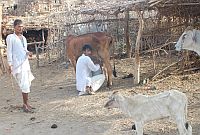
Gujjars, indigenous, semi-nomadic people,graze their cattle in and around reserves Credit: Malini Shankar/IPS
"There is simply too much biotic pressure and anthropogenic conflict emanating from the presence of man inside the reserve," insists R.N. Mehrotra, the chief conservator of forests, Rajasthan state. The dry deciduous forest, 200 kms northwest of New Delhi, is prime tiger country.
However, the villagers who have resisted eviction for nearly three decades, are combative. "Now that the tigers are no longer there, the forest department might as well pack up and leave custody of the forest and its resources to us the traditional forest dwellers," says Ratiram Gujjar, a graduate from Umari village.
His cousin Ratanlal adds: "The forest department cannot protect the wildlife; they are only interested in big perks and pensions. There are a few villages outside the reserve that kill tigers for money. Surely, the forest department knows about these villages. It is best to ask them (foresters), and hold them to account why tigers were lost to poachers".
In Sariska, the forest department has failed to reconcile the needs of communities that live near the protected area with those of forests and wildlife.
One of the oldest reserves of Project Tiger, launched in 1973 to save tigers from extinction in one of the last habitats in the world, there are 24 villages in the core zone, and 246 villages in the buffer zone.
The villages are dirt poor, and lack basic services like water and power supply, schools, hospitals, roads and sewerage. A steep, rock-strewn path is the only road to the nearest town Sawai Madhopur, 80 km away. The road winds through scrub jungle, withering grasslands and bone-dry acacia trees.
Families have tiny land holdings that have been tilled for centuries. But not one household has the papers to prove ownership. Without the document, they cannot negotiate with the forest department for a better deal on its relocation proposal.
"Villagers here regard the tiger, and the park administration, as their common enemy. They live sandwiched between the two, and are bitter about their desperately wretched existence and continued harassment," concludes the Tiger Task Force Report authored by Sunita Narain, director of the New Delhi-based non-governmental organisation (NGO), Centre for Science and Environment.
The Task Force was set up by the government in the wake of the disappearance of tigers from Sariska to suggest measures to improve tiger conservation. The report submitted in August 2005 reiterated that unless local people have a stake in tiger conservation, its protection will be a fantasy.
Sariska’s villagers say the forest department should have made use of their familiarity with the terrain and natural resources.
Ratanlal Gujjar in Umari village says: "We Gujjars are better informed, and better equipped to conserve and manage forest resources but the forest department thinks otherwise. If they appoint us in some capacity, the forest department will benefit from our traditional knowledge."
His cousin, Ratiram, adds: "I am a graduate, yet they have not given me a job in the forest department. By employing us they can use our skills and stamina to conserve the tiger."
Unfortunately, the relationship between the villagers and the forest department has been very strained.
"Every step in the administration of Project Tiger has led to confrontation with the villagers inside and outside the tiger reserves," admits Arvind Kumar Jha, a hapless range forest officer in the Sariska Tiger Reserve.
Kanhaiyan Lal Gujjar is from Hindala village that skirts the Ranthambhore Tiger Reserve, which borders Sariska. A village elder, he says an acute water crisis has village women climbing down a steep 400 metre cliff to reach a source of fresh potable water.
Here women make a trip twice a day to fetch eight containers of water for their families on the top of the hill.
Hindala’s children, both young and old, trek up and down the cliff to reach a government school in the nearest village Chaannh. While the men toil night and day, in the absence of irrigation facilities, to grow what lentils they can, in desertified soil. They optimistically build embankments around their barren agricultural lands with the generous supply of small boulders that are found all around.
The forest department has a litany of complaints. "They lop trees for fodder for cattle everyday and deplete the habitat," says U.B. Nidar, a forest guard. "They know the tracks in the interior, the perennial streams. But instead of using this knowledge for forest conservation, they work as guides for the poachers," he alleges.
The villagers return the charge. "Every time we informed the forest officials of the activities of poachers, the officials turned a blind eye," says Lakshmi Narayan Gujjar of Kankanwadi village inside Sariska. "All the tribals have got a bad name because of the annihilation of tigers by a few criminals."
 Print
|
Print
|




