
Friday, October 16, 2026



News and Views from the Global South
Q&A: 'Listen to the Rural Poor'
Interview with Lennart Båge, Int'l Fund for Agricultural Development
- The world's rural poor are hardest hit by climate change. But their concerns do not draw the focus of public debate, says Lennart Båge, president of the International Fund for Agricultural Development (IFAD) in Rome.
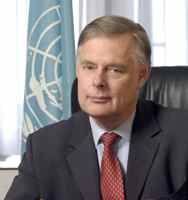
Lennart Båge Credit: IFAD
His hope is apparently well-founded: together with senior representatives of other UN agencies, the IFAD president, who is from Sweden, has been asked by UN Secretary-General Ban Ki-Moon to provide inputs for the inter-governmental discussions on climate change.
Båge spoke to Ramesh Jaura during a visit to Berlin this week. Some excerpts.
Q: Climate change has been in focus at the high-level meeting convened by UN Secretary-General Ban Ki-Moon end of September at the UN headquarters and at a conference organised by U.S. President George Bush. Has the plight of the rural poor been adequately focussed?
Lennart Båge: No.
Q: Plain and simple 'no'. How would you then highlight the concerns of the rural poor?
LB: One has to realise that we have about 3 billion people living in rural areas in developing countries. That's almost half the population of the world. Two-and-a-half billion are involved in farming. One-and-a-half billion are small-holding farmers. More than one billion live on less than one dollar a day. Of the one billion living in absolute poverty, 800 million live in rural areas.
This gives you the magnitude of the challenge of development in reaching the MDGs. That needs much more attention, much more resources and much more investment. But in terms of climate change one has to realise that all these people – most poor, most vulnerable, living in very vulnerable areas to climate change, will suffer the most. They will have the biggest challenge to become more resilient and manage a profound climate change.
Q. Which means the gap between the developing and developed countries will be widened further?
LB: I would hope that the world community would see not only the need to eradicate poverty to reach the Millennium Development Goals but also to invest much more in rural areas – that imperative has been there for a long while. But the fact is that ODA (official development assistance) provided to the agricultural sector has been steadily declining. (Since the late 1980s and throughout the 1990s, it amounted to only 7.5 billion dollars, or 14 percent of total ODA, compared to nearly 15 billion dollars, or 25 percent of ODA ten years before.)
Q. Why such a steep decline?
LB: Well, that's a very good question. For IFAD, we are one hundred percent through our mandate involved in development of agriculture. We also wonder why the world has not seen the plight of a billion people – probably because they are not living in urban areas.
Q: Has IFAD done enough to draw the world community's attention to the rural poor?
LB: Certainly we should have done more to draw attention to the rural poor, we have tried to make the case; we have made a case. But we can see that they have not been seen and heard and invested into.
Q: What now in the face of climate change?
LB: Poor rural people are indeed the most vulnerable to the effects of climate change. They are the least able to adapt and cope. They live on ecologically fragile land – mountains, coastal areas and deserts. They depend on vulnerable sectors like agriculture, fisheries and forestry. They also lack the institutional and financial capacity to protect themselves.
Q: What should be done?
LB: We have to understand that the focus of efforts to help the world poor has until now been all on adaptation, to assist them in adapting to inevitable climate change. But I think one also has to realise that the rural poor can be a partner of the world community in mitigation. They can do tremendous services in managing actual resources, in developing farming and managing forests. We must enable them (the rural poor) to be part of the solution. This is the big challenge.
In view of this I hope that the climate change negotiations will develop the means to compensate farmers for their services by way of managing natural resources, and the way they mitigate climate change.
Q. Compensate – in what way?
LB: Well, you have financial mechanisms that are tried, tested, developed in order to give incentives for mitigating climate change. So the point is to find a mechanism that is sufficient and rewards the efforts they make.
Q: Make the effort for what?
LB: To keep forests, to grow food in a sustainable way.
Q: You have been in office for more than six years now. Is there anything you have learnt through the long intensive years at the helm of IFAD?
LB: First of all it has confirmed my belief that the starting point of every development for eradication of poverty are the poor themselves, poor men and women, poor communities – that is where you have the energies, that's where you have the dedication and the determination to work for a better life. That's also where you get the knowledge for the needs, of solutions to start. What we should do is to assist the poor in their aspirations. One-anda-half billion small holding farmers are an asset for the world. Because they can feed the world. They can be part of a solution with their dedication, with incomes. We need to support them, we need to invest in their priorities.
Q. Is this recognised by international, multilateral institutions?
LB: Maybe in speeches. Very often our system is based on experts from the North. We can contribute. But the starting point has to be the knowledge of the people in the South.
Q: Which means development is a process that takes place on the ground. But are multilateral institutions, experts from the North, really keeping pace with the developments and processes on the ground?
A: We do need to assist – as the word says – and not tell. Listen, understand, to be humble about our own lack of knowledge, to realise that development is not just one-dimensional; it is complex; it is very much anchored in societies rich in culture, rich in heritage. Ours is help where help is needed, with investments, loans, education, financing, by bringing in new tools for unlocking the potential of production through rural finance. There are many tools but they have to be used, they have to be designed, they have to be put together in programmes with the users.
Q: Which means donor coordination?
LB: Donor coordination, yes. But it is not one or the other. The starting point is not donor coordination. The starting point is coordination with the poor people who will benefit. They have to be the starting point. And then we have to coordinate among donors so that there is coherence.
Q: At the level of the European Union, there is very often talk about the need for donor coordiantion, better donor coordination. How does it work within the multilateral institutions? Are you satisfied with that?
LB: Well, coordination can always be better. I think it has improved significantly in recent years – through the Paris Declaration (agreed in March 2005 between 100 government ministers, heads of agencies and other senior officials).
Let me tell you what IFAD is doing. We work with a wide range of partners in the international development community. They include other United Nations agencies, to increase the effectiveness of global development efforts. Our many other partners in countries and communities include governments, non-governmental organisations, community-based organisations and poor rural people themselves.
Q: What message do you expect for the poor from the global climate change conference in December in Bali?
LB: My hope is that there will be a strong message saying we care about the plight of the poor in the rural areas, we see their needs not only for adaptation but also we see them as strong partners for mitigation and that their work, that their potential is recognised.
 Print
|
Print
|




