
Sunday, October 25, 2026



News and Views from the Global South
RIGHTS-BURMA: Media-in-Exile Examine Strengths, Weaknesses
Lynette Lee Corporal
- As Burma’s junta clamps down on citizen journalists in the wake of the brutal repression it unleashed on monks and pro-democracy protestors, the ‘media-in-exile’ are hard put to maintain the information flow on events in their country.
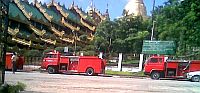
Fire engines outside the now deserted Shwedagon Pagoda in Rangoon - centre of monk-led protests in September Credit: Myint Oo/Mizzima News
Although the government has eased its tight hold on the Internet and opened communication lines once again, the seed of fear has apparently been sown.
"People are too afraid to talk on the phone as the lines are tapped. We can still call some numbers but these are very limited calls. Many people can still use e-mail but they are careful because these too are being monitored," said Aung Naing, chief editor of the Thailand-based Network Media Group, which distributes news to Burmese- language radio programmes of media outfits as Radio Free Burma and the Democratic Voice of Burma.
For Aye Chan Naing, director of the Norway-based Democratic Voice of Burma, the suppression of both the voices of the public and of journalists in Burma has made the double-checking of information all the more difficult. "While we still have regular communication with our reporters on the ground, getting accurate information is getting to be a challenge," he said.
But people are still turning to shortwave radio to listen to broadcasts by the Burmese media abroad.
"The military may be aware of this, but this does not prevent people from listening to the BBC, Democratic Voice of Burma or Radio Free Asia," said Network Media Group editor Moe Zaw. All these stations can be accessed via shortwave radio at certain times of the day. At best, they get more information from sources in the border areas.
The challenge now is for these exiled media organisations to protect their sources and keep them out of harm's way, explained Aung Naing.
What is quite alarming for Aye Chan Naing is that journalists in Burma, particularly the underground network of journalists that ‘smuggle’ information out, are now the next targets of the junta, called the State Peace and Development Council (SPDC).
"We are very worried about their situation within the country. (We have received reports that) some pro-regime journalists are giving authorities information about their colleagues in the media who covered the recent protests (last week of September) in Rangoon," he told IPS.
While there is no solid evidence of pro-government journalists turning against their fellow media members, Aung Naing believes this is quite possible.
"Government control is too strong and they have been known to use journalists working for state-run media to help them hunt down anti-government journalists," said the former student activist who fled to Thailand after the 1988 crackdown on pro-democracy student protesters where more than 3,000 people were killed.
For the India-based editor of ‘Mizzima News’, Soe Myint, recent events have negatively affected the morale of local Burmese journalists whose lives are now being threatened. "The regime has basically made the journalists and activists 'hostage' in its last efforts to hold on to power, using any means to ensure its own survival," he said.
"We always keep in mind the safety of our network of journalists. This is our utmost priority," he told IPS.
He, however, cautions people against letting down their guard in the wake of government's relaxing Internet restrictions, intimating that this could be a ploy to trace those who send information to the outside world via the Internet.
Learning from the lessons of the September protests, Aung Naing sees the need for journalists both in and outside Burma to develop their information technology (IT) skills.
"We've seen how IT played a big role in the recent events, unlike in the 1988 protests," he explained. "We now know that most of the information about the demonstrations that were picked up by the news media worldwide came from tech-savvy teenagers who made full use of the new media during those critical times."
Exiled Burmese media groups will be assessing their situation at the Burmese Media Conference in November, to be held in the northern Thai city of Chiang Mai.
Burma News international, a network of 10 media in exile organisations, is also expected to discuss new reporting strategies in its regular conference.
"We will discuss how we can develop the Burmese media more and how we can make use of new communication technologies to improve reporting from within and outside Burma," said Aung Naing. "We need to be able to learn more IT skills, use software and programmes available to us."
But lest people start to expect too much from exiled journalists, Aye Chan Naing says he does not think that the exiled media alone can bring democracy and freedom back to Burma. These have to come from the people inside Burma, he said.
For Moe Zaw, objective reporting remains the exiled media’s priority. "Most of our news reflect the real situation. The exiled media, because of their different backgrounds, have different 'leanings'. Some journalists, because of their political backgrounds, are more involved in pro-democracy ideas," he said.
Aung Naing agrees, saying that the style of reporting and the choice of stories are different among the exiled media. Some want to be more objective in their reporting while some are more 'involved', he added. But one thing is clear, and that is "most of the exiled media are pushing for change".
''To my knowledge, there is no alliance of exiled media formed to bring down the dictatorship as a united front. We all report on the news and what is happening in Burma, including pro-democracy movements. It is only right that we should let people decide for themselves and not to try to influence them based on what we want to happen," explained Aye Chan Naing.
"Otherwise, we won't be any different from the Burmese government media," he stressed.
 Print
|
Print
|




