
Thursday, October 22, 2026



News and Views from the Global South
ENVIRONMENT-PAKISTAN: Army Factory Effluents Kill Cattle – Won’t Own Up
Zofeen Ebrahim
- The Sindh Environmental Protection Agency (SEPA), known to go about its work with zeal, appears to have run up against a particularly formidable polluter – a fertiliser factory run by the Pakistan army.
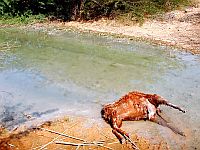
Cattle dead after drinking from effluent contaminated water course Credit: Fahim Siddiqi
So when the local Baloch community claimed that several heads of goats and cows had died after drinking water from the 10 km-long drain, over the last two or three months, the culprit was not hard to find.
SEPA’s investigating team confirmed the charge that the cattle had died of ingesting toxic effluents. “We took samples from three places within a one km range of where the carcasses of the dead animals were found and it is beyond doubt that the ammonia in the water was as high as 560mg/lt as against the permissible 40mg/lt set by the National Environmental Quality standards,” said Jahangeer Asad, a senior SEPA officer, who visited the site on Jan. 24.
SEPA was alerted by newspaper reports of cattle deaths on Jan. 23, and the next day its team went to the area to carry out investigations which included examining carcasses and taking muscle and tissue samples.
Abdul Malik Ghauri, SEPA’s director-general, told IPS that a legal notice would be sent to the polluters and that no one, not even the army, was above the law. “We’re not giving them (army) a clean slate,’’ he said.
But the army has taken a defensive position on the issue. “Someone is politicising the issue. We have evidence that some elements are behind this to create unnecessary ripples before elections,” declared Lt. Col. (retd) Iftikharuddin, a senior executive in the human resources department of the FFBL.
The FFBL’s managers concede that its fertiliser unit is the only one which discharges effluents into the storm water drain, but insists that only non-toxic ones are allowed to flow into it. ‘’We only drain that which is not hazardous and within permissible limits,” insisted Farhan ul Karim, the plant’s general manager.
Spread over 11,000 acres, including a textile city, the PQA has 104 factories but no facility to dispose solid or liquid waste.
Former SEPA employees say it’s difficult to enforce any law or hold the polluters responsible, let alone penalise them. Most industrialists are influential people and wield a lot of political power, they said.
According to community members the phenomenon of animals dying suddenly started in October. “First we’d seen wild dogs dying, around 14-15 must have died in the last four months,” said 64-year old Pir Bakhsh, a former counsellor of village Saleh Mohammad Goth.
Nabi Baksh Qaisrani, another local from Goth Sodho village said since October ‘’over a hundred of our animals died, of which 24 were cows”. With each cow valued at Rs 100,000 (1,633 US dollars), many villagers have lost a major portion of their meagre assets.
The villagers were first wronged when the government decided to build Port Qasim back in the 1970s and forcibly evacuated 27 of their villages. They are still doing the rounds of the courts seeking compensation.
Recently when an attempt was made by PQA to level ancient graveyards, the locals protested and the work was stopped, at least temporarily. “Some of these graves are 400 years old. We can’t let them to do that our ancestors,’’ said Qaisrani.
On Jan. 20, the villagers tried to meet FFBL officials but were shooed away. “We were very hurt and angry. We don’t have the guts to take up a fight against the faujis (army-men). In any case what do we fight with?” asked Qaisrani.
FFBL’s Karim admitted that the villagers had made an attempt to meet them. “Yes, some locals came on Jan. 20 and said their cows died after drinking water from the drain,’’ said Karim. But he added that FFBL would need “stronger evidence” than just the carcasses which he said “seemed to have been deliberately and purposely” plonked about.
“We would also like to know if someone actually saw the animals drinking that water and dying,” added Iftikharuddin. “If we are responsible we’d like to help these people; we’re not against them, but no one can extort money from us,” he said.
Pointing to whitish deposits on the side of the drain, SEPA’s Asad explained: “This and the dead foliage are clear signs of too much ammonia.” In fact, according to Asad, the water could be used as fertiliser for greening gardens, if diluted.
“Even if our report is suspect, take a look at FFBL’s own wastewater analysis that was sent in last week. Even that shows a 100 percent rise in ammonia level of the wastewater discharged into the nala (drain),” said Asad.
According to Karim, the plant is not only ISO-14001 certified but also submitted monthly reports to SEPA. Every 24 hours the water that is released is checked thrice to ensure that the toxins were within permissible limits. “The hazardous waste goes to a huge 350-acre evaporating pond. We only release the less lethal waste into the storm water drain and for that we have permission from the Port Qasim Authority, whose land this is,” said Karim.
An FFBL insider requesting anonymity said that the evaporating pond, into which the management said all the hazardous effluents were discharged, had actually been in a state of disrepair since October.
As for releasing the “less lethal” effluents into the natural drain, Asad pointed out: “No landowning agency can give such a permission to release any biological, chemical or toxic waste anywhere… only SEPA has that authority, and would never grant permission to dump wastewater into a natural drain which eventually flows into the sea.”
Already the mangroves, at the point where the drain empties out into the sea, have been severely degraded due to high concentrations of ammonia and phosphates.
 Print
|




