
Friday, October 23, 2026



News and Views from the Global South
DEVELOPMENT-PAKISTAN: Major MDG Initiative Winds Down
Zofeen Ebrahim
- On Thursday, Mohammad Ibrahim loses his job at the United Nations-partnered National Commission for Human Development (NCHD) as part of ‘downsizing’ that will see 22,404 employees (including literacy coordinators and healthcare programme staff) sacked.
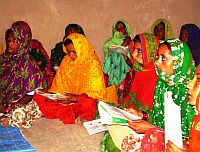
Adult education programmes such as these will be hit by downsizing the NCHD. Credit: Zofeen Ebrahim/IPS
Founded in 2002 by Pakistani President Pervez Musharraf to provide support for government departments in primary education and basic healthcare and meet key Millennium Development Goals (MDGs) set by the United Nations, the NCHD seems to have fallen afoul of the new government of Prime Minister Yousuf Raza Gilani.
With Gilani’s government failing to honour previous commitments worth 98 million US dollars the NCHD is now on its way to dissolution – and its lower level employees to ruination.
Ibrahim’s first reaction was to tell one of his five younger brothers that he would not be able to furnish the Rs12,000 (170 US dollars) needed to pay as fees for the next semester at a polytechnic institute. ‘’He is now looking for a part-time job, but I’m not sure if he will be able to earn much … I myself have been unable to land a decent job," Ibrahim told IPS.
The termination letter said: ‘’NCHD has reduced its programmes due to financial constraints being faced due to non-availability of funds from the federal government… The management has decided that the strength of the employees working in the capacity of LC (literacy coordinator) has to be reduced.’’
Ironically, over the last six years the NCHD had expanded rapidly and now works in 123 of Pakistan’s 133 districts. Besides the federal government, it was funded by the private sector, major international donors like Bill and Melinda Gates Foundation and multinational corporations. Its partners include the UNDP, UNICEF and UNESCO.
Things have come to such a pass that, last month, all of the NCHD’s 87,000 employees were paid half their salaries.
But while further reduction in the number of ordinary workers to 50 percent is in the offing, managers those higher up in the hierarchy are being left untouched.
"By sacking the commission’s pillars, the very workforce that reaches the grassroots, how can they continue running literacy and healthcare programmes?" is the question on the lips of Diba Kausar, Mohammad Bashir Burfat, Wahid Gohar, Amber Sultana and Ashfaque Hussain Mirani. All of them lose their jobs along with Ibrahim.
"The provincial and federal government could absorb us in the literacy department and some parallel programmes. We are already trained and have post-graduate degrees," suggests Sultana.
Gilani’s government has, meanwhile, announced establishing an alternate commission on human development to create jobs for the youth across the country. "Setting up another commission when this one has already created jobs and employment for the youth is beyond me," says an exasperated Gohar. "The government can restructure and reshape the existing commission and perhaps refine its existing programmes.’’
Sultana, a single mother, is worried for her children. "I have had to take them off from tuitions." Spiraling food prices and the increased transport fares are no help. "I don’t know how I will manage to send them to school. And I have still not found another job!"
In Burfat’s home there are 13 hungry mouths to be fed and just two breadwinners. "All my nine siblings are studying. As a first measure, I have stopped their tuitions and am trying to help them myself." He has already borrowed Rs 5,000 (71 dollars) from a friend to pay his sisters’ school fee. "To tell you the truth, I am so apprehensive I cannot devote time to their studies."
Most were stunned by the suddenness of it all. "In May, we received letters to state we were being employed permanently. I actually thought that would be followed by a raise. Instead, we were given termination letters!" says Kausar.
The top management remains unmoved and has conveniently put all the blame on the new government. "If it were up to us we would not have expanded so quickly, but there was so much governmental pressure because it wanted to attain the MDGs, somehow,’’ said Aamir Bilal, spokesperson for Nasim Ashraf, the commission’s chairman.
Earlier this year, news reports linked Ashraf’s name to unauthorised and unaccounted expenditures amounting to over 18 million dollars.
With the chief benefactor, the government, moving away, chances are that foreign donors and the multinationals will follow suit. With Musharraf’s popularity waning, the corporate sector can be expected to toe the new government’s line.
"I think those at the helm should understand what human development means. Before solving the nation’s socio-economic woes, they should first look within the organisation and see how many people, sole bread earners of their families, will be rendered unemployed by this action," says Kausar.
 Print
|



Pictures for this story
This story includes downloadable print-quality images -- Copyright IPS, to be used exclusively with this story.


