
Thursday, October 8, 2026



News and Views from the Global South
SRI LANKA: Protect Tamil Civilians – India
IPS Correspondents
- As the Sri Lankan army stands poised to overrun the last Tamil rebel strongholds, Indian Prime Minister Manmohan Singh has called for steps to protect an estimated 220,000 civilians trapped by the fighting in the northern part of the island.
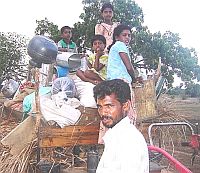
Meagre belongings loaded on a tiller, this Tamil family flees the fighting around Kilinochchi. Credit: IPS Correspondents
A statement released in Colombo, soon afterwards, said Rajapakse told Singh, during the telephonic conversation, that his security forces were ‘’under strict instructions to avoid causing any civilian casualties’’.
India’s foreign minister Pranab Mukherjee has also been invited to visit Colombo for discussions, the statement said. Official sources in New Delhi said on Monday that Mukherjee is likely to travel to the island nation and hold discussions with Rajapakse and foreign minister Rohitha Bogollagama.
Resentment at the Sri Lankan military’s offensive is brewing in India’s southern Tamil Nadu state – home to 55 million Tamils who are ethnically linked to Sri Lankan Tamils – whose Chief Minister M. Karunanidhi has warned that his party men would resign en masse from Indian parliament unless the hostilities cease. A final decision would be taken on Oct. 28.
Observers in Colombo, however, feel that New Delhi’s influence over the country is considerably reduced from the last time that India intervened in Sri Lanka, in 1987, by sending in the Indian Peace Keeping Force (IPKF) as part of a tripartite deal that involved the Liberation Tigers of Tamil Eelam (LTTE) and the governments of the two neighbouring countries.
But the Indian army, which at one point had committed 70,000 troops to the IPKF, had to withdraw from Sri Lanka in 1990 after suffering heavy losses fighting the LTTE and faced with lack of political support from Colombo. "I think their leverage is quite limited from what it was in 1987. India most certainly will not send troops," Paikiasothy Saravanamuttu from the Colombo-based think tank, the Centre for Policy Alternatives, told IPS.
"What New Delhi could do is increase international pressure (on the Rajapakse government) to seek a political settlement, and it has already indicated that it was pushing Colombo for a political settlement,’’ he said.
Saravanamuttu feels that there is very little India can do to stop the offensive against the LTTE. "It can try to cut off existing non-lethal military assistance, but Colombo has already shown that it has other options to obtain military supplies."
Sri Lanka’s defence ministry said that troops operating just south of Kilinochchi have smashed through an important trench line set up by the LTTE. "Troops dominated a three km stretch on the earth bund and captured 19 heavily fortified LTTE bunkers," the ministry said, adding that the LTTE had launched a gas attack on advancing troops.
Kilinochchi, once the showpiece of LTTE domination in Sri Lanka’s north, is reported to have been turned into a ghost town with civilians abandoning it.
Most of the civilians have fled east, towards Mulaithivu, another LTTE stronghold. ‘’The civilians have moved away from the town area, they have moved on to the Paranthan-Mulaithivu road," the government agent for Kilinochchi, Nagalingam Vedanayagam, one of a handful of public officials contactable in the town, over telephone, told IPS.
Desperate civilians are paying between Rs 12,000 (120 US dollars) to Rs 24,000 (240 dollars) to get away to safer areas northeast of Kilinochchi by tractor, according to latest reports from the Inter Agency Standing Committee (IASC), an umbrella organisation of the United Nations and other relief agencies.
While international agencies working in the Vanni area controlled by the LTTE have relocated, following a government directive in mid-September and deteriorating security, food and other supplies have been moving in. So far, 75 trucks with World Food Programme (WFP) supplies have reached the internally displaced persons (IDPs) since the relocation.
Last week, the supplies ran into trouble when a delayed U.N. convoy of 50 trucks was forced to return to government controlled areas when fighting erupted on the route.
"There was heavy fighting on the A9 (the main road) and the convoy had to turn back," U.N. spokesman Gordon Weiss told IPS. The U.N. said that explosions had taken place very close to the convoy, prompting security experts to abandon the trip.
The convoy had left the last government controlled town of Vavuniya on Sep. 16 with 750 metric tonnes of food when explosions near the road close to Puliyankulam, about 10 km north of the crossover point into LTTE-held areas, forced it to turn back.
After the U.N. obtained guarantees from both the LTTE and the government, supplies were resumed on Oct. 17. Earlier, the U.N.’s refusal to join a convoy scheduled on Oct. 10 for lack of security had drawn sharp criticism from the government. "The action of the U.N./WFP to delay the 50 trucks already loaded with the goods until security assessment of its mission is completed is unacceptable," Commissioner General of Essential Services S. B. Divaratne said in a report on the supplies to Vanni handed over to Rajapakse this week.
Divaratne said due to the U.N.’s refusal to move the convoy, the government had to procure 300 metric tonnes of supplies in October. "This action has impeded the uninterrupted supplies to Vanni districts for which WFP should take the responsibility,’’ he said in his report.
But the 20-truck government convoy got bogged down due to monsoon rains. Officials in the Vanni have warned that the onset of the annual monsoon could hamper supplies as well as lead to flooding of areas where the IDPs are now camping.
‘’The roads are in pretty bad shape and it will be difficult for convoys of heavy vehicles to move on them during and after heavy rains," Imalda Sukumar, the government agent for Mulaithivu district with the largest concentration of IDPs (155,000), said.
When the U.N. agencies relocated out of the Vanni, only 2,100 temporary shelters had been erected and now at least 20,000 families are in need of shelter material, according to the government agents for Kilinochchi and Mulaithivu. "The IDPs are facing difficulties after the rains started. There is the risk of flooding in most of the areas they remain now," Vedanayagam said.
According to the IASC, report most of the IDPs had converged on low-lying areas rejected by humanitarian agencies. "Many IDPs have congregated in areas along the A35 which were once paddy land and therefore prone to flooding. Shelter agencies had previously assessed some of this land as potential IDP sites and found them unsuitable," an IASC situation report released on Oct. 13 said.
Vedanayagam also said that low-lying areas were infested with snakes and at least 120 bites had already been reported. "Most of these people are living in paddy lands where there are snakes but we have had problems with carrying out medical services."
 Print
|
Print
|



Pictures for this story
This story includes downloadable print-quality images -- Copyright IPS, to be used exclusively with this story.


