
Sunday, October 11, 2026



News and Views from the Global South
Wanted: Pied Piper for Swazi Village Under Siege
- When good rains finally fell, Catherine Mngomezulu was so hopeful that this year she would reap a bumper harvest. Then the rats appeared.
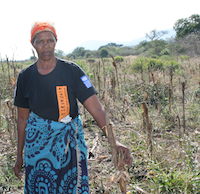
Catherine Mngomezulu's maize has been devastated by rats. Credit: Mantoe Phakathi/IPS
Like many others in Swaziland’s arid Lavumisa region, Mngomezulu and her family have survived on food aid since prolonged drought hit her community in 1992.
When timely rain fell beginning in September 2009, Mngomezulu and her family took to the fields and planted more than two hectares of maize, beans, groundnuts, sweet potatoes and cotton.
The rains help up and crops progressed from tender shoots until they were ready to be harvested in February and March, holding out the promise of ample food for her family of eleven.
But the Mngomezulus harvested barely half a hectare of these crops. Instead of the expected 500 kilos of maize, the family got just 50 kg.
The poverty-stricken communities of Lavumisa are facing an invasion of rats.
“I tried to poison them using weevil tablets and while I was able to kill a few of them, the chickens ate the dead rats and died,” said traditional healer Sarah Sihlongonyane. “I stopped killing the rats and now they do as they please in my home.”
Weevil tablets are used to kill pests in maize that is put in storage facilities. The tablets are highly poisonous and many people in the country have used them to commit suicide.
Catherine Mngomezulu can't quantify the loss in dollars, but she said she had planted enough to sustain her family.
"I don’t even have maize meal because the rats ate all the maize," said Mngomezulu. "They also feasted on the cotton seeds leaving the wool behind."
A painful feature of the rats' appetite: devouring the seeds leaves the unhappy farmers with near weightless cotton fibres, when they take the remnant of the harvest to be weighed for sale.
The family got no return at all from the hectare of cotton they had planted; in a typical year they would have fetched 1,000 elangeni (about 140 dollars), enough to buy groceries for two months.
The many holes in Mngomezulu’s field are evidence that there are indeed many rats in this area.
"I have never seen so many rats - some very big - in my life. I’m seeing rats much bigger than the normal ones and they eat everything that they come across not only in the fields but even at our houses.
"We do have rats in this area but not in these numbers. I’m also fascinated by their appetite," she said.
The rodents spare nothing: not food in the kitchen, nor grass used in the roof, electronic appliances, or clothes. Mngomezulu is even worried about her ill, wheelchair-bound son who sleeps alone in his hut alone, fearing the rats might attack him. She checks on her several times each the night because he is too weak to defend himself.
"The rats are even eating on one another," said Sarah Sihlongonyane, a traditional healer at the area.
She has spent several nights under the light of the moon observing the behaviour of these rodents as they run around on the roof of her hut. She told IPS she's seen three different types; small brown ones, larger grey and white ones, and a big grey variety that is the most familiar in this part of Swaziland.
Sihlongonyane has come to the conclusion that even her indigenous knowledge cannot overcome these rats. Having a cat in the family is one method to chase them away, but Sihlongonyane said even cats are now "tired of these pests and just ignore them."
The national director of agriculture, Dr George Ndlangamandla, said government is willing to assist the people of Lavumisa in getting rid of these rats, but there is no budget in place to deal with these pests.
“We sent officials to inspect the situation and we do appreciate that we have a problem in the affected areas. But I guess the communities should consider clearing their fields because these rodents don’t go to clean areas,” said Ndlangamandla. He advised the community to use traps to kill the rats.
Dr Ndlangamandla is prescribing a cough mixture to a TB patient in this matter, said Philip Mntshali (63), who is cultivating vegetables for commercial purposes along the Mkhondvo River.
“We’ve tried setting up traps but these rats are so many it makes no difference,” said Mntshali. He is now placing poisonous pellets around his garden to kill the rats although he is aware that this poison might kill birds [of prey], which feed on the dead rats.
“There is nothing I can do,” said Mntshali. “Government is not helping us even with technical advice on how to deal with this problem, let alone money.”
Few in the community are aware that free poisonous pellets are available from the nearby Matsanjeni Health Centre. According to Nimrod Dlamini, the environmental health officer at Matsanjeni Health Centre, people who visit the facility and complain about the rats can get pellets for killing rats.
Dlamini said the poison pellets they were handing out are sufficient to kill a rat, he said chickens or raptors would have to eat several rats to be poisoned.
Like Ndlangamandla, Dlamini agreed that there has not been an aggressive campaign to help people cope with the rodent invasion. But the problem could be that government is confused about this outbreak as well.
“I’ve been in this ministry for 30 years and I’ve never seen such,” said Ndlangamandla. “We need to do a study first but unfortunately we don’t have money.”
Professor Ara Monadjem, from the Department of Biology at the University of Swaziland (UNISWA) agreed that there is a need for a study on this outbreak. However, Monadjem said rodent irruptions do occur from time to time and that there is nothing unnatural about it.
“In Africa, these tend to be tied to good rainfall, six or twelve months prior to the irruptions, which results in increasing food supplies for these creatures,” he said.
He said people often, although not always, exaggerate the outbreak of these rodents.
“Unless followed up by properly-organised surveys, such reports should be interpreted with caution,” warned the professor.
But judging from the amount of crops, clothes and other material eaten by the rats at Lavumisa, there is no exaggeration. The many holes in homesteads and fields give a clear picture that there are more rats than usual.
Dr Themba Mahlaba, also from Uniswa, agrees with Monadlem that the good rains could have resulted in abundant food attracting rats to the area.
“Rats also reproduce very fast which is why now they are eating everything because they are competing for food,” said Mahlaba.
He said the country should assess how much farmers have lost so that government and other stakeholders could come up with a strategy to help them.
“We need to put in place a monitoring system for rats so that we are prepared to deal with such outbreaks,” said Mahlaba. He also advised the community against the use of pesticides arguing that they could end up killing others creatures thus destroying the environment.
“The people need to be trained on how to make community traps so that they can kill as many rats as possible,” said Mahlaba.
Meanwhile Mngomezulu and her community are locking valuables in metal trunks and gloomily anticipating another year relying on donor food.
 Print
|
Print
|




