
Thursday, October 15, 2026



News and Views from the Global South
Caribbean Launches New Tool to Deal with Climate Change
- If the studies conducted by the International Code Council (ICC) are true, then by 2025, Caribbean countries will witness a significant increase in Category 4 and 5 hurricanes from the present level of 1.4 annually to four.
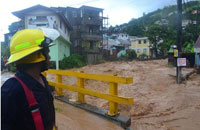
Severe flooding is one of many devastating effects of climate change, as the Caribbean island nation Dominica experienced in 2011. Credit: Desmond Brown/IPS
And if the studies by the ICC – which focuses on safe building designs – are not frightening enough, another recent study conducted by the Mona campus of the University of the West Indies is projecting an increase in rainfall during tropical storms and hurricanes.
Against this background, the Caribbean last Friday launched a seminal online support tool that it hopes will promote climate-smart development by helping to embed a risk management ethic in decision-making processes across the region.
“The timing of this launch is opportune. To begin with, it comes during the 2013 Tropical Atlantic hurricane season, which, according to scientific predictions, will see above-normal hurricane activity,” said St. Lucia’s Sustainable Development Minister Dr. James Fletcher.
Fletcher told IPS that the Caribbean can expect, due to climate change, an increase in the severity of hurricanes and, therefore, an increase in the ability of these weather systems to inflict serious harm on the region.
“Studies point, for example, to the future inundation of a number of sea ports and airports across the region and some estimates point to the cost of climate change claiming as much as 21 percent of gross national product (GDP) in some Caribbean countries by 2100.
“Already, constraints such as geographic location, small size and open and relatively undiversified economies have colluded to render our countries particularly susceptible to external shocks. Only now, climate change has superimposed another layer of risk as a result of sea level rise, elevated temperatures, changes in precipitation and more intense hurricanes,” he added.
The U.S. National Oceanic and Atmospheric Administration and the Scripps Institute of Oceanography said recently that greenhouse gas concentrations in the earth’s atmosphere have crossed the 400 parts per million (ppm) threshold.
For many years, the Alliance of Small Island States (AOSIS) has been calling for greenhouse gas concentrations to be stabilised at well below 350 ppm in order to ensure that their countries are not swallowed by the rising seas.
“Now that our planet has achieved this dubious milestone, the outlook is for more pronounced, and prolonged, climate change,” Fletcher said.
Myrna Bernard of the Guyana-based Caribbean Community (CARICOM) Secretariat, who also spoke at the launch of the new initiative, said that a recent study conducted by the regional governments-owned Caribbean Catastrophe Risk Insurance Facility (CCRIF) indicates that losses caused by weather-related natural catastrophes in the Caribbean account for six percent of GDP and that figure could increase by as much as three percentage points by 2030.
The Belize-based Caribbean Community Climate Change Centre (CCCCC) has developed the Caribbean Climate Online Risk and Adaptation Tool (CCORAL) with funding from the United Kingdom Department for International Development (DFID) and the London-based Climate and Development Knowledge Network (CDKN) that operates in 40 countries trying to respond to the gap “of what we call climate compatible development”.
“We know climate change is a global phenomena, we know the provision of more public goods and knowledge around it is very critical at multiple levels, and I think this is a tool that can play a critical role in this,” said the CDKN’s Sam Bechoseth.
He said the passage of Tropical Storm Chantal through the Lesser Antilles last week “reminded me of some of the threats your region faces”.
“The point is we have to integrate climate change into our development trajectories. It is absolutely non-optional and we need risk assessment tools that can help us in that process.”
He told IPS that both the private and public sectors have long been assessing risks “but we need to look at this in a different way and in a different light in the face of the current and expected future impacts from climate change”.
 Print
|
Print
|




