
Saturday, October 17, 2026



News and Views from the Global South
Opinion
How Asia Can Unlock $800 Billion of Climate Financing

Credit: GMB AKASH / UNDP
Asia-Pacific countries experienced, on average, six natural disasters a year over the past three decades – about twice as many as developing countries of Latin America and the Caribbean and about three times as many as in sub-Saharan Africa.
Governments, central banks, financial supervisors, and multilateral institutions must coordinate and develop a comprehensive strategy to attract more private capital.
- Countries in the Asia-Pacific region face a shortfall of at least $800 billion in climate financing. With public finances depleted by the pandemic, policymakers must unlock the vast potential of private capital to join the fight more effectively against global warming.
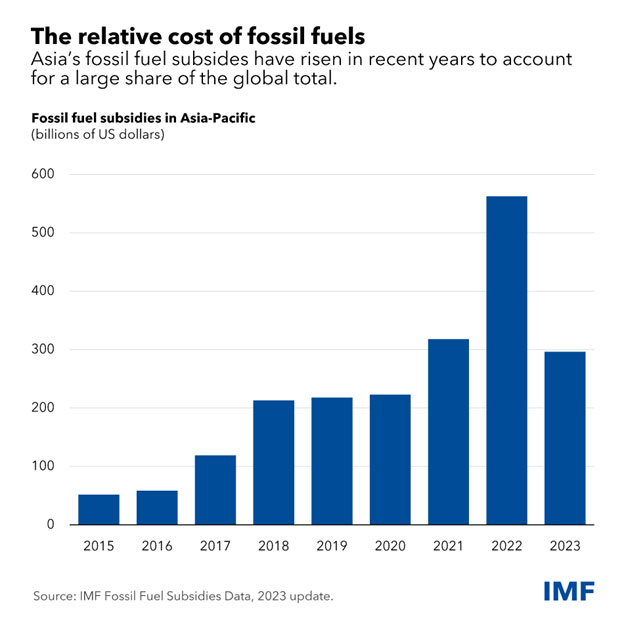
Doing so will demand a coordinated and multi-faceted approach by actors on all sides, from governments and central banks to financial supervisors and multilateral institutions. Important strategies include phasing out fossil-fuel subsidies, which have reached a record $1.3 trillion. It will also be key to expand carbon pricing, bridge critical data gaps, and promote innovative financing along with public-private partnerships.
Here’s an explainer based on our latest research, which draws on recent chapters of the Global Financial Stability Report on scaling up climate finance and other IMF studies on climate issues:
- • Why is climate finance urgent? Progress is too slow. Global temperatures are set to surpass the critical 1.5 degrees Celsius threshold above pre-industrial levels. Efforts to halve 2019 levels of greenhouse gas emissions by 2030 fall alarmingly short, targeting only an 11 percent reduction. Without stronger action, our warming planet imperils homes, health, and food security. Mobilizing more climate finance is vital not only for mitigating emissions but to build adaptive capacity through investments in climate resilient infrastructure. This is especially important for Asia, which is home to several of the largest emitters and a region acutely vulnerable to climate change due to high population density and geography.
• What makes Asia’s role pivotal? The region’s transition to greater sustainability has global implications. Asia contributed about two-thirds of global growth last year, and will again in 2024, but its heavy reliance on burning coal for energy means that it contributes more than half of harmful global greenhouse gas emissions. Asia’s economies recognize how climate hazards directly impact lives and livelihoods, and have made deeper commitments, as their revised Nationally Determined Contributions under the 2015 Paris Agreement show. Asia can aid the climate fight by demonstrating how to balance economic growth and environmental sustainability.
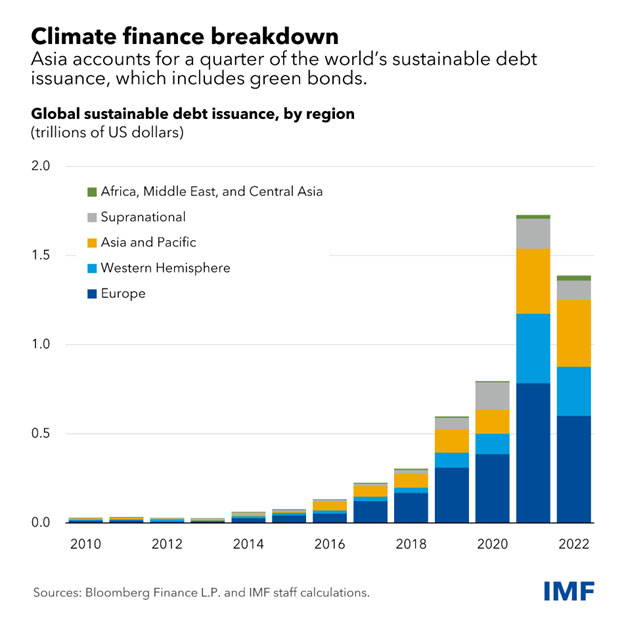
- • How significant is the funding gap? Asia’s emerging market and developing economies need investment of at least $1.1 trillion annually to meet mitigation and adaptation needs. But they’re only getting $333 billion, mostly from sustainable debt instruments like green bonds, and public sources contribute more than half. Such a shortfall leaves these economies with a funding gap of at least $815 billion. China leads in attracting climate finance, making major strides in renewable energy adoption, and its collaborations with the EU have yielded crucial frameworks for sustainable finance, such as the Common Ground Taxonomy and stricter China Green Bond Principles.
• What are the biggest challenges? Pacific island countries and other small economies often have trouble accessing international capital markets or obtaining financing via global climate funds. In particular, they find it hard to meet stringent accreditation requirements of global climate funds as their capacity is already stretched thin and public investment management is challenging. For larger countries, green bonds may be as costly as conventional securities because investors appear to be less trusting of green characteristics in Asia’s sustainable debt instruments. These issues underscore the broader challenges for the region’s funding aspirations.
• What do countries say? A survey of 19 countries in Asia revealed important gaps in data, disclosures, and taxonomies, and that these are exacerbated by inconsistent national climate policies that can promote fossil fuel subsidies. These deficiencies undermine investor confidence in forward-looking targets and transition. Greenwashing also is a risk, respondents say, because it can call into question the legitimacy of environmental claims made by bond issuers. In addition, increasing geoeconomic fragmentation, including friend-shoring and fraying global supply chains, could threaten cooperative and collective action to contain climate change.
Action to unlock much more climate finance requires coordination among agencies overseeing climate initiatives, plus collaboration between local and global entities:
- • How can Asia’s governments help? One way will be to comprehensively enhance the framework on data, taxonomies, and disclosures. They should phase out fossil fuel subsidies and expand carbon pricing, which would generate revenue for sustainable public investment. This would help boost investment in green technology, jobs, and growth, while supporting vulnerable households. Measures that strengthen macroeconomic and public investment management will help reduce risk premiums and funding costs, drive economic growth, and attract private capital.
• Where do central banks and financial supervisors fit in? They should promote global standards for transparent and consistent disclosures, while strengthening climate risk analyses and incorporating climate-related financial risks into prudential frameworks to enhance financial stability. Lastly, collaborating with multilateral standard setters to develop internal capacity is crucial for improving the clarity and reliability of ESG score ratings, fostering greater trust and understanding in these evaluations.
• What is the IMF’s role? The Fund is working with member countries to better detail climate-related economic risks and policies in surveillance and lending activities. The IMF also is strengthening data and statistics, including through capacity building and peer learning, to develop common standards for measuring and analyzing climate risk.
• Finally, our Resilience and Sustainability Trust can help vulnerable low- and middle-income countries catalyze financing from other sources by restoring sound macroeconomic management and building the institutional capacity of the public sector. Other multilateral organizations can provide more grant financing and concessional lending, and risk-mitigating mechanisms can help expand their lending capacity. Cooperation among multilateral institutions is essential to align efforts and resources to achieve a balanced allocation between mitigation and adaptation lending.
—This IMF blog reflects research by Cheng Hoon Lim, Ritu Basu, Yan Carriere-Swallow, Ken Kashiwase, Mahmut Kutlukaya, Mike Li, Ehraz Refayet, Dulani Seneviratne, Mouhamadou Sy, and Ruihua Yang.
IPS UN Bureau

 Print
|
Print
|




