Saturday, April 18, 2026



News and Views from the Global South
Opinion
At Rome’s Colosseum, Faith Leaders Confront a World at War — and Dare to Speak of Peace
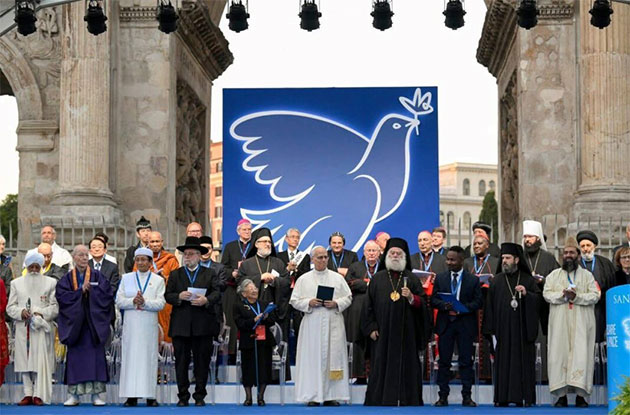
The closing ceremony held against the backdrop of the ancient Roman ruins, the Colosseum Credit: Community of Sant'Egidio
- In the shadow of Rome’s Colosseum — once a monument to imperial violence — religious leaders from across the world gathered this week to deliver a message that felt both ancient and urgent: peace must once again become humanity’s sacred duty.

Colosseo Credit: Kevin Lin, INPS Japan
The meeting concluded Tuesday evening with Pope Leo XIV presiding over a ceremony that was equal parts prayer service and political statement.
“War is never holy,” the pope said. “Only peace is holy — because it is willed by God.”
A Call for Moral Courage
Speaking beneath the Arch of Constantine, Pope Leo urged governments and believers alike to resist what he called “the arrogance of power.”
“The world thirsts for peace,” he said. “We cannot allow people to grow accustomed to war as a normal part of human history. Enough — this is the cry of the poor and the cry of the earth.”

Hirotsugu Terasaki, vice president of Soka Gakkai with Pope Leo XIV. Credit: Vatican News
They stood together in silence as candles were lit around the ancient amphitheater — small lights flickering against the stone, symbolic of a shared prayer for reconciliation.
Faith and Accountability
The pope’s speech drew a clear line between faith and political responsibility.
“Peace must be the priority of every policy,” he said. “God will hold accountable those who failed to seek peace — for every day, month and year of war.”
Those words, delivered as fighting continues in Ukraine and Gaza, carried a deliberate edge. The Vatican under Leo XIV has increasingly positioned itself as a moral counterweight to political paralysis on global crises — speaking of peace not as abstraction but as obligation.

Pope John Paul II Credit: Gregorini Demetrio, CC BY-SA 3.0
Lessons From Assisi
This year’s meeting marked nearly four decades since John Paul II convened the first interreligious gathering for peace in Assisi in 1986. Since then, the Sant’Egidio Community has maintained that dialogue among faiths can temper political divides.
“We have dared to speak of peace in a world that speaks the language of war,” said Marco Impagliazzo, the group’s president. “To close the paths of dialogue is madness. As Pope Francis said, the world suffocates without dialogue.”
Session on the Dignity of Life
Earlier Tuesday, Soka Gakkai delegation took part in Session 22 titled “Justice Does Not Kill: Abolishing the Death Penalty,” held at the Austrian Cultural Forum.
Professor Enza Pellecchia of the University of Pisa, representing Soka Gakkai, took the stage and spoke about the movement’s efforts to abolish the death penalty, referring to the words of its founder, President Daisaku Ikeda, from his dialogue with the British historian Dr. Arnold Toynbee.
“The sanctity of life cannot be judged by guilt or merit — all lives are equal. Therefore, no one has the right to take a life, even in the name of justice. Accepting the death penalty is a form of institutionalized violence that assigns different values to human life, and President Ikeda has described it as ‘a manifestation of the prevailing tendency in modern times to devalue life”.

Professor Enza Pellecchia of the University of Pisa, representing Soka Gakkai, delivering her speech during the Forum titled “Justice Does Not Kill: Abolishing the Death Penalty,” held at the Austrian Cultural Forum. Credit: Seikyo Shimbun
Professor Pellecchia said that President Ikeda’s humanistic philosophy deeply resonates with Pope Leo XIV’s recent statement that “one cannot claim to be pro-life while accepting the death penalty or any form of violence.” Both, she noted, confront the same moral error — the belief that some lives are expendable.
When Religion Refuses Silence
For decades, the Colosseum has hosted symbolic gatherings for peace. Yet this year’s ceremony, participants said, carried a sharper urgency. The wars in Europe and the Middle East, the displacement of millions, and rising authoritarianism have all given moral language new weight.
“Peace begins with the transformation of the human heart,” said Terasaki of SGI. “Interfaith cooperation is not symbolic — it’s a method for changing history.”
A Plea That Still Echoes
As night fell, the trumpeter Paolo Fresu performed a mournful solo. Children stepped forward to deliver a Peace Appeal to diplomats and officials — a reminder that the next generation will inherit the choices made now.
The pope’s final words were brief, almost whispered:
“God wants a world without war. He will free us from this evil.”
The candles continued to burn as the crowd dispersed — a fragile constellation of light against the ruins of Roman empire, and a quiet act of defiance in a world still learning to dare peace.
This article is brought to you by INPS Japan in collaboration with Soka Gakkai International, in consultative status with the UN’s Economic and Social Council (ECOSOC).
INPS Japan
IPS UN Bureau

 Print
|
Print
|