
Monday, October 26, 2026



News and Views from the Global South
Opinion
Russia’s African Cannon Fodder
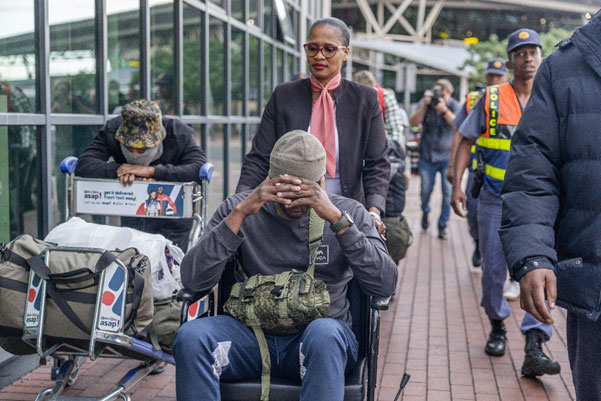
Credit: Rajesh Jantilal/AFP
- On 7 April, the government of Cameroon published a list of 16 of its citizens confirmed killed fighting for Russia against Ukraine. That means the number of Cameroon citizens killed in this distant war has likely surpassed a hundred, making the country the biggest victim of a Russian recruitment drive increasingly focused on Africa.
Conflict attrition
When Vladimir Putin launched Russia’s full-scale invasion of Ukraine in February 2022, he probably assumed the war would be over in days. But now it has ground on past the four-year mark, and Russia’s tactics have brought horrendous loss of life on both sides. Putin treats his soldiers’ lives as disposable, throwing wave after wave of troops at Ukrainian lines in what have been called ‘meat grinder’ assaults. Amid pervasive disinformation, casualty estimates vary widely. A project to count confirmed deaths puts Russian military fatalities at over 206,000, while some estimates reach 1.3 million. Russia is reportedly losing soldiers faster than it can replace them.
Putin has turned to North Korean dictator Kim Jong Un: since 2024, North Korean forces have been fighting alongside Russian troops. Over 20,000 have been deployed, with a reported 6,000 casualties. Russia has also recruited from Central Asian countries and long-term allies such as Cuba. Ukraine too has brought in thousands of foreign fighters, including Colombian mercenaries. Now Russia is increasingly turning to Africa.
Russia’s African strategy
Putin has spent years cultivating relationships with African states, helping Russia resist international isolation and counter pressure from western states. The military relationship has been two-way: Russian mercenaries from the shadowy Wagner Group, now closely controlled by the government, have been deployed in as many as 18 African countries, including Burkina Faso, the Central African Republic and Mali. In some, they fight alongside government forces against insurgent groups; in others, including Libya, where two rival governments contest power, and Sudan, home to a brutal civil war, they’re backing one of two sides fighting for power. Wherever they operate, Russian mercenaries are accused of committing atrocities.
Russia’s arrival has come with some public support, cast as an alternative to the former colonial power France and promising more equal partnerships. When Wagner forces entered Mali in 2022, crowds lined the roads to greet them, waving Russian flags. Extensive pro-Russia disinformation campaigns typically precede Russia’s military involvement, laying the groundwork for such welcomes.
The relationship is extractive: in return for soldiers, Russia typically receives natural resources, including diamonds and gold, which help sustain a war that, despite Russia’s anti-imperialist posturing in Africa, is fundamentally imperial.
Repressive Central and West African governments, several run by military juntas or former army leaders who’ve traded their uniforms for civilian clothes, value a partner with no interest in scrutinising their human rights performance. Civil society organisations and media that try to expose human rights abuses by Russian forces come under attack.
From Africa to the frontlines
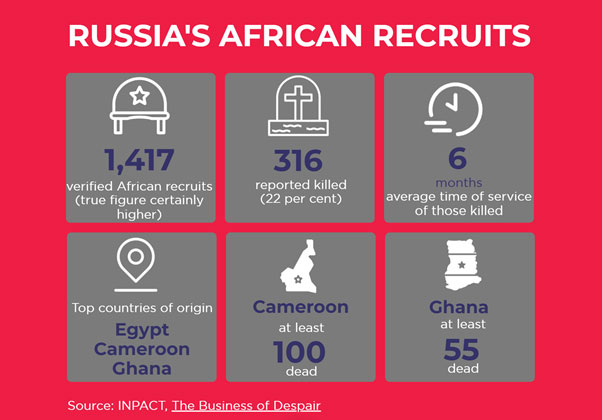
Russia is now exploiting the economic insecurity of many young African men, recruiting them to serve – and possibly die – on the Ukrainian front. Extensive recent civil society research has verified that Russia has so far recruited 1,417 African nationals, with the true figure almost certainly higher. The numbers have increased year on year, indicating a systematic plan. Egypt has supplied the most recruits, followed by Cameroon and Ghana. Of 1,417 verified recruits, 316, 22 per cent, have reportedly been killed.
Some recruits have expressed support for Russia online. Others are attracted by the promise of Russian citizenship and wages that far exceed anything they could earn at home. They may compare Russia’s apparent openness, signalled by its recent relaxation of visa requirements, with Europe’s increasing hostility towards migrants.
Others who’ve managed to escape report being conned. Fake job adverts made them believe they were signing up for civilian or support roles, including jobs as plumbers and security guards. On arrival, recruits are forced sign Russian-language contracts they can’t read, given minimal training and dispatched to the frontlines. The average service length of those killed is just six months, evidence that Russia treats them as expendable.
Intermediaries – including social media influencers who promote recruitment, travel agencies and people trafficking networks – are profiting from supplying recruits. In a bizarre political twist, Duduzile Zuma-Sambudla, a daughter of former South African president Jacob Zuma, is among those accused of recruiting Africans, including some falsely told they’d be trained as bodyguards for her father’s party. In December, South African police arrested five people on charges related to the recruitment of South Africans, including a journalist known for spreading pro-Russia propaganda.
Pressure for accountability
As evidence has accumulated, several African governments have taken action. The government of Togo warned its citizens about the dangers and, when several Togolese soldiers were captured in Ukraine, confirmed they’d been lured there by false promises of jobs and educational opportunities. Last year, the government of Botswana announced it was investigating the cases of two young men who believed they were signing up for a short-term military training programme but were forced to fight. In February, Ghana’s foreign minister confirmed that at least 55 of his country’s citizens had been killed and travelled to Ukraine to seek the release of Ghanaian prisoners of war. Police in Kenya and South African have arrested people trafficking gangs and closed down recruitment agencies. The Kenyan government recently announced Russia had agreed to stop recruiting Kenyan citizens, offering evidence that sustained bilateral pressure can produce results.
But many other African governments remain in denial, placing warm relations with Russia above the lives of their citizens. By doing so, they’re making clear that those lives are as disposable to them as they are to Russia.
Far more states must press Russia to end its abusive recruitment practices. And for international partners who claim to care about the welfare of young Africans, there’s a clear starting point: help address the economic conditions that create a ready pool of desperate recruits and drop the hostile migration policies that make Russia, of all places, look like a desirable destination.
Andrew Firmin is CIVICUS Editor-in-Chief, co-director and writer for CIVICUS Lens and co-author of the State of Civil Society Report.
For interviews or more information, please contact research@civicus.org

 Print
|
Print
|




