Wednesday, October 21, 2026



News and Views from the Global South
Climate Action
Santa Marta Summit Aims to Push Fossil Fuel Phase-Out as Indigenous Voices Demand Urgent Action
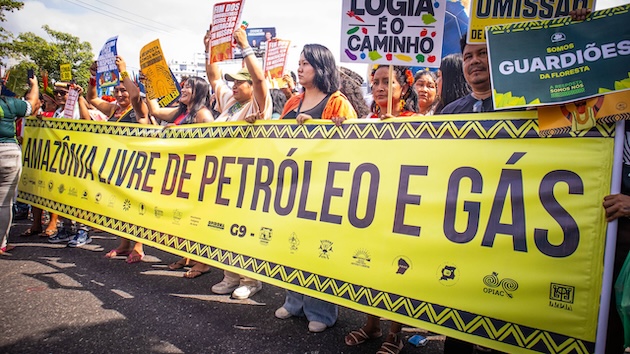
Protests ahead of the 1st Conference Transitioning away from Fossil Fuels. Credit: Kefas Matos
- A high-stakes international summit in Colombia starting today (April 24) is expected to sharpen global efforts to phase out fossil fuels, as governments, scientists and Indigenous leaders warn that the world is running out of time to avert irreversible climate damage.
During a virtual press briefing on April 16, Colombia’s Environment Ministry and a diverse panel of experts outlined expectations from the upcoming Fossil Fuel Phase-Out Summit in Santa Marta. The event is being positioned as a critical platform to accelerate energy transition and address mounting pressure from Indigenous communities living on the frontlines of extraction.
It was at the Belém Climate Conference in 2025, wherein a coalition of over 80 countries unanimously decided to act decisively to phase out fossil fuels that have been driving three quarters of global greenhouse gas emissions.
On the sidelines, 24 countries went further: they issued the Belém Declaration, pledging to work collectively toward a just, orderly, and equitable transition aligned with 1.5°C pathways. To this end, Colombia and the Netherlands volunteered to co-host the First International Conference on Transitioning Away from Fossil Fuels.
The Conference is taking place from 24 to 29 April 2026 in Santa Marta, Colombia. The organisers invited 97 national governments and 30 subnational governments. The high-level segment convenes on April 28–29, 2026.
“We are in a moment of no return. It is clear that there is climate change and that there is no denialism. This is the moment… to accelerate the transition and the progressive elimination of fossil fuels,” said Luz Dary Carmona Moreno, Colombia’s Vice Minister for Environmental Land Use Planning.
The summit comes at a time of growing geopolitical tension and continued global dependence on fossil fuels. Carmona noted that conflicts and economic instability continue to be shaped by oil, gas, and coal and stressed that there is an urgent need for structural change.
“The economy continues depending on fossil fuels,” she said, pointing to global crises that reflect the entrenched role of hydrocarbons.
Colombia has framed the Santa Marta conference around three strategic pillars. The first focuses on overcoming global dependence on fossil fuels. The second addresses transformation of supply and demand systems. The third seeks to rethink multilateral cooperation frameworks.
Carmona emphasised that the conference aims to produce a concrete roadmap, backed by science, public participation, and political will.
“This conference seeks common points to accelerate the transition, concrete actions and enablers that allow that acceleration,” she said.
The event has already drawn strong international participation. According to Colombian officials, 45 countries have confirmed attendance, along with 13 ministers and a broad coalition of civil society groups, indigenous organisations, academics, and private sector actors.
More than 2,800 participants, including grassroots organisations, Indigenous communities, youth groups, and labour unions, have registered to take part.
Indigenous Leaders Warn of “Unjust Transition”
For Indigenous leaders, however, the urgency of the climate crisis is matched by frustration over what they describe as a gap between rhetoric and reality.
Oswaldo Muca, General Coordinator of the Organisation of Indigenous Peoples of the Colombian Amazon (OPIAC), said communities continue to bear the brunt of extraction despite promises of a “just transition”.
“We are very concerned. We talk about a just transition, but in practice it is not true,” Muca said.
He described ongoing environmental degradation in Indigenous territories, including illegal mining, deforestation and mercury contamination.
“Mining continues. Extraction continues. Deforestation continues. The territories and Indigenous peoples continue suffering this problem, and it is becoming more serious every day,” he said.
Muca also criticised the lack of direct benefits for local communities, noting that profits from extraction often leave the country while environmental damage remains.
“The resources do not reach Indigenous territories but they destroy the territory and leave the damage,” he said.
He called for Indigenous participation at every stage of policymaking, from design to implementation, across technical, political, legal and financial dimensions.
Science Points to Sharp Cuts
Scientific findings presented during the briefing reinforced the scale of transformation required.
Dr Marcel Llavero Pasquina, a researcher at the University of Barcelona, said limiting global warming to 1.5 degrees Celsius would require drastic reductions in fossil fuel production.
“Eighty-six percent of oil and gas reserves currently under production should be prematurely decommissioned,” he said.
Even under a less ambitious 2-degree scenario, at least 12% of producing reserves would need to be phased out.
Pasquina also warned that no new fossil fuel exploration is compatible with global climate targets. “At least 10,000 of the existing oil and gas extraction contracts should be cancelled,” he said.
He highlighted the economic tensions shaping climate negotiations, noting that fossil fuel companies stand to lose trillions of dollars under transition scenarios.
“Fossil fuel companies… have a material and quantifiable conflict of interest,” he said, arguing they should be excluded from climate policymaking.
At the same time, governments face significant fiscal challenges, with potential revenue losses estimated at US$117 trillion globally under a 1.5-degree pathway. Still, Pasquina stressed that these costs are outweighed by the human and environmental toll of inaction.
“These transition costs are dwarfed by the climate costs communities would otherwise suffer,” he said.
Policy Momentum Builds
Despite the scale of the challenge, policy experts pointed to growing momentum worldwide.
Paola Yanguas Parra, a policy advisor at the International Institute for Sustainable Development, said governments have already begun implementing measures to restrict fossil fuel expansion.
“We found… 58 active restrictions, which go from bans and moratoria to exploration and licensing,” she said.
These measures include protections for ecologically and culturally significant areas such as the Amazon, as well as restrictions on extraction methods like fracking.
Yanguas Parra noted that such policies often make economic sense in addition to environmental benefits.
“You would take a huge environmental, social and climate cost… for something that would not even make you enough profit,” she said, referring to unviable extraction projects in remote regions.
She added that the summit offers an opportunity to shift global discussions from whether to transition away from fossil fuels to how to implement that transition effectively.
“This coalition will focus on implementation, on learning from each other,” she said.
Amazon at a Crossroads
Speakers from across the Amazon basin warned that the region is increasingly being treated as a new frontier for fossil fuel expansion.
Alana Manchineri, an Indigenous leader from Brazil, described the climate crisis as an immediate reality rather than a distant threat.
“There is no more space for delays,” she said.
She warned that oil and gas projects are already causing widespread damage, including water contamination, biodiversity loss and rising conflict.
“It is not just environmental damage but violations of rights and ways of life,” she said.
According to Indigenous organisations, more than 320,000 square kilometres of Indigenous land in the Amazon basin are already affected by oil and gas blocks.
Manchineri stressed that any transition must fully incorporate Indigenous knowledge and leadership.
“This path will only be legitimate and effective with the full participation of Indigenous peoples,” she said.
Beyond COP: Complement, Not Replacement
Panellists repeatedly emphasised that the Santa Marta summit is not intended to replace existing UN climate processes but to complement them.
“There are groups of countries… that have gathered to discuss more focused issues,” Yanguas Parra said, describing the summit as part of a broader ecosystem of climate cooperation.
Pasquina offered a more critical view, arguing that while UN climate negotiations have produced frameworks like the Paris Agreement, they have failed to curb rising emissions.
“The COP has been a great success on paper. In reality, emissions have only been increasing,” he said.
He suggested that initiatives like Santa Marta could increase pressure on countries that have resisted stronger action.
A Test of Political Will
As preparations intensify, expectations for the summit remain high. Colombian officials say the final outcome will be a report outlining actionable steps and mechanisms to accelerate transition.
“We want the report not to remain just another document. We expect people to turn it into action,” Carmona said.
For many participants, the success of the summit will depend on whether it delivers concrete commitments rather than broad declarations.
Indigenous leaders, in particular, say the credibility of the process hinges on real inclusion and tangible change on the ground.
“If we do not take real and effective actions. We can talk about a just transition, but in reality, other mechanisms will continue destroying the territory,” Muca warned.
IPS UN Bureau Report

 Print
|
Print
|