
Friday, October 16, 2026



News and Views from the Global South
Opinion
Colombia’s next President: A Reckoning for Peace, Climate and Human Rights
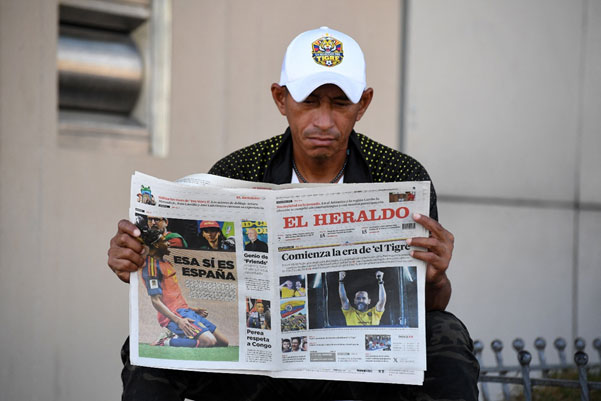
Credit: Jaime Saldarriaga/AFP
- On 21 June Colombians made their choice. By the narrowest of margins, Abelardo de la Espriella, a far-right criminal lawyer who’s never held elected office, became president-elect. Climate activists, human rights defenders, Indigenous communities and peace advocates have the most to lose from the incoming government’s agenda.
The election results follow the logic of a decade of deepening polarisation. Since the 2016 Peace Accord with the Revolutionary Armed Forces of Colombia began a contested and incomplete transition away from armed conflict, Colombian society has divided into two mutually hostile blocs. The election further revealed that no middle ground remains between them. The mainstream right is gone, its candidate receiving a humiliating 6.3 per cent of the first-round vote, and a new right, harsher and less constrained by institutional norms, has taken its place.
Peace agreement in trouble
Nothing divided the two runoff candidates more starkly than the 2016 Peace Accord. Iván Cepeda, the candidate backed by outgoing leftist President Gustavo Petro, is a long-time human rights advocate and senator, and chairs the Senate’s Peace and Post-Conflict Commission. He ran on a ‘comprehensive peace’ platform focused on addressing the structural roots of violence, including land access, inequality and the absence of state services in rural areas.
In contrast, De la Espriella said there would be no peace process under his watch, proposing instead to resume aerial bombardment of armed groups and reinstate herbicide fumigation of coca crops, a practice with well-documented environmental and public health consequences.
According to figures from Colombia’s Ombudsman’s Office, the six-decade conflict caused over 1.1 million killings and more than 200,000 enforced disappearances, while over nine million were forcibly displaced. That record, and the significant progress made since 2016, will now be judged expendable by a government that regards the accords as illegitimate.
For the communities living in territories where armed groups overlap with extractive industries, this is no abstract policy debate. Human rights organisations have warned that a return to a full military offensive will be devastating for civilian populations, particularly the environmental defenders and Indigenous communities who already face lethal threats. Colombia is the world’s deadliest country for environmental and land rights defenders. It’s likely about to get worse.
Cutting the human rights lifeline
De la Espriella also proposes to part ways with the international human rights architecture that has provided Colombia’s victims with a path to justice. On the campaign trail, he announced his intention to withdraw from ‘useless’ international organisations including the UN and the Organization of American States, and denounced the Inter-American Commission on Human Rights as ‘a farce’ that has served only to ‘support the left and persecute our security forces’.
In Colombia’s conflict-ridden territories where Afro-Colombian and Indigenous communities continue to experience massacres and displacement, international monitoring bodies are often the only source of independent verification that violence is happening. The American Convention on Human Rights, which Colombia ratified in 1973, is embedded in the country’s constitutional framework, shaping the interpretation of fundamental rights across the legal system.
The Inter-American Commission on Human Rights has hundreds of cases involving Colombia. In December 2024, the Inter-American Court of Human Rights found the state responsible for the 1995 enforced disappearance of two human rights defenders. Their families waited almost three decades for closure, and only got it because they turned to the regional system when domestic institutions failed them. Now that route could be closed.
What the results mean
Colombia’s change of direction could have global repercussions. Just weeks before the election, Colombia hosted the First Conference on Transitioning Away from Fossil Fuels, bringing together 57 states alongside civil society and scientists frustrated by the repeated failure of UN climate summits to deliver binding commitments on fossil fuel phase-out. Under Petro, renewable energy grew from two per cent to around 16 per cent of the energy mix, and Colombia issued no new contracts for fossil fuel exploration.
That era ends when de la Espriella takes office on 7 August. He frames fossil fuel expansion as a fiscal imperative and calls for the immediate legalisation of fracking, currently banned by judicial moratorium. Since the country includes significant parts of the Amazon rainforest, the climate impacts won’t be limited to Colombia.
Ultimately, De la Espriella did not win for his positions on peace, climate or human rights. He won on security and the promise of order. Calling himself ‘The Tiger’, he modelled his campaign on the populist template of Argentina’s President Javier Milei and El Salvador’s Nayib Bukele, vowing to shrink the state, build megaprisons and combat corruption with tools normally reserved for organised crime. The movement he founded, Defenders of the Homeland, carried Donald Trump’s public backing. The combination proved effective in a country exhausted by decades of violence where many are deeply sceptical of the left’s ability to deliver safety.
The far-right candidate converted legitimate grievances about insecurity into a mandate to dismantle the peace process, reverse climate commitments and withdraw from the international human rights architecture. The consequences will be felt most acutely by those his campaign never meant to speak to.
Inés M. Pousadela is CIVICUS Head of Research and Analysis, co-director and writer for CIVICUS Lens and co-author of the State of Civil Society Report. She is also a Professor of Comparative Politics at Universidad ORT Uruguay.
For interviews or more information, please contact research@civicus.org


 Print
|
Print
|




