
Thursday, October 15, 2026



News and Views from the Global South
Opinion
Of 40 Million People Living with HIV today, 32.1 Million are now on Treatment, Living Long & Healthy
Remarks by Winnie Byanyima, Executive Director of the Joint UN Programme on HIV/AIDS (UNAIDS), at a High-level Meeting in the General Assembly Hall, 22 June 2026
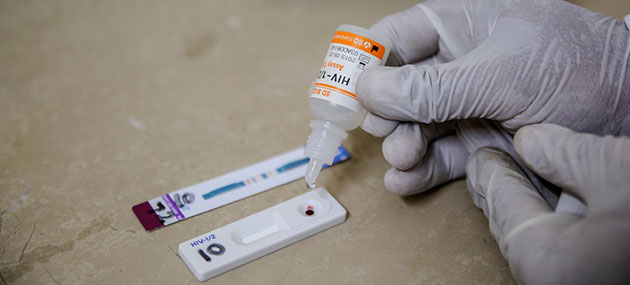
A lab technician conducts an HIV screening test at a medical centre in Hayatabad in the Peshawar district of Pakistan. Credit: WHO/Asad Zaidi
- I am honoured to address this High-Level Meeting. I thank very much the President of the General Assembly for her leadership, our Co-Facilitators, and all the Member States for the extraordinary effort that brought us here now.
I also pay special tribute to the communities that have carried the AIDS response on their shoulders for four decades. These are people living with HIV; women and girls; gay men and other men who have sex with men; transgender people; people who inject drugs; sex workers. I also salute health workers; scientists; philanthropists; and development partners. Millions are alive because of your courage and brilliant contributions.
Twenty-five years ago, world leaders gathered in this hall for the first-ever United Nations General Assembly Special Session on a health crisis.
At the height of the pandemic, they made a promise: that AIDS would be stopped; that treatment and prevention would be accessible to all people in all countries; that funding would be mobilized to enable every country to fight the disease; that communities would lead; and that the United Nations would coordinate a global, multisectoral response unseen before.
As AIDS deaths peaked, my friend Diana, in my country Uganda, widowed by the virus, called me in tears. She said “I am ill. I may die. Please take care of my three children.” I kept my promise to her that day. Today those children are thriving adults — a lawyer, an accountant, an administrator.
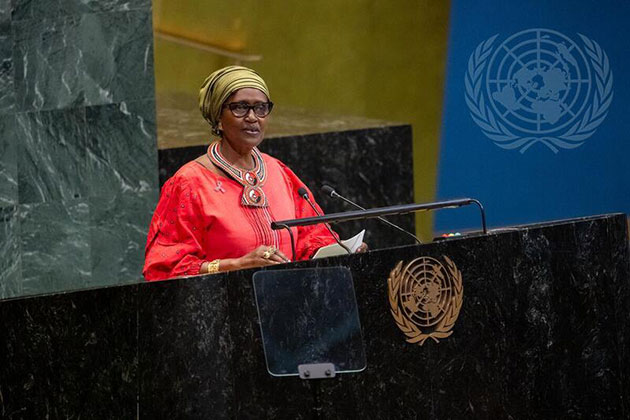
Winnie Byanyima, Executive Director of UNAIDS
Millions kept that promise. Communities, governments, scientists, health workers and companies kept the promise. That is the global AIDS response. And what progress we have made. Of 40 million people living with HIV today, 32.1 million are now on treatment, living long and healthy lives.
But let us not confuse progress with success. Nearly 9 million people are still not on treatment, and last year there were 1.2 million people who were newly infected. This is our last High-Level Meeting before the 2030 promise to end AIDS as a public health threat. We are just four years away. And the opportunity is extraordinary. Breathtaking science like long-acting medicines can now protect people from HIV with just two injections a year — it is not a vaccine, but it is the closest we have come. Research could yet give us a cure. Ending AIDS is possible.
Yet we meet at a perilous moment.
Multilateralism is at its weakest in a generation, and two threats are poised to reverse all our gains: the collapse in development financing, and the rollback of human rights, gender equality and civic space.
According to the OECD, development finance fell 23% in 2025 — the sharpest drop on record — HIV programmes in high-burden, low-income countries were hit hard. Our new UNAIDS data released last week show fragility. HIV testing has fallen 22% in high-burden settings, meaning people do not know their status and the virus continues to spread. Funding for condoms has been cut by more than 90% in some places. Prevention is being dismantled at the very moment we should be scaling innovations like new long-acting medicines.
Evidence also shows that countries that protect rights achieve stronger HIV outcomes. Yet we are seeing a dangerous rollback of the rights of those at highest risk — women and girls, gay men, trans people, people who inject drugs, sex workers. For the first time since UNAIDS began tracking, criminalisation is rising: over the past 10 to 15 years the trend has been of decriminalization. Last year two more countries criminalised same-sex relationships, and one increased penalties in 2026. These laws undermine services and allow HIV to spread. The shrinking of civic space is disabling community-led organizations that have proven the most effective in delivering services to people living with and affected by HIV. One study across 47 countries found community services to those most in need cut by 50 to 85%.
And yet Excellencies we can still seize the opportunity to stop this pandemic.
I stand here on behalf of UNAIDS, the Joint United Nations Programme on HIV/AIDS. We were created in a moment of crisis — it is in our DNA to operate in crisis.
And here is what gives me hope.
52 countries have committed to increasing domestic financing since the rapid cuts. Regional initiatives — the Accra Reset led by President Mahama of Ghana, the African Union Roadmap, the Alliance for the Elimination of HIV in the Americas — are building health sovereignty. Financing agencies—the Global Fund, called for in this hall by Kofi Annan; the US bilateral programme—have secured new funding even in times of challenge. And we call for more.
Brazil’s G20 initiative is advancing regional production of medicines. And everywhere, communities refuse to give up and die —they continue to deliver services and defend one another under attack.
Governments of the world: are we going to keep the promise?
Five UN resolutions before now have driven progress up to here. The global AIDS response is perhaps the greatest, most successful story of multilateralism in forty years. Surely we can find a way to build on that success.
This Political Declaration is our chance to build on 25 years of commitment and point the way to 2030, and actually show multilateralism can deliver. We cannot fail, because we know what we must do:
- • Commit to multilateralism, and to the shared targets before you.
• Sustain international financing, as countries mobilise their own resources.
• Protect the rights of people living with HIV to reach lifesaving services.
• Free the space, and let communities lead for their people
• Spur the science, so that innovations reach everyone in need as fast as possible
If we do these things, we can end AIDS.
Excellencies, when we walk out of this hall, let us look 40 million people living with HIV around the world in the eye and say: we kept our promise.
IPS UN Bureau


 Print
|
Print
|




