
Tuesday, October 13, 2026



News and Views from the Global South
Opinion
From the Nuclear Age to the Age of Artificial Intelligence: Can Humanity Build a New Architecture for Peace?
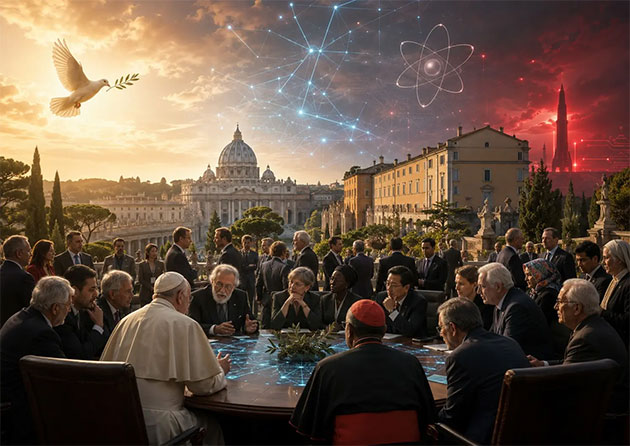
A conceptual illustration of the Global Nobel Laureates Assembly at Castel Gandolfo, where Nobel laureates, AI experts, religious leaders and civil society representatives will confront the intertwined risks of artificial intelligence, nuclear weapons and war while seeking a new architecture for peace. Credit: INPS Japan
- More than eight decades after the atomic bombings of Hiroshima and Nagasaki ushered humanity into the nuclear age, the world is confronting another technological revolution whose consequences extend far beyond science and industry.
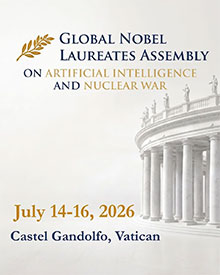
Global Nobel Laureates Assembly on AI and Nuclear War
Against this backdrop, more than 200 participants — including around 30 Nobel laureates and representatives of Nobel Prize-winning organizations, former heads of state and government, leading artificial intelligence researchers, scientists, Catholic figures and civil society representatives — are set to gather from July 14 to 16 at Borgo Laudato Si’ in the Pontifical Gardens of Castel Gandolfo.
The Global Nobel Laureates Assembly on Artificial Intelligence and Nuclear War will bring together some of the world’s most prominent voices in science, technology, peacebuilding and ethics to consider one of the defining questions of the twenty-first century:
Can artificial intelligence become a force for peace, or will it deepen the dangers of war in an already unstable nuclear age?
The three-day gathering will conclude in Rome on July 16 with the presentation of the Rome Declaration for an Unarmed and Disarming Peace, intended to set out principles and recommendations for addressing artificial intelligence, nuclear weapons, autonomous weapons, digital governance and emerging models of technological development.
Source: Progressive Hub
The timing of the Assembly is no coincidence.
The international security environment has become increasingly fragile. Russia’s war in Ukraine has shaken Europe’s post-Cold War security order. Conflicts in the Middle East have heightened fears of wider regional escalation. Relations among the major powers have deteriorated, while nuclear rhetoric has returned to international politics with an intensity not seen for decades.
At the same time, all nine nuclear-armed states are modernizing or expanding their arsenals. Many of the arms-control arrangements that once helped manage strategic rivalry have weakened, expired or become politically paralyzed. Channels of communication among adversaries have narrowed, increasing the danger of misunderstanding and miscalculation.
Artificial intelligence is entering this volatile environment at extraordinary speed.
AI systems can already process vast quantities of intelligence, identify patterns, assist military planning, strengthen cyber capabilities and accelerate decisions that once required hours or days of human deliberation. They may eventually provide new tools for crisis prevention, verification and early warning.
But those same capabilities could also make crises more dangerous.
Artificial intelligence may shorten the time available to political and military leaders during emergencies. It may generate unreliable or misleading assessments, magnify disinformation, increase the vulnerability of command systems to cyberattacks and encourage states to delegate more authority to automated technologies.
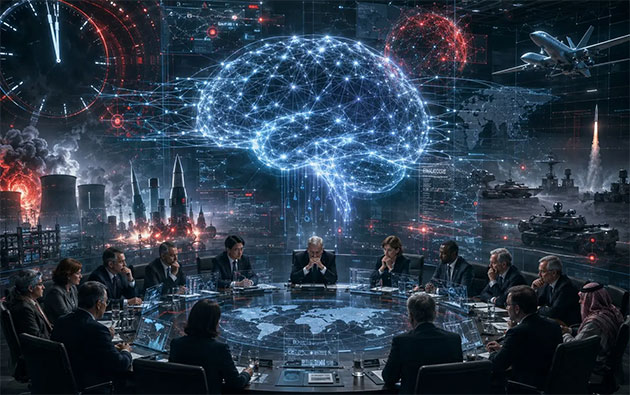
A conceptual illustration of world leaders confronting the growing influence of artificial intelligence on military power and nuclear decision-making, as technological advances threaten to outpace political judgment and international governance. Credit: INPS Japan
The central concern is not necessarily that a machine will independently decide to launch a nuclear weapon. The more immediate danger is that AI-generated information, predictions or recommendations could influence human decision-makers during moments of extreme pressure, when information is incomplete and the consequences of error are irreversible.
Humanity is therefore confronting a challenge unlike any it has faced before.
The question is no longer simply how nuclear weapons should be controlled. It is also how the relationship between artificial intelligence, military power and nuclear decision-making should be governed before technological developments outpace political judgment.
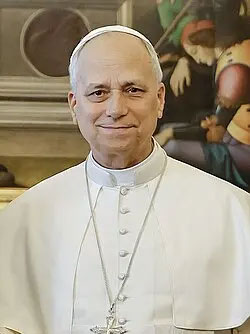
Pope Leo XIV, photographed in October 2025 during an audience with President of Brazil Luiz Inácio Lula da Silva in the Vatican Credit: Wikimedia Commons
The choice of the Vatican as host is deeply symbolic.
The Holy See commands no nuclear arsenal and exercises little conventional military power. Yet it maintains diplomatic relations with most of the world’s states and has long sought to place human dignity, moral responsibility and the protection of civilians at the center of debates about war and peace.
The Assembly is being held at Borgo Laudato Si’, an educational and ecological center established in the gardens of the papal residence at Castel Gandolfo. According to the organizers, the meeting is inspired by Pope Leo XIV’s encyclical Magnifica humanitas, devoted to the protection of the human person in the age of artificial intelligence.
Its guiding vision — an “Unarmed and Disarming Peace” — suggests a concept of peace that goes beyond the absence of war.
An unarmed peace rejects the assumption that security can be permanently sustained through ever-greater military force. A disarming peace seeks not only the reduction of weapons but also the transformation of the political fears, rivalries and economic structures that perpetuate militarization.
This approach broadens the discussion beyond questions of technological safety.
It asks what kind of society humanity wishes to build as increasingly powerful systems reshape politics, economics, communication and warfare. It also raises a deeper ethical question: whether innovation will remain subordinate to human dignity, or whether human beings will gradually be subordinated to the technologies they create.
Beyond Governments
Perhaps the Assembly’s most significant feature is its recognition that governments alone can no longer govern all the technologies shaping the future.
During the Cold War, nuclear diplomacy belonged primarily to states. Agreements such as the Treaty on the Non-Proliferation of Nuclear Weapons and the Comprehensive Nuclear-Test-Ban Treaty were negotiated among governments because states controlled nuclear arsenals, delivery systems and the materials needed to build them.
Artificial intelligence presents a fundamentally different reality.
Many of the world’s most advanced AI systems are being developed by private companies, universities and research laboratories. Technology firms possess computing resources, data and specialized expertise that rival or exceed the capacities of many governments. Decisions made inside corporate research divisions can have global political, social and security consequences.
Effective governance will therefore require more than traditional diplomacy.
It will require sustained cooperation among states, technology companies, scientists, universities, international institutions, religious communities and civil society.
That is precisely why the Assembly will bring together Nobel laureates, AI companies, leading universities and research institutions, nuclear disarmament organizations, Catholic figures centered around the Vatican, and civil society organizations, including Soka Gakkai, a Buddhist-based movement engaged in peacebuilding, dialogue and nuclear abolition.
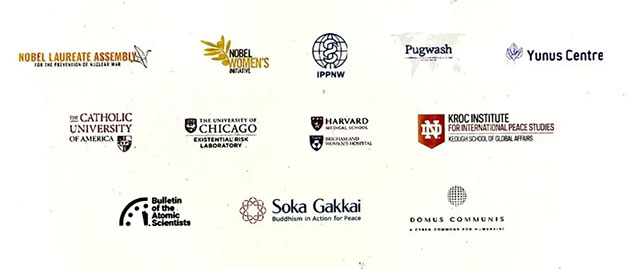
Global Nobel Laureates Assembly on Artificial Intelligence and Nuclear War
Participants and supporting institutions include representatives associated with OpenAI, Google DeepMind, Anthropic and AARU, as well as the Nobel Women’s Initiative, International Physicians for the Prevention of Nuclear War, the Pugwash Conferences on Science and World Affairs, the Yunus Center and the Bulletin of the Atomic Scientists.
Universities and research institutions from Europe, Asia, North America and Australia are also expected to take part.
The significance of this gathering lies not simply in the prominence of those attending, but in the diversity of the communities represented.
Instead of relying exclusively on governments, the Assembly reflects an emerging model of global governance in which science, technology, ethics, religion and civil society seek common ground in addressing shared existential risks.
From Warheads to Algorithms
For much of the nuclear age, arms-control negotiations focused on physical objects: warheads, missiles, bombers, submarines, nuclear materials and testing facilities.
The AI age introduces a different set of challenges.
Algorithms are less visible than missiles. Software can be modified rapidly. Data can cross national borders almost instantaneously. Commercial systems developed for peaceful purposes can also have military applications. Verification, accountability and transparency become far more difficult when the relevant technologies are embedded in code, networks and privately controlled computing infrastructure.
This means that future arms-control and security frameworks may need to govern not only weapons but also the digital systems that inform, guide or accelerate their use.
Questions that once appeared theoretical are becoming increasingly urgent.
Should artificial intelligence ever be integrated into nuclear command-and-control systems? What level of human oversight must be maintained over autonomous weapons? How should states respond when AI systems produce conflicting warnings during a crisis? Can private technology companies be held accountable when their products are adapted for military purposes? And what international institutions are capable of establishing credible safeguards?
The Assembly cannot resolve all these questions in three days.
But by placing nuclear experts, Nobel laureates, AI developers, scholars, religious figures and peace advocates in the same forum, it may help establish a common vocabulary for debates that have until now often taken place in isolation from one another.
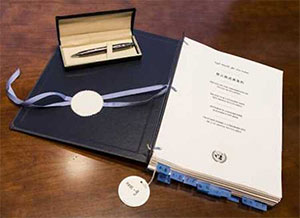
The Treaty on the Prohibition of Nuclear Weapons, signed 20 September 2017 by 50 United Nations member states. Credit: UN Photo / Paulo Filgueiras
History suggests that humanity has repeatedly responded to existential threats by creating new ideas, institutions and norms.
The Russell-Einstein Manifesto of 1955 warned that nuclear weapons had placed the survival of the human species in jeopardy. The first Pugwash Conference in 1957 opened channels of communication among scientists divided by the Cold War. The Nuclear Non-Proliferation Treaty later became the central framework of the international nuclear order.
The Treaty on the Prohibition of Nuclear Weapons, adopted in 2017, further strengthened the humanitarian and moral challenge to nuclear deterrence by declaring nuclear weapons incompatible with international humanitarian principles.
Whether the Global Nobel Laureates Assembly will eventually be regarded as part of that historical lineage remains uncertain.
Declarations issued at international conferences rarely transform policy overnight. They may lack legal force, enforcement mechanisms or immediate political support. Their language can be aspirational, and their influence may not become visible for years.
Yet declarations can also change the terms of international debate.
The Russell-Einstein Manifesto did not eliminate nuclear weapons, but it helped inspire a movement. The first Pugwash meeting did not end the Cold War, but it established relationships that later contributed to arms-control diplomacy. The Universal Declaration of Human Rights was not initially binding, yet it became a foundational reference for international law and political legitimacy.
The importance of the Rome Declaration may therefore depend less on whether it produces immediate agreements than on whether it begins a sustained process involving governments, technology companies, universities, international organizations and civil society.
The larger question is whether it can help create norms before dangerous practices become entrenched.
Looking Toward the Rome Declaration

Palazzo Senatorio Credit: Di Tournasol7 – Opera propria, CC BY-SA 4.0
The document is intended to address the age of artificial intelligence, nuclear and autonomous weapons, new digital protocols and emerging models of digital development. According to the organizers, it will seek to promote international security based on cooperation, human dignity, integral development and peace among peoples.
The critical test will be whether the Declaration moves beyond broad ethical appeals.
Will it call for meaningful human control over nuclear and autonomous weapons systems? Will it propose restrictions on the role of AI in nuclear decision-making? Will it outline responsibilities for private AI companies? Will it recommend new international monitoring, dialogue or verification mechanisms? And will it establish a continuing process capable of translating principles into policy?
The answers will determine whether the meeting remains primarily symbolic or becomes the starting point of a broader “Rome Process” on artificial intelligence, nuclear risk and human security.
More than eight decades after Hiroshima and Nagasaki, humanity once again faces technologies capable of reshaping the future of civilization.
Nuclear weapons remain the most immediate means by which human beings could destroy their own societies. Artificial intelligence, meanwhile, is beginning to influence the speed, complexity and character of the decisions that could determine whether those weapons are ever used.
The defining challenge is therefore no longer simply whether humanity can control nuclear arms.
It is whether humanity can build institutions capable of ensuring that artificial intelligence strengthens human judgment rather than displacing it, reduces the danger of catastrophic error rather than magnifying it, and serves peace rather than war.
The answer will not emerge from three days of deliberation at Castel Gandolfo.
But the conversation beginning there may help shape international debates over technology, security and human responsibility for years to come.

Credit: UN photo
INPS Japan will report from Castel Gandolfo and Rome during the Assembly and will publish follow-up analysis after the Rome Declaration is presented on July 16. This article is brought to you by INPS Japan in collaboration with Soka Gakkai International in consultative status with UN ECOSOC.


 Print
|
Print
|




