
Friday, October 9, 2026



News and Views from the Global South
Opinion
Where did the Billion Dollar Funding for Rohingya Refugees Go?
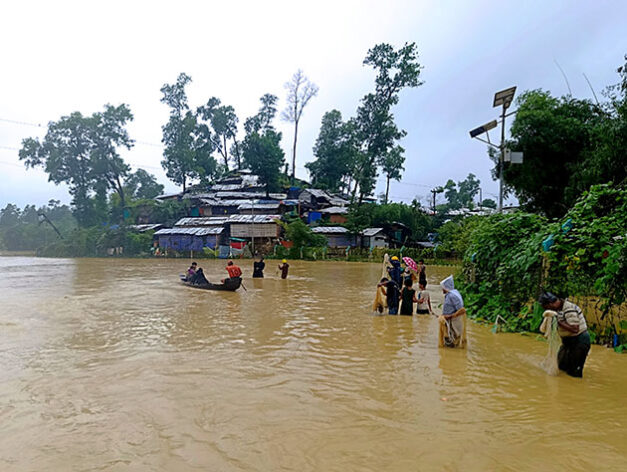
A Rohingya family is relocated by boat from a flooded refugee camp in Cox's Bazar on July 6 while men fish nearby. Credit: Mohammed Zonaid
- Landslides and flooding triggered by heavy monsoon rains swept through the world’s most densely populated concentration of refugee camps this week, killing at least 14 Rohingya refugees, most of them women and girls.
Three girls and their teacher were killed in an Islamic learning center hit by a landslide on July 8. At least 10 more refugees were killed in separate landslides in six camps.
Thousands of families in the camps in Cox’s Bazar, southeast Bangladesh, have been relocated to safer places, mostly at learning centers. Hundreds of ‘homes’ – tarpaulin and bamboo shelters – have been destroyed and flooded.
Tragically such disasters are commonplace, especially in the cyclone and monsoon season. The deaths have also prompted the predictable response by aid agencies to call for more funding.
But beyond the immediate effort of rescuing survivors, what is now really needed is an urgent focus on how the money available is actually spent – as revealed in the alarming findings of an audit by the UN Office of Internal Oversight Services (OIOS).
OIOS Report 2025/084 raises serious concerns over UNHCR’s Rohingya response in Bangladesh in project planning, procurement, monitoring and effective use of humanitarian resources.
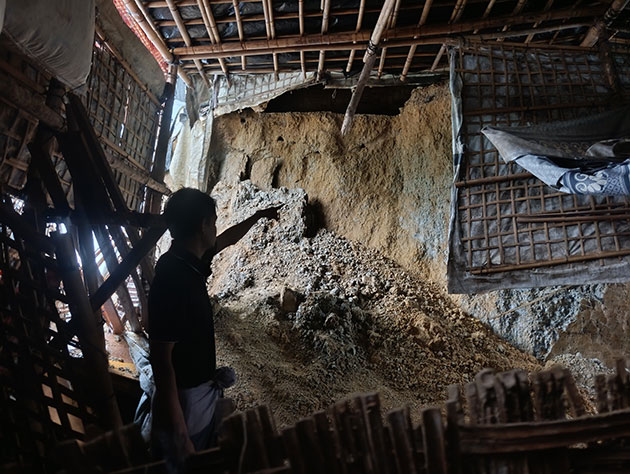
Mohammed Ahsom, 22, points to the site of a landslide where he rescued a child and helped to recover bodies in a Cox’s Bazar camp for Rohingya refugees on July 6. Credit: Mohammed Zonaid
As reported recently by the Bangladeshi newspaper New Age, millions of dollars were spent on infrastructure that remained unused; projects overlapped; procurement processes lacked sufficient oversight, and several programs failed to achieve intended objectives.
All this at a time when humanitarian aid is shrinking even while thousands more stateless Moslem Rohingya displaced by ongoing conflict in neighbouring Myanmar continue to arrive, joining a mass exodus of some 700,000 Rohingya who fled a brutal crackdown by the Myanmar military in Rakhine State in 2017.
Among the findings of the audit, a specialized hospital in Ukhiya costing US$1.5 million was built but remained unused. A 20-bed inpatient facility in Bhasan Char, with $140,000 of solar equipment and a $74,301 X-ray machine was also unused. In addition $18,000 was spent on honour boards, $23,000 on staff uniforms, and $27,000 on producing a documentary. The audit highlighted these expenditures as unnecessary while humanitarian needs remained urgent.
Perhaps most shocking, UNHCR spent $182,028 on cutlery (spoons, forks, knives etc) that refugees largely do not use because we traditionally eat with our hands. I have lived in one of the Cox’s Bazar refugee camps since 2017 and never found such things distributed to us.
In contrast, food assistance for most Rohingya refugees has been reduced from $12 to $7 per person per month— the cost of a couple of cups of coffee in many countries where those humanitarian staff are based and making decisions on cuts in food rations.
Informal learning centers that once provided at least a bit of education have in many cases become empty playgrounds. Hospitals built with millions of dollars often provide only basic, low-cost medicines such as paracetamol and omeprazole. A personal example — last year I had to buy Antozal nasal medication for my daughter from a local pharmacy after we waited hours in line to see two highly paid doctors. Later when we went with the prescription, we were told the drugs were not available because of funding cuts.
The audit also found that UN partners spent $4.2 million on shelter materials that UNHCR had already procured. Solar and energy projects costing $194,000, and medicines and medical equipment amounting to $800,000, were also duplicated because of faulty procurement.
The audit noted that eight years into the Rohingya crisis, 67 percent of funding had been spent on immediate humanitarian relief, while only 17 percent was allocated to empowerment and long-term solutions.
As yet UNHCR has not responded to questions by the media over the audit – not for the first time. UNHCR has often been criticized for responding only during major emergencies, such as large fires in the camps that attract international attention and are seen as moments to justify appeals for more funding spent on sustaining UN staff, their salaries and organizational costs.
Major international human rights organizations and international news outlets also show little interest.
Since the Myanmar military and allied Buddhist militia launched the killings and mass displacement of the mostly stateless Rohingya minority in August 2017, the international community has provided more than $5 billion in aid funding. The latest appeal by the Joint Response Plan (JPR) for 2026 is for $710 million.
Yet if you visit the refugee camps today you will find that there is still no formal education system, medical services remain inadequate, and durable shelters have not been built.
Refugees exist in shelters in hilly areas mostly denuded of trees and prone to catastrophic floods and landslides. Around 200,000 newly arrived refugees since 2024 have not been provided with shelter and live in extremely vulnerable conditions.
So my question is simple: Where did the billions of dollars go?
This is not just about the Rohingya in Cox’s Bazar. The JRP for the Rohingya Humanitarian Crisis is led by the government of Bangladesh, the UNHCR and IOM and includes scores of UN agencies and international and national NGOs.
Each year the JRP is supposed to allocate some 20 to 30 percent of its funding to benefit Bangladeshi host communities.
However, many local residents living even within the camp perimeter have never received a bag of rice or an LPG cylinder. Their children have not benefited from livelihood or skills training programs. Many are not even aware that funding has been allocated for host communities.
The time has come to establish independent Quality Assurance and Financial Audit Committees for Rohingya camp operations. These committees should include representatives from relevant UN bodies, the government of Bangladesh, donor countries, independent human rights organizations, and the Rohingya diaspora. Their role would be to ensure that every project is genuinely needed by Rohingya refugees and Bangladeshi host communities, and that they are properly implemented.
Humanitarian assistance should go to the people it is meant to serve—not become a system that primarily sustains thousands of jobs and does not provide for proper independent oversight.
Aid organizations should not be able to evade responsibility, as in these recent disasters, by blaming deaths on lack of funding.
Transparency, accountability, independent oversight and measurable impact must become the foundation of the Rohingya humanitarian response for as long as we Rohingya are not able to return to Myanmar with our rights, safety and dignity.
Mohammed Zonaid is an award-winning Rohingya journalist and photographer, in Cox’s Bazar, Bangladesh.
IPS UN Bureau


 Print
|
Print
|




