
Thursday, October 15, 2026



News and Views from the Global South
Post-Coup Polarisation Marks Honduran Election Campaign
- The unhealed wounds left by the 2009 coup in Honduras will continue to mark the campaign for the Nov. 24 elections, in which nine parties are participating, four of them new political groups, spanning a wide ideological range.
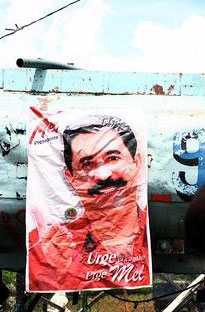
Ousted president “Mel” Zelaya’s party LIBRE, with his wife Xiomara Castro as presidential candidate, is leading the polls for the November elections. Credit: Yamil Gonzales/CC BY-SA 2.0
The elections will focus on two main issues, according to analysts who spoke to IPS: insecurity in the most violent country in the world, with an official homicide rate of 85.5 per 100,000 population in 2012; and the political polarisation that has resulted from the coup d’état four years ago.
On Jun. 28, 2009, then president Manuel Zelaya was ousted and sent out of the country on a plane, still in his pyjamas. He is participating in the election campaign that just began, as the leader of a new party backing the presidential candidacy of his wife, Xiomara Castro, and as a congressional candidate.
The general elections, announced May 23 – according to legal regulations, six months in advance – are a novelty in that four new political parties are participating, one of them a political-military grouping and one regarded as an “outsider.”
The new arrivals are joining three traditional parties in a bid to break with the dominant two-party system that has ruled for 30 years of unstable governments, in the transition to democracy of this Central American country of more than eight million people.
David Matamoros, the president of the Supreme Electoral Tribunal, said in a speech to the nation that in the interests of greater political participation, “this high court has authorised the registration of four new political parties, thereby extending the options for the Honduran electorate and advancing in the democratisation of our political system.”
The electoral spectrum is now made up of the governing rightwing National Party (PN), which has alternated in power with the conservative Liberal Party (PL) for over 100 years.
The social democratic Innovation and Unity Party, the Christian Democracy Party and the leftwing Democratic Unification Party are referred to as “bonsai” by political analysts because they have not grown in over two decades of existence.
The new arrivals on the scene are the leftwing Libertad y Refundación (LIBRE – Freedom and Refoundation Party) of former president Zelaya; the Frente Amplio Político Electoral en Resistencia (FAPER – Broad Political Electoral Front in Resistance), also of the left; the centre-right Anti-Corruption Party (PAC); and the Patriotic Alliance, a political-military project headed by Romeo Vásquez, the former armed forces commander who led the coup in 2009.
The electoral race includes major political figures who were directly involved in the 2009 political crisis, Eugenio Sosa, a sociologist and university professor, told IPS. Among these actors, he said, were “Zelaya and his wife Castro, who are now seeking to return to government with LIBRE, and General Vásquez.”
In addition, “Juan Orlando Hernández, who was a member of Congress for PN and the spokesman for his congressional sector at the time of the coup, is now their presidential candidate; and Mauricio Villeda, the PL candidate, supported the de facto government of Roberto Micheletti,” the president of parliament at the time of the coup.
“In this campaign we will again be hearing the epithets of ‘coupmongers’ and ‘non-coupmongers,’ ‘far-right’ and ‘far-left,’ ‘pro-constituent assembly’ and ‘anti-constituent aseembly,’ among others,” Sosa predicted.
Then there is sports commentator Salvador Nasralla, presidential candidate for PAC, “whose discourse is anti-political and against the leadership, typical of a political ‘outsider’,” he said. Sosa forecast a campaign in which ideological polarisation will characterise the debate, and insults and put-downs may be more common than constructive proposals.
 Print
|
Print
|




