
Tuesday, October 6, 2026



News and Views from the Global South
New Initiative Aims to Integrate Agriculture and Conservation
Prestigious scientists and leaders of organisations devoted to biodiversity conservation have launched an initiative to promote a new approach to agriculture.
- It took Brazil four decades to overcome food insecurity and earn a place as a major global food supplier. Now its experiences will contribute to the evidence base for a new initiative that seeks to reconcile agriculture and the conservation of biological diversity.
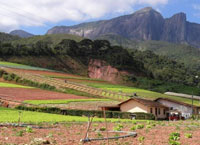
A family farm in the state of Rio de Janeiro, with a crop system adapted to the local impacts of climate change. Credit: Fabiola Ortiz/IPS
“Although there are some who consider Brazilian agriculture to be aggressive and destructive, we want to share another vision for the rest of the tropical belt, which is home to the poorest countries and those who suffer the greatest food insecurity,” Maurício Lopes, president of the Brazilian government’s agricultural research agency EMBRAPA, told Tierramérica*.
The Bridging Agriculture and Conservation initiative was launched in July in Rio de Janeiro by a group of global agricultural, conservation and sustainability leaders. Lopes was one of them. The Brazilian Foundation for Sustainable Development (FBDS) and Bioversity International, a non-profit research-for-development organisation based in Rome, created the initiative.
The goal is to gather, over the course of two years, scientific evidence from the work of 25 researchers in different parts of the world, and present the international community and governments with economically viable measures.
“Brazil managed to transform large tracts of poor and arid soils into fertile areas. That was our first revolution,” said Lopes. “Then we ‘tropicalised’ crops: we brought genetic resources from different parts of the world and created the concept of tropical agriculture.”
The current challenge for Brazil is to promote another revolution integrating agricultural and forestry systems. “The country still has 60 percent of its natural virgin forests, and we want to keep them that way, by managing them intelligently. No other country has an agricultural sector that is moving so determinedly towards sustainability as Brazil,” he added.
EMBRAPA estimates that between 50 and 60 million hectares of degraded pasture land – areas that were occupied between the 1970s and 1990s – have now been rendered productive again through recovery technologies.
“Most of the developing countries in Africa have been given only solutions based on the classical industrial model of agriculture,” explained Emile Frison, the former director general of Bioversity International. However, he noted, “the majority of the farmers are small-scale farmers and the solutions that have been provided so far have not addressed their needs. They are still poor.”
There are no “magic solutions” that can be applied everywhere, so what is needed is a new approach in which scientists and farmers work together, he told Tierramérica. Ann Tutwiler, the new director general of Bioversity International, stressed the need to solve “multiple equations”.
The aim of the new initiative is “to look at different solutions that can help solve more than one equation, both local and global. We can identify production practices that can conserve biodiversity, reduce environmental impact and maintain or improve yields. We can identify crops that will improve nutrition and provide ecological services,” Tutwiler told Tierramérica.
The Bioversity International director criticised the “artificial division” between the nature conservation community and the agricultural sector, which is responsible for supplying the world’s population with food. One point that everyone agrees on is the need for an agenda with incentives and government policies. “If we don’t have that supporting policy in environment and agriculture, it is very hard to engage business, farmers and others,” said Tutwiler.
 Print
|
Print
|




