Tuesday, May 26, 2026



News and Views from the Global South
RIGHTS: Peace Begins With Mothers, Daughters, Sisters
Anja Tranovich
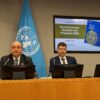
- Women are at the forefront of community-level conflict resolution but are rarely included in higher-level peace processes, leading to a sexist politics of peace, declared four experts on women’s involvement in peace negotiations Monday.
Measures like Security Council resolution 1325, passed in 2000 and which mandates increased involvement of women in national and international negotiations, has raised awareness of the problem of unequal gender representation in conflict resolution.
However, little real progress has been made, said Nyaradzai Gumbonzvanda, a programme director at the United Nations Development Fund for Women (UNIFEM).
"There is awareness, but awareness is not enough. The awareness hasn’t translated into action," she said at a press conference that drew 24 reporters – all of them women.
"As we approach the five-year anniversary of 1325 in October, what’s needed is stronger support for women’s participation in all efforts to promote and maintain peace and security," added Joanne Sandler the deputy director of UNIFEM.
The work women do at local and regional levels is central to peace-building processes, but "women’s roles are often undervalued or ignored, despite the fact that it is their right to participate on equal terms with men in all governance and decision-making processes," Gumbonzvanda said.
"Formal peace negotiations that leave out half the population have limited hope of popular support," she noted.
While some countries have passed laws to boost women’s participation in peace processes, national legislation aligned with Security Council resolution 1325 is often watered down when it comes before approval committees.
For example, an Israeli bill passed in March that attempted to increase female participation in government peace efforts initially stated that women should comprise 25 percent of the participants.
However, because the government was reluctant to set a quota, the bill that finally passed merely stated that "a decent amount" of women should be included in government peace negotiations.
The Jerusalem Post noted that the legislator announcing the bill tried to show that he valued women by stating that he was behind the podium, "by virtue of my wife" (in his own version of the adage: "behind every good man is a woman").
Another speaker responded that, "There were those who would prefer that your wife was here by your virtue."
Underlying the "politically correct" language of gender equity legislation there is often a patriarchal political culture. Even the United Nations has not complied with its own legislation and goals. The 1995 U.N. women’s conference in Beijing adopted a goal of a 50-50 gender balance in the U.N. system by 2000 – which has not been met.
Security Council resolution 1325 also called for Secretary-General Kofi Annan to appoint more women as special representatives to conflict zones; this similarly has not been met.
"There is only one woman at the level of special representative of the secretary-general out of approximately 50 such positions," Canada’s deputy U.N. ambassador Gilbert Laurin has noted.
Which raises the question of whether international standards like Security Council resolution 1325 make any difference. Tonni Annbrodber, a UNIFEM gender advisor in Haiti, believes the answer is ‘yes’. Even though resolution 1325 has no implementing mechanism, it is an important political tool for leverage in women’s advocacy on communal and regional levels.
"It’s a good framework," she told IPS. "You have to work at all levels and you need something for countries to be accountable to."
Despite national reluctance to adopt international legislation like 1325, women have used it and other international measures in their grassroots work toward conflict resolution and peace-building.
Annbrodber said UNIFEM works in Haiti to "give women tools, to let them know that there are international standards that their countries have signed – they have rights."
"We are trying to be a bridge," she said. "Women negotiate daily on all levels. Market women negotiate with their clients, they negotiate in their homes. How can they negotiate on the community and national level to ensure that their needs are heard?"
Asha Hagi Amin, a newly appointed MP and founder of the group Save Somali Women and Children, said that she had to "think outside the box" to help Somali women’s interests be heard in the Djibouti peace talks in 2000.
The negotiations promised fair and equal accommodation of the five clans in Somalia, but none of the clans would submit a female representative.
"Women are not given the chance to protect the clan nor the responsibility to represent it." Amin said. "As women, we had no role in the traditional clan structure, so we had no right to represent our own clans and therefore were shut out of the peace process."
"Since we were not treated as full members of our individual clans, we refused to rally behind them, and chose instead to form our own, to represent the voice of women," she explained. "Somali women did not resign themselves to being victims. They were proponents of peace."
She said the women mobilised to form a sixth clan, which was eventually accepted as an equal participant in the high-level peace talks
"We stood outside the tent demanding our identity to participate," Amin said. "It was the first time women went to high negotiation tables to participate as equal partners, as citizens of that country."
The sixth clan successfully advocated for the inclusion of women’s human rights and affirmative action in the Somali charter.
As was the case in Somalia, peacetime negotiations often lay down the institutional framework for rebuilding society. When women are present at peace negotiations, their needs are more likely to be addressed in key legislation and institutions. And the benefits of women’s involvement in peace processes go beyond women’s rights.
Shelley Anderson of the Women’s Peacemaker Programme notes that women’s specific vantage point and experiences – like presiding over extensive family networks and community ties – make them an asset to peace negotiations.
Amin, for example, married outside of her birth clan, and she said that this experience helped her work toward the formation of the sixth clan.
In addition, through their roles as caregivers, women often represent different constituencies: those in need of education, and of health care. They have a different experience of war from male fighters and politicians.
Tonni Annbrodber told IPS that, "It’s not just about having a woman in power, it’s about having a vision. This is transformational leadership. We acknowledge that the answer is not just in having a woman leader, but when there are women at the table there will obviously be a different perspective."
 Print
|
Print
|