
Thursday, November 12, 2026



News and Views from the Global South
Opinion
Protecting the Climate Means Protecting Territorial Rights
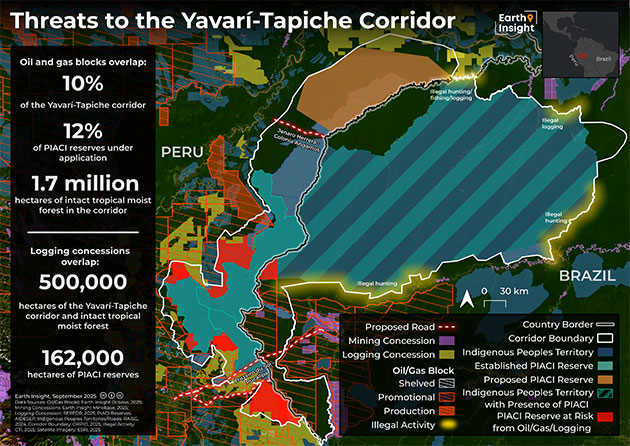
'The proposed Yavarí-Tapiche Corridor is home to Indigenous communities, including Indigenous Peoples living in voluntary isolation and initial contact, and 1.7 million hectares of intact tropical forest. The cross-border corridor is threatened by oil and gas, logging, and mining, as well as illegal activity.’ Credit: Earth Insight
- The world cannot claim to protect the climate and nature while opening Indigenous Peoples’ and local communities’ territories to industrial activities that threaten their rights, livelihoods and ways of life. Yet governments increasingly recognize these communities’ contributions to climate and biodiversity protection while authorizing mining, oil drilling, industrial agriculture and infrastructure projects that can undermine the very territories they safeguard.
Last year, at COP30 in Belém, governments took an important step toward addressing the historical injustice of insecure land tenure. Through the Intergovernmental Land Tenure Commitment (ILTC),17 countries and one subnational government have now committed to advancing territorial rights across 160 million hectares by 2030: recognizing tenure across at least 80 million hectares and strengthening governance and protection across another 80 million hectares where rights are already recognized. A complementary $1.8 billion Forest and Land Tenure Pledge for 2026–2030 offers resources to support this work.
One year later, as governments gather for COP31 in Antalya, the challenge is to turn this landmark commitment into lasting territorial security.
For Indigenous Peoples, local communities and Afro-descendant Peoples, territories are inseparable from identity, culture, livelihoods, knowledge and, for many, spirituality and self-determination. Securing these rights, alongside recognizing and upholding the rights of nature, is fundamental to protecting both communities and the territories they have stewarded for generations.
Our new research shows that forests within established and proposed reserves for Indigenous Peoples in Isolation and Initial Contact (PIACI) in the Peruvian Amazon experienced 16 times less forest loss than forests outside these areas. Across the tropics, communities are recovering ancestral lands, exercising customary governance, monitoring threats, and restoring ecosystems. Their stewardship sustains biodiversity, carbon storage and water cycles essential to climate resilience.
Yet industrial pressures threaten these achievements. Our research has found that oil and gas blocks overlap approximately 31 million hectares of Indigenous and community territories in the Amazon Basin, while mining concessions overlap 18.7 million hectares in Mesoamerica. In the Congo Region, oil and gas blocks overlap 38% of mapped community forests and mining concessions 42%. In Indonesia, wood concessions overlap approximately 6 million hectares of Indigenous territories. These overlaps highlight potential conflicts between industrial development and territorial rights.
The proposed Yavarí-Tapiche Territorial Corridor illustrates what is at stake. This Indigenous-led initiative spans approximately 16 million hectares across Peru and Brazil, including territories of Indigenous Peoples in isolation and initial contact. Yet oil and gas blocks overlap approximately 10% of the proposed corridor, alongside logging and infrastructure pressures. Industrial development can affect entire watersheds, ecosystems and livelihoods through roads, pollution and habitat fragmentation.
From Recognition to Territorial Security
Legal recognition is a fundamental achievement and the foundation of territorial security. But rights recognized on paper must also be respected in practice. When energy, mining, infrastructure and investment decisions disregard rights-holders’ authority, the benefits of recognition can be undermined. The ILTC gives signatories an opportunity to align tenure recognition and governance with land-use planning, licensing, and investment decisions, while respecting the rights and priorities of affected peoples and communities.
Five Priorities for Action
First, accelerate recognition of Indigenous Peoples’, local communities’ and Afro-descendant Peoples’ territorial rights, including customary tenure. Recognition and restitution must respect rights-holders’ institutions, priorities and applicable human rights standards.
Second, strengthen governance and protection alongside recognition. Newly recognized and existing territories need sustained legal, institutional and financial support so rights-holders can exercise their authority, advance their priorities and protect their lands.
Third, align industrial licensing, infrastructure and investment with territorial rights. Governments must address conflicting concessions, qrespect territorial governance plans and fulfill applicable consultation and free, prior and informed consent obligations, including respecting rights-holders’ decisions to reject unwanted industrial activities.
Fourth, ensure financing reaches rights-holders. Governments and donors must provide direct, flexible and sustained funding for communities’ priorities, including governance, territorial protection, monitoring and sustainable economies.
Finally, measure more than hectares. Progress must reflect whether rights-holders can exercise their authority, industrial threats are addressed and financing reaches communities.
Delivering these priorities requires coordinated government action so that land, energy, mining, infrastructure and investment decisions reinforce territorial rights. Building on the leadership of Indigenous Peoples, local communities and Afro-descendant Peoples, the ILTC can help align policies and financing with their priorities. By 2030, success should be measured not only by hectares recognized, but by whether rights-holders can exercise their rights, govern their territories and determine their own futures free from extractive and large-scale industrial activities.
The commitment was made in Belém. Antalya is an opportunity to turn it into lasting territorial security.
Juan Carlos Jintiach is Executive Secretary, Global Alliance of Territorial Communities and M. Florencia Librizzi is Deputy Director, Earth Insight
IPS UN Bureau



 Print
|




