
Saturday, November 21, 2026



News and Views from the Global South
POLITICS-US: Dem Race Could Be Decided By Party Elites
Ali Gharib
- Bringing an abrupt end to Sen. Barack Obama’s winning streak in the primary battles for the Democratic U.S. presidential nomination, rival Sen. Hillary Clinton reinvigorated her campaign by taking three of four primaries on Tuesday – including key delegate-rich states Ohio and Texas – and by doing so, raised ominous questions for the Obama campaign.
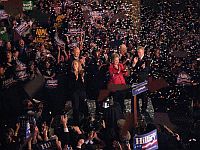
Hillary Clinton addresses supporters in Dallas, Texas on Mar. 4, 2008. Credit: talkradionews
“The history is clear for the superdelegates,” said Blumenthal, suggesting that the party elite will likely settle the nomination battle.
Though not winning by large enough margins to significantly close Obama’s delegate lead, Clinton appears poised to extend the nomination campaign towards the Democratic National Convention without a clear winner emerging with a majority of the pledged delegates decided by primary voters and caucus goers – forcing the election into the hands of the 796 superdelegates.
The Democratic superdelegates, including members of congress, former high-level Democrats and party officials, are free to vote for whomever they please at the convention, and can change their pledges and promises at any point.
According to CNN’s estimates, Clinton currently holds the superdelegate lead with 238 supporting her to Obama’s 195.
Many critics fear that a clash that ends with the superdelegates choosing the candidate will likely disillusion voters who turned out at the polls only to have their voices trumped by party elites.
But some experts disagree, saying that superdelegates are beholden to political realities and are likely to act in the best interest of the party.
“A review of the history of superdelegates suggests they are likely to play a constructive role in resolving the nomination before the convention and in unifying the party for the general election campaign,” wrote two election scholars, Norman Ornstein and Thomas Mann, in an Op-Ed for the New York Times last month.
“They have to go through the fire of elections themselves, or, as state or local party officials, are responsible for the election of the party’s slate. No delegates are more sensitive to the potential pitfalls of the presidential candidates or their electability than the superdelegates,” they wrote.
The history, in this case, may work out for Obama. He will likely retain the pledged delegate lead, and the superdelegates have yet to overturn the will of the voters in their 24-year history.
Obama also saw a big bump in superdelegate endorsements during a string of 11 straight primary and caucus wins since the candidates effectively split the Feb. 5 Super Tuesday “national primary.”
But with less than half of the superdelegates having declared support, the coming weeks and months promise to show whether the Democratic establishment has embraced Obama or, as some allege, the recent endorsements were an instance of superdelegates jumping on the bandwagon as the his campaign gained momentum.
Obama has faced some other troubles in recent weeks as he came under increased media scrutiny after emerging as the frontrunner. He saw several negative news cycles involving his ties to a Chicago businessman indicted on federal corruption charges and a flap over his campaign positions against the North American Free Trade Agreement.
But barring an unlikely series of lopsided victories for Clinton in the remaining 12 contests, Obama will retain a lead in pledged delegates – creating an uphill battle for the Clinton campaign.
Obama, on the other hand, can maintain his lead just by keeping the primaries close.
Texas, for example, runs both a primary and a caucus on the same day – allotting two-thirds of its pledged delegates for the primary and the rest for the caucus.
Though Obama lost the primary, caucuses have been a format in which he has performed well and, according to CNN’s latest numbers, he holds a slim lead in Texas. The victory could negate some of Clinton’s small gains from her close primary win.
Nonetheless, the Clinton victories – winning decisively in Texas, Ohio and Rhode Island, leaving only Vermont for Obama – provide a much-needed spark to her campaign at a time when many had called for her to withdraw from the race in the face of Obama’s success.
By handling the Obama challenge with great fanfare, the Clinton campaign is likely to see boosted morale as well as an infusion of cash – an important factor given that Obama has been out-fundraising Clinton since his campaign gained momentum.
“You all know that, if we want a Democratic president, we need a Democratic nominee who can win the battleground states, just like Ohio,” said Clinton in her victory speech, perhaps making a point about electability to the superdelegates.
But the appeal of an Obama candidacy that can win over independents and even some Republicans in smaller states across the nation may provide the party with new turf on which to battle the presumptive Republican candidate, Sen. John McCain – another contender who does well among independents.
Plagued by problems garnering support last summer, McCain completed an improbable comeback Tuesday night by sweeping Ohio, Texas, Vermont and Rhode Island, and thus clinched the Republican nomination by surpassing 1191 pledged delegates – the majority of delegates that is required to win the nomination at the Republican National Convention.
 Print
|




